William De Arteaga: Quenching the Spirit

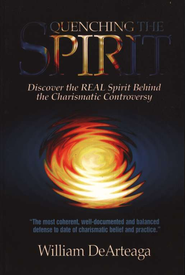
 William De Arteaga, Quenching the Spirit: Discover the REAL Spirit behind the Charismatic Controversy (Orlando: Creation House, 1992, 1996), 358 pages, ISBN 9780884194323.
William De Arteaga defines pharisaism as a religious attitude and heresy that so affirms the role of tradition that a new move of the Holy Spirit is often identified as demonic (p.335). Quenching the Spirit was written to confront that attitude and show how it has led to the suppression of charismata throughout the history of the Church. Let me begin by saying that De Arteaga has produced an extremely well written work. That he has done a tremendous amount of research into church history is obvious to anyone reading this book. A very helpful feature in this work is a glossary of terms in the back. Some of his terms are either obscure or of his own making, thus the glossary is indispensable. Much inflammatory rhetoric has been written on the subject of the gifts. This reviewer believes that De Arteaga has avoided such an approach and written in an honorable manner. May more books be written as this one, promoting a cool headed discussion of differences, rather than character assassination and misrepresentation.
Overview
This book consists mainly of two parts. The first, and longest (224 pp.), is a history of attitudes towards charismata in the church. He states, “This book performs the unpleasant task of documenting resistance to the Holy Spirit” (p.15). This is admittedly over-simplifying the historical part of the book, which also contains an interesting chapter on quantum physics (really) and its application to doctrine. The second section of the book is an assessment of the reproofs and attacks brought on the modern charismatic movement.
As the title implies, De Arteaga has taken upon himself to refute the practice of quenching the spirit. Two terms, mentioned early in the book, are woven throughout: Pharisaism and consensus orthodoxy. De Arteaga’s definition of pharisaism is stated in the first sentence of this review. He defines consensus orthodoxy as the theological interpretation accepted by the majority of religious people during a given time period (p.333). Thus, with few exceptions, those dogmatically defending the consensus orthodoxy, even in the face of Scripture, are the Pharisees.
The first chapter lays out the many characteristics of the Pharisee. He begins by explaining that they were heretics (p. 16). One point he emphasizes is that they held their tradition, the Talmud, equal with Scripture, the Torah (p. 18). Because of this switch from a living God to a dead tradition, the emphasis of belief went from the heart to the head (p. 19). They set up fencing (p. 20) to keep from falling into sin. They judged others by their theology, or where they were born (pp. 21-22). In short they put doctrine over faith (p. 22) so that if anything crossed their doctrine, even the Son of God, they were opposed.
De Arteaga then begins to explain how Pharisees have been with us since the times of Christ. Chapters two and three deal with the Great Awakening, and how the opposition was pharisaical. The contrast between Jonathan Edwards, the revival’s main theologian and defender, and Charles Chauncy, its main critic and detractor, is the centerpiece of these two chapters. The next fifteen chapters deal with the historical opposition to the gifts, from early catholic monks avoiding the gifts as a fence against pride, to some dispensationalists relegating the gifts to another age. It is very informative and, being history, very interesting. Especially eye-opening is his link between cessationist doctrine and the Godless Enlightenment (ch.7). The remaining non-historical chapters, nineteen through twenty-four, deal with the modern reproof and criticism of the Charismatic movement, beginning with Charles Farah Jr., whom he is in favor of, all the way to John MacArthur Jr., with whom he strongly disagrees.
Comment
De Arteaga has written a powerful refutation of cessassionism from an historical perspective. In this sense Quenching is a strong defense of the modern charismatic movement. The author, however, may assume a greater unity in the renewal than is warranted. This is evident in his preface. Referring to D.R. McConnell’s book A Different Gospel, De Arteaga states, “It was moderate in tone, a scholarly ‘pastor’s book,’ but it offered a formidable challenge to the integrity of the charismatic renewal” (p. 13, emphasis mine). D.R. McConnell’s work was specifically addressing the Word of Faith movement, not the charismatic movement at large. Similarly he states that Charles Farah Jr.’s work From the Pinnacle of the Temple was a “Reproof for the Charismatic Renewal” (p. 225). Farah’s book, like McConnell’s was written only to the Faith movement.
Starting with chapter eleven until the end of the book, De Arteaga deals almost exclusively with the defense of what he terms faith idealism. He defines it as “An understanding of Scripture in which the believer may anticipate the fulfilling of a promise of God for which there is no sensory evidence” (p. 334). This adds up to a somewhat moderated form of word of faith theology. Thus, the latter chapters deal mostly with a defense of the faith movement.
The author embraces From the Pinnacle of the Temple, the aforementioned book by Charles Farah Jr., as a solid, Godly reproof of the faith movement that should be heeded, and laments that some have not listened (ch. 19). “While the charismatic renewal was undergoing its greatest expansion, it was also sliding into extremism. The faith-idealism theology of [E.W.] Kenyon . . . was being simplified into a system of absolutes. The new faith-popularizers were presenting a form of Christianity which claimed that suffering and sacrifice were no longer part of the price of the kingdom because proper faith could overcome all adversity” (p. 225). He maintains that though the leaders of the Faith movement have not directly responded, they have moderated their message. D.R. McConnell, responded to this statement by De Arteaga in his 1995 revision of A Different Gospel by saying, “If the Faith movement has moderated as is being said by some, let it be demonstrated by a massive reediting of their printed materials, materials that are being translated and distributed all over the world in their original form. As far as I’m concerned, the Faith controversy will never be over until that happens” (p. 212).
De Arteaga responded to criticisms from Dave hunt, Hank Hanegraaff, and John MacArthur Jr. He did an excellent job of showing how they generally misrepresent the movement by trotting out extremists as the norm, and often quoting out of context. Ironically, De Arteaga himself may have misrepresented MacArthur’s view on salvation. In chapter twenty-four the author writes, “MacArthur believes that a valid salvation experience must lead to a process of discipleship. He opposes those who hold to the more traditional view the salvation experience is sufficient to guarantee eternal life” (pp. 292-293, emphasis his). De Arteaga is referring to the Lordship-Salvation debate that has pitted many former theological colleagues of MacArthur against his view of discipleship. Anyone wanting to follow this further may read MacArthur’s book The Gospel According to Jesus.
Maybe the most controversial topic in De Arteaga’s book is his contention that God will, after trying everything else, send heretics to the church to bring about sound doctrine (ch. 13). He argues that “God uses whomever He wishes and whatever group He wishes to achieve His end” (p. 159). This chapter forms somewhat of a foundation for the remainder of the book. It is a tough case to make, and though De Arteaga argues it heroically, this reviewer found the argument without biblical foundation. Let the reader judge for himself.
Quenching the Spirit seems to be two books at once. It is, to be sure, an excellent defense of the gifts. De Arteaga brilliantly thumbed through history, identifying both the churches attitude and the world’s response. That in itself makes this an important book, one that the entire church would do well to read. At one point, however, the book became a defense of the Word of Faith movement, which De Arteaga almost equates with the charismatic renewal itself. A broader view of the charismatic movement would have made this work more helpful in refuting critics of the charismatic renewal. Nevertheless, Quenching stands as one of the most thorough and well researched defenses of the contemporary operation of the gifts. I highly recommend this book.
Reviewed by Michael J. Dies