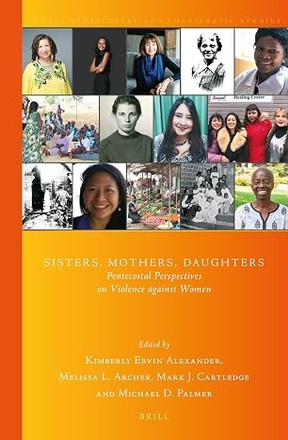
Sisters, Mothers, Daughters: Pentecostal Perspectives on Violence against Women

 Kimberly Ervin Alexander, Melissa L. Archer, Mark J. Cartledge, and Michael D. Palmer, eds., Sisters, Mothers, Daughters: Pentecostal Perspectives on Violence against Women, Global Pentecostal and Charismatic Studies, Volume 43 (Leiden: Brill, 2022), 271 pages, ISBN 9789004513198.
The global movement began in 2017 with a simple #metoo. It was later followed by #churchtoo and #pentecostalsisterstoo. As women around the world typed a hashtag on their social media accounts, the public, including the church, became increasingly aware of the magnitude of violence being committed against women. The edited volume of Sisters, Mothers, Daughters: Pentecostal Perspectives on Violence against Women contains responses by seventeen pentecostals to the epidemic of violence against women. After briefly summarizing the thirteen main articles in this edited academic volume, I name one strength and one deficiency pertaining to it.
Cheryl Peterson approaches the subject of violence against women by featuring two pentecostal theological emphases on the subject of suffering: the Holy Spirit’s victory over suffering and the Holy Spirit of the cross. She draws from Shelly Rambo’s Spirit and Trauma and the Gospel of John to put forth a different response to survivors of sexual violence other than a victorious one. For Peterson, the Holy Spirit is alongside Jesus, being a co-sufferer or a witness; therefore, survivors of sexual violence may discover the Spirit journeying with them into the hope of healing and a new life.
Casey Cole centers on the story from Judges 19, the rape of the concubine at Gibeah. Cole asserts that too often individuals cognitively analyze this story to determine the ways in which it aligns with one’s cognitive beliefs, or orthodoxy. Cole invites us to discover the affections of the text, or orthopathy. She challenges us to let the intense feelings of the text grab us and have the courage to tell and preach this story.
Linda Ambrose also underscores cultural gender roles by discussing that historically the Pentecostal Assemblies of Canada embraced “binary gender roles” after WW2, such as men were breadwinners and women homemakers. She describes the ways in which Pentecostals had assumptions about the roles of men and women by basing particular skills on gender, which bestowed privileges to men while placing women in less influential positions. Ambrose speaks to how this postwar response continues to influence the Pentecostal church today.
Martin Mittelstadt draws from the literary work Women Talking, a novel by Miriam Toews, perceiving Toews to be an artistic prophet. According to Mittelstadt, Women Talking is a type of a counter-testimony when juxtaposed with Amish-Grace, a true story of forgiveness after the attack on a West Nickel Mines’ school. After summarizing Towes’ novel, Mittelstadt considers how Toews as a prophet might speak to Pentecostals concerning violence against women.
Lauren J. Raley seeks to outline a Pentecostal ecclesiology to encourage human flourishing for both individuals and the community, particularly those who have experienced gender-based violence. She provides practical ways that a Pentecostal community and clergy may offer a place of healing, such as by the community’s listening and believing survivors and by the survivor’s participating in a community of welcome and trust. Concerning the latter, Raley describes how the laying on of hands and anointing with oil and/or foot washing service, (both being done after asking permission from a survivor) may be healing and empowering for survivors. Raley’s article conveys that it is necessary for Pentecostal communities to be educated about and understand the needs of those who have experienced gender-based violence if we are to offer appropriate support.
Joy Qualls challenges the rhetoric that Pentecostals use concerning women. Qualls holds that the way in which churches speak of women in leadership and in the home influences the violence perpetrated against them. Pentecostals have espoused a belief of Spirit empowerment for all, no matter their gender, which decreases an abuse of power in relation to women. Unfortunately, as Pentecostals became institutionalized, they moved in practice from this theological conviction of equal empowerment to aligning more closely with culture’s view of patriarchy and hierarchy. Qualls argues that Pentecostal women in leadership roles may heal both men and women and alter Pentecostalism’s contemporary trajectory toward violence, abuse, and a withdrawal of women from its ranks.
More than one article emphasizes the issue of violence against women outside of the United States and Canada, raising our eyes globally to the issue. Tanya Riches drew from her ethnographic research in Sydney, Australia. She comments how churches supporting complementarianism frequently preach about submission of women but fail to speak against the violence committed against women. This type of silence strengthens the power of perpetrators. In such churches, women often theologize separately from the rest of the church. Riches believes while this is necessary, churches must also purposefully integrate women’s issues and contributions, having these discussions in the whole church body.
Two articles highlight sexual violence in the Democratic Republic of Congo (DRC). Tommy Davidsson and Rakel Ysteø Alegre tell the story of the Scandinavian Pentecostal Mission in the DRC from 1920s to the 1990s, providing the necessary elements for the work of Congolese Pentecostals, such as that of Dr. Denis Mukwege. In another article, Rory Randall interviews Dr. Mukwege, Nobel Peace Prize recipient, pentecostal pastor, and founder of Panzi Hospital. The interview underscores how Panzi Hospital cares for women spiritually, medically, surgically, psychologically, socio-economically, and legally who have been raped by militia members.
Alex R. Mayfield tells of the story of Door of Hope, a pentecostal mission run by women for women in Shanghai. Mayfield argues that Door of Hope offered a period of pentecostal theologizing concerning systemic violence against women.
Judith C.P. Lin focuses on violence against women in Taiwan. She highlights how Confucianism adheres to roles based on gender. Although a Taiwanese woman today may pursue higher education and a career, she continues to bear the weight of these gender roles in that they remain unexpressed expectations. Lin calls this soft violence, which is “a form of oppression that is internalized and experienced by women in a subtle way on a regular basis” (242). Recognizing that Charismatic women experience soft violence, Lin draws from womanist theology to address violence against women. Lin writes of the need to: identify the issue, thereby being “resistance-oriented”; counter an “overspiritualization” that idealizes suffering; and cultivate a different hermeneutical method other than an evangelical one in relation to women.
Pentecostal pastors will appreciate how this academic volume engages this subject from a variety of perspectives, including pneumatologically, scripturally, ecclesiologically, historically, rhetorically, literarily, cross-culturally, and practically. In this way, this edited volume is properly researched, offering pastors a well-rounded approach to an important contemporary subject that impacts their church. However, if readers are hoping for perspectives from a various ethnicities and races, they will be disappointed. Although Sisters, Mothers, Daughters speaks of violence against women in other countries, this volume may be strengthened by including more authors who are not of a White, European descent.
Researchers have noted (see also Raley’s article) that clergy feel they are ill-prepared to address violence against women; thus, many remain silent. Sisters, Mothers, Daughters provides pentecostals with first-steps to become more aware of the problem, to consider the issue scripturally and theologically, and to respond to the problem in a helpful, healing manner. Violence against women is not an issue that will resolve itself. As Pentecostals, may we be known as people of healing by participating in Christ’s healing ministry toward women by learning about the issue and responding appropriately in the power of the Spirit.
Reviewed by Pam Engelbert
Publisher’s page: https://brill.com/display/title/62114