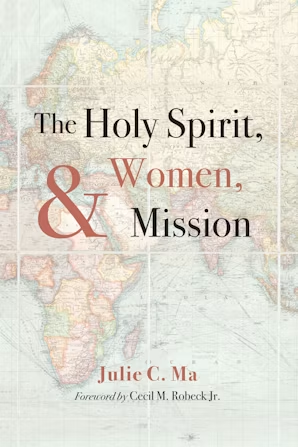
 Julie C. Ma, The Holy Spirit, Women, and Mission (Eugene, OR: Pickwick Publications, 2026), 160 pages, ISBN 9798385239184.
In The Holy Spirit, Women, and Mission, Julie C. Ma explores the often-overlooked contributions of Spirit-empowered women whose ministries have significantly advanced the mission of the church. Drawing upon biblical reflection, historical examples, and contemporary case studies, Ma argues that the empowering work of the Holy Spirit has repeatedly enabled women to transcend social, cultural, and ecclesiastical barriers in order to serve effectively in ministry and mission. The result is a concise but compelling volume that contributes to Pentecostal studies, missiology, and the growing scholarship on global Christianity.
Ma writes from a unique vantage point. As a Korean Pentecostal scholar, missionary educator, and longtime observer of global Pentecostalism, she brings both academic expertise and personal familiarity to the subject. Her Asian perspective is particularly valuable, as much of the existing literature on women in ministry has emerged from Western contexts. Throughout the volume, Ma demonstrates a keen awareness of the cultural realities facing women in Asia while simultaneously highlighting the transformative role of the Holy Spirit in empowering women for service.
The empowering work of the Holy Spirit has repeatedly enabled women to transcend social, cultural, and ecclesiastical barriers in order to serve effectively in ministry and mission.
The book is organized into eight chapters. After establishing biblical foundations for women in ministry, Ma explores Korean spirituality and the influence of prayer, revival, and Pentecostal experience in shaping women’s leadership. She then surveys the challenges faced by women in Asian societies, including issues of education, social status, and cultural expectations. The latter chapters present a series of biographical sketches of women whose ministries illustrate the central thesis of the book: when empowered by the Holy Spirit, women have made extraordinary contributions to evangelism, church planting, education, healing ministries, social transformation, and global mission.
One of the strengths of the volume is Ma’s use of narrative. Rather than approaching the subject primarily through theological argumentation, she allows the lives of women leaders and missionaries to demonstrate the fruit of Spirit-empowered ministry. Particularly effective is her discussion of Jashil Choi, whose prayer ministry became foundational to the growth of Korean Pentecostalism. Choi’s life illustrates the profound influence of intercession, spiritual discipline, and dependence upon the Holy Spirit. Ma’s treatment of Korean spirituality is especially insightful and reflects her deep familiarity with the Korean Pentecostal tradition.
Julie Ma demonstrates a keen awareness of the cultural realities facing women in Asia while simultaneously highlighting the transformative role of the Holy Spirit in empowering women for service.
Equally compelling is the chapter devoted to Mark and Huldah Buntain in Calcutta, India. While Mark Buntain is widely known in Pentecostal circles, Ma appropriately highlights Huldah’s indispensable role in the development and continuation of their ministry. The account of the Buntains’ holistic mission, including schools, feeding programs, clinics, and Mercy Hospital, provides a vivid example of Pentecostal mission that integrates evangelism and compassionate service. Huldah’s perseverance following her husband’s death serves as a powerful testimony to faithful Spirit-led ministry. This chapter is among the strongest in the volume and effectively demonstrates Ma’s broader argument that women have often exercised transformative leadership in contexts where their contributions were not always fully recognized.
Pentecostal empowerment is not merely a theological concept but a lived reality that has produced measurable impact in churches and communities around the world.
Additional chapters introduce readers to figures such as Pandita Ramabai, Kathryn Kuhlman, Margaret Benson-Idahosa, and numerous Asian Pentecostal leaders. While diverse in culture, ministry setting, and historical period, these women share common characteristics that Ma identifies throughout the book: deep spirituality, responsiveness to the Holy Spirit, perseverance amid adversity, and a commitment to serving others. By placing these stories alongside discussions of social realities facing women in Asia, Ma demonstrates that Pentecostal empowerment is not merely a theological concept but a lived reality that has produced measurable impact in churches and communities around the world.
Women have often exercised transformative leadership in contexts where their contributions were not always fully recognized.
A notable contribution of this work is its distinctly Pentecostal interpretation of women’s ministry. Ma does not frame her argument primarily in terms of rights, status, or institutional advancement. Instead, she consistently emphasizes the empowering presence of the Holy Spirit as the source of ministry effectiveness. In doing so, she remains firmly rooted within the Pentecostal tradition, where spiritual gifting, divine calling, and Spirit-empowered service have often provided opportunities for women to minister even in environments characterized by significant social and cultural restrictions.
The brevity of the volume is both a strength and a limitation. The concise format makes the book highly accessible to students, pastors, and lay readers. At the same time, readers may wish for further development of some of the theological and historical themes introduced throughout the text. Nevertheless, Ma succeeds in accomplishing her stated purpose: to encourage readers to recognize the significant role women have played—and continue to play—in the mission of God.
The history of Pentecostalism cannot be fully understood apart from the contributions of Spirit-empowered women.
The greatest strength of
The Holy Spirit, Women, and Mission lies in its ability to combine biblical reflection, historical analysis, and inspiring narratives into a coherent Pentecostal vision of ministry. Ma reminds readers that the history of Pentecostalism cannot be fully understood apart from the contributions of Spirit-empowered women. This volume will be of particular interest to scholars of Pentecostalism, missiology, and global Christianity, while also serving as an encouraging resource for students and ministry practitioners. It is a welcome contribution to the growing literature on women, mission, and the work of the Holy Spirit.
Reviewed by Connie Dawson
Publisher page: https://wipfandstock.com/9798385239184/the-holy-spirit-women-and-mission/
-
Connie Dawson, PhD, is Professor of Church and Revival History at Global Awakening Theological Seminary. An ordained minister and former missionary to Asia, she earned her MA in Theology and MDiv from Asia Pacific Theological Seminary and her PhD from Regent University. Dawson is the author of John Wimber: His Life and Ministry and writes and lectures on Pentecostal, Charismatic, and Renewal movements in global Christianity.