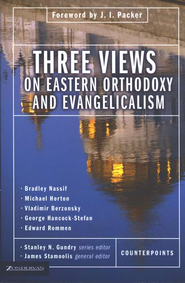
Three Views on Eastern Orthodoxy and Evangelicalism

 Stanley N. Gundry and James Stamoolis, eds., Three Views on Eastern Orthodoxy and Evangelicalism, Counterpoints (Grand Rapids: Zondervan, 2004), 294 pages.
This book is a fine addition to Zondervan’s Counterpoint series, in which controversial theological issues are examined from a variety of stances by reputable scholars and/or denominational leaders. This particular book offers a variety of perspectives on the relationship between the evangelical movement and the oldest Christian community, the Eastern Orthodox Church. Respected evangelical scholar J. I. Packer writes the forward and five pastors and theologians, some evangelical and some Orthodox, offer answers to the question of whether Eastern Orthodoxy and evangelicalism are compatible. All five present their answers (yes, no and maybe) and the other four are given the opportunity to respond to the presenter. The presenting writer is then allowed to respond to the respondents.
Bradley Nassif, an Orthodox theologian with an extensive background in evangelical higher education and ecumenical activity offers the sole affirmative response for the compatibility of these two Christian traditions. Nassif demonstrates not only a thorough grasp of his own tradition but an impressive comprehension and positive assessment of evangelicalism. His primary thesis is that Orthodoxy and evangelicalism are compatible because Orthodox theology is evangelical, whether or not Orthodox adherents and church leadership care to identify it as such. Nassif uses David Bebbington’s fourfold definition of evangelicalism to show Orthodox and evangelical compatibility. First, both groups emphasize “crucicentrism” (centrality of the life, death and resurrection of Christ), “biblicism” (commitment to the inspiration and authority of Scripture), “conversionism” (personal commitment of one’s life to Christ) and “activism” (witness and holy living). Nassif grants that both Orthodoxy and evangelicalism do not often emphasize specific doctrinal elements contained in these basic agreements to the satisfaction of each group, but the agreement is nonetheless there in principle.
Michael Horton, a Reformed evangelical theologian, writes next, denying the compatibility of the two traditions. Horton begins by appreciating the areas of commonality between the two, such as a high view of Scripture and conservative Christology (doctrine of Christ’s person and work). He finds problems, however, with the high view of church tradition espoused by Orthodoxy in relation to Scripture, finding there the same problem he perceives with the Roman Catholic view. Even more fundamentally, however, Horton alleges that Orthodoxy does not possess an adequate view on issues of sin, free will and salvation, particularly with regard to justification and sanctification. He contends that, due to Orthodoxy’s stress on sanctification, it promotes a salvation by works that fundamentally denies justification by faith alone. He claims that the evangelical view denies any role of the human in salvation and that this, in contrast to the Orthodox view, is the true Gospel message.
Vladimir Berzonsky, a Russian Orthodox pastor and theologian, offers a negative response from the other side, contending that evangelicalism is far too individualistic and possesses a glaring lack of a truly biblical ecclesiology (doctrine of the church). This fosters a “me and Jesus” piety that, combined with an overemphasis on justification with a lack of emphasis on sanctification, does not reflect the requirement of personal transformation demanded by the Gospel.
George Hancock-Stefan, a childhood convert from Orthodoxy to Baptist evangelicalism, offers a “maybe” response to the question of compatibility. His essay is largely geared toward church issues as they relate to the proper concept of salvation. He believes that an evangelical could become Orthodox if the latter would affirm the salvation of those beyond their own Christian community (non-Orthodox Christians) and acknowledge more explicitly the individual dimensions of salvation.
Edward Rommen, a convert from evangelicalism to Orthodoxy, offers the other “maybe” essay, which is perhaps the best piece in the entire collection. He too takes the strategy of noting areas of compatibility before moving to factors that militate against communion between the two traditions. Both place a high premium on the inspiration and authority of Scripture and the work of the Holy Spirit. Differences abide, however. First, there is a cultural divide between East (Orthodoxy) and West (evangelicalism) that equips the two movements with two differing conceptual paradigms for doing theology. The East is much more relational and person-oriented while the West is more interested in matters of substance and nature in its development of specific concepts and doctrines. He also notes that evangelicals persistently and erroneously accuse the Orthodox of denying justification by faith, which constitutes a serious barrier to compatibility.
Nassif and Rommen’s essays are the best in the collection, though Rommen’s is the very best due to his realistic but hopeful attitude. Nassif’s is very commendable due to his optimism, but suffers from perhaps more optimism than is due in the current ecumenical climate. Hancock-Stefan’s contribution is average, offering more of an assessment than a definitive position. Berzonsky’s piece, while oftentimes moving and theologically insightful, crosses from argumentation to almost open hostility in too many points to facilitate fruitful dialogue, which proves one of Hancock-Stefan’s points. Horton, while probably possessing more understanding of Eastern Orthodoxy than most evangelical theologians, still gets it wrong in too many crucial areas. His repeated insistence that Orthodoxy denies justification by faith and advocates a works righteousness that flies in the face of evangelical, and therefore biblical, theology is wrongheaded and assumes that the Reformed branch of evangelicalism is the only one. This leads to a key criticism of the entire work: who gets to define evangelicalism? Where is the Wesleyan/Holiness/Pentecostal strand represented? The book would have been a great deal more of a contribution to ecumenical dialogue had at least one scholar representing this broad swath of evangelicalism been tapped.
Reviewed by Matthew Thompson