In 1977, after a consideration of all New Testament literature, J. K. Moon gave this classic Pentecostal/charismatic, albeit eclectic, definition of the anointing:
The anointing is the special presence of the Holy Spirit in the life and ministry of God’s servant which produces an inspiring awareness of the divine presence. His entire faculties are enhanced (heightened illumination, courage, wisdom, discernment, faith, guidance, memory, vocabulary, emotions, intellect, and physical performance) beyond natural abilities. The Word of God is quickened to accomplish its regenerating, healing, edifying, and sanctifying objective. And those ministered to are invested with a God-consciousness. …1
John also spoke of an anointing, and his description … is much different than Luke’s.
For most Protestant Christians the word anointing has this univocal meaning, the rich meaning with which Luke impregnated it in his usage of its verb form in association with the empowerment of Jesus when the Holy Spirit descended upon him (3:22; 4:18). According to Luke, when the Spirit came upon Jesus, he experienced the power (4:14) and fullness (4:1) of the Spirit, which enabled him to victoriously endure satanic attacks, to preach the gospel, to effect inner-healing (4:18), to do good, and to heal those oppressed of the devil (Acts 10:38). However, John also spoke of an anointing, and his description, defying Moon’s definition, is much different than Luke’s.
The Lukan and Johannine Anointings
Oil of anointing, by Stan Myers. Used with permission
In 1981, David Bundrick specifically addressed the Johannine anointing and isolated it, rightly so, as one particular kind of anointing, i.e., distinct from the Lukan anointing. Bundrick hinted at the distinction when he wrote that, “While emphasis today is placed upon ‘the anointing of the teacher,’ this text [1 John 2:18-27] demonstrates that ‘the anointing upon the student’ is vital.”2 But neither Moon nor Bundrick clearly defined and delineated both the Lukan and the Johannine anointings.
It cannot be said that the Lukan anointing abides, and it cannot be said that all Christians have it, whereas the Johannine anointing is had by all Christians and abides.
The distinctive marks of the Lukan anointing are the accompanying, mighty acts of God (such as, healings, exorcisms, evangelism). The Johannine anointing, on the other hand, is the chrisma (only John uses this word in its noun form). Its effect is more internal and thus hidden from the view of others. (It is not to be confused with Paul’s unrelated term charisma.) It cannot be said that the Lukan anointing abides, and it cannot be said that all Christians have it, whereas the Johannine anointing (chrisma) is had by all Christians (1 John 2:20) and abides (1 John 2:27). The Johannine anointing teaches and lends assurance to the believer that he has the truth and should remain in Christ (1 John 2:27; cf. 2 Cor. 1:21-22); the Lukan anointing enables one to be a teacher and lead others to Christ or further in Christ. Whereas the Lukan anointing is evidenced by external, mighty deeds of God for the performance of God’s will, the Johannine anointing is the quiet, inner witness of the Spirit, which certifies the truth of a teaching.
Unfortunately, Moon’s definition above blurs the distinction between the Lukan and the Johannine anointings, as Moon co-mingles the functions of the two anointings. In the opening quotation, note that Moon’s first three sentences refer to the classic Pentecostal anointing, whereas the last sentence refers to the “chrismatic,” i.e., Johannine, anointing: “And those ministered to are invested with a God-consciousness. …” (Although, even here, Moon writes as though this God-consciousness comes from the instrumentality of the anointed minister rather than from the chrisma of the Holy One, i.e., Jesus, cf. 1 John 2:20.)
The Johannine Anointing for Today’s Christian
Whereas the Lukan anointing is evidenced by external, mighty deeds of God for the performance of God’s will, the Johannine anointing is the quiet, inner witness of the Spirit, which certifies the truth of a teaching.
In the first century, John was writing to Spirit-endowed believers (3:24; 4:13) who were being seduced by super-spiritualists, whom some have identified as Gnostics; however, John identifies them as antichrists (such a one denies the Anointed One, the Christos, 2:22). Inasmuch as the chrisma serves to certify the truth of “all things” (2:27), false statements to the contrary would be anti-chrisma, making John’s “antichrist” identification both logical, rhetorically pleasing, and apropos. The common thread in the various branches of Gnosticism was and still is the Gnostic’s claim to greater and higher knowledge, usually of an esoteric and thus unverifiable origin and nature. The Gnostics of John’s day were denying the humanity and incarnation of Jesus. This eventually led to the denial of the efficacy of the atonement and the trinitarian concept of the godhead.3 The teachings of today’s super-spiritualists eventually deny the sovereignty of God, the Lordship of Christ, and the servanthood of the believer. These historic, biblical doctrines are denied by many teachers today who place man at the center with God in orbit around him.
Unfortunately, Pentecostal/charismatics, more than other Christians, have gravitated toward these unscriptural teachings. Therefore, a reminder of the Johannine anointing from Pentecostal/charismatic leaders would be in order. John reminded his readers of the teachings they received in the beginning; these were the truths in which they should continue (1 John 2:24). In the beginning, they had received an anointing, but some were discarding it and opening themselves up to seducing teachers. They left their beginning and no longer relied upon the Teacher or Paraclete (John 14:26) who, in fact, gave them their beginning through the teachings of the apostles (1:1-5a; 4:5-6).
Conclusions
Whereas the Lukan chrisma speaks of a usually visible manifestation of the Spirit, the Johannine chrisma is an inner witness to the truth of a teaching.
Though Luke and John both speak of a chrisma (Luke using its verb form), the contexts do not suggest a univocal usage of the term. Whereas the Lukan chrisma speaks of a usually visible manifestation of the Spirit, the Johannine chrisma is an inner witness to the truth of a teaching. The function of the Johannine anointing is to confirm these truths within the hearer, especially as they relate to Jesus (1 John 2:22-23; 4:1-3; 5:5-10; cf. John 14:26; 16:14-15). The text (1 John) seems to indicate that this function of the Spirit is operable in all believers who have been given the Spirit (3:24; 4:13).
These spiritual concepts are not in competition, neither are they mutually exclusive. Our prayer should be for both: may the fire fall, expanding the kingdom, and may our minds be illumined, securing truth within us.4
PR
Notes
1 “The Holy Spirit in Preaching,” Paraclete (Fall) 1977: 26.
2 “Ye Need Not That Any Man Teach You,” Paraclete (Fall) 1981: 17.
3 Bundrick, 15.
4 I would like to express my gratitude to Professor Paul Elbert (Church of God Theological Seminary) for his insightful comments on an early draft of this article.
PneumaReview.com: The Back to Jerusalem ministry that you work with recently released a new study resource called Chasing Revival: A Road Trip Bible Study, where did the idea for this resource come from? Eugene Bach: I travel more than 300 days a year for ministry and see a lot of different types of Christians. I…
In this day of specialization, it seems we have a difficult time combining thorough Bible study and relevant practical application. Too often, practitioners do not get their principles from studying the Bible, and scholars do not produce relevant principles and practical application. I would like this essay to begin a dialogue that will bring these…
Craig S. Keener, Gift & Giver: The Holy Spirit for Today (Grand Rapids: Baker Academic, 2001), 224 pages. Craig Keener, a New Testament professor at Eastern Baptist Theological Seminary, has already made a name for himself in the world of biblical studies. The present work on the Holy Spirit will undoubtedly introduce his name also…
John Christopher Thomas, The Apocalypse: A Literary and Theological Commentary (Cleveland, TN: CPT Press, 2012), xvii + 716 pages, ISBN 9781935931270. John Christopher Thomas (PhD, University of Sheffield; Clarence J. Abbot Professor of Biblical Studies at the Pentecostal Theological Seminary, Cleveland, TN and Director of the Centre for Pentecostal and Charismatic Studies at Bangor…
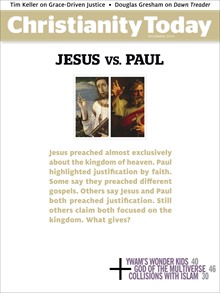
Must Re-centralizing Jesus Mean Displacing the Spirit? A Review Essay of Scot McKnight’s “Jesus vs. Paul” In this review essay, Tony Richie responds to Scot McKnight’s article that introduces a conversation among theologians. Scot McKnight, “Jesus vs. Paul” Christianity Today (December, 2010), pages 24-29. The December 2010 cover encapsulates the discussion: Jesus preached almost…
To provide the best experiences, we use technologies like cookies to store and/or access device information. Consenting to these technologies will allow us to process data such as browsing behavior or unique IDs on this site. Not consenting or withdrawing consent, may adversely affect certain features and functions.
Functional
Always active
The technical storage or access is strictly necessary for the legitimate purpose of enabling the use of a specific service explicitly requested by the subscriber or user, or for the sole purpose of carrying out the transmission of a communication over an electronic communications network.
Preferences
The technical storage or access is necessary for the legitimate purpose of storing preferences that are not requested by the subscriber or user.
Statistics
The technical storage or access that is used exclusively for statistical purposes.The technical storage or access that is used exclusively for anonymous statistical purposes. Without a subpoena, voluntary compliance on the part of your Internet Service Provider, or additional records from a third party, information stored or retrieved for this purpose alone cannot usually be used to identify you.
Marketing
The technical storage or access is required to create user profiles to send advertising, or to track the user on a website or across several websites for similar marketing purposes.