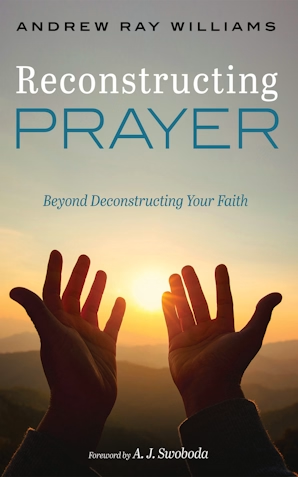
Andrew Ray Williams: Reconstructing Prayer

 Andrew Ray Williams, Reconstructing Prayer: Beyond Deconstructing Your Faith (Cascade Books, 2023), 90 pages, ISBN 9781666738247.
Andrew Ray Williams is a pastor, professor, and writer who shares that, while in pastoral ministry, he experienced a prolonged season of questioning and scrutinizing his Christian beliefs. Going through a phase of deconstruction, he wrestled with questions such as the compatibility of God’s goodness with evil and suffering, assurance of salvation, how faith and science interface, and the afterlife. Williams defines deconstruction as “the disassembling of something that was once constructed.” He continues, saying, “Theological deconstruction, then, is the disassembling of some part of one’s established beliefs” (xiv). Deconstruction has become a growing phenomenon in the church since the early 2000s and gained more widespread popularity from about 2016 onward when the term “exvangelical” was coined by Blake Chastain.
Questioning what you believe and why you believe always carries the potential to either undermine or bolster one’s faith, and in the author’s case, the latter was the outcome. In the introduction, he credits this to three main factors: the love and perseverance of his wife, being deeply rooted in the local church, and studying theology at the graduate and postgraduate levels, which introduced him to fresh concepts that enabled him to reconstruct “a more good, true, and beautiful view of God and the world” (xv).
Chapter one addresses the problem of evil—the rock of atheism. Bart Ehrman and Marty Sampson are both mentioned as notable figures who abandoned their faith because of this perennial issue. Finding many theodicies lacking in that they either emphasize God’s goodness or His greatness, but not both, the author uses the children’s prayer that begins with “God is great and God is good” to argue for a God who is both great and good. This is done in part by turning to the Psalms, highlighting that “the psalmists were able to trust in God despite their disillusionment” (5). Job is also used as an example of how to deal with questioning God regarding suffering, writing, “Job shows us oftentimes, the only lucid thing to do is question” (6). Having questions and doubts is not the same as unbelief, the author writes, and such questions can be transformed into hope. Acknowledging both God’s goodness and His greatness should lead us to a place of thanksgiving.
In the West, many Christians are “deconstructing” and/or “doubting” their faith. As a result, some people seeking to follow Jesus have become disillusioned with prayer—perhaps even skeptical about it. And yet there is still a great desire and longing for connection with God. What is needed, then, is a reconstructed account of prayer— one that is theologically robust, pastorally honest, and spiritually wise. Andrew Ray Williams seeks to provide such an account by providing meditations on childlike prayers in hopes that it might open new ways of understanding specific issues related to Christian faith.
In chapter three, the question addressed is how the Christian faith intersects and interacts with the modern sciences. The author notes that the way Christians engage with science is further complicated by political and cultural influences. He uses environmental science to highlight that, in the United States, if one is an environmentalist, it is often assumed that one is a Democrat, and likewise, being a Republican is often seen as incompatible with supporting ecological stewardship. Quoting scholars such as N. T. Wright, the author shows how this is largely an American phenomenon often connected to conservative evangelicalism. “For those of us in the American context, we must consider how larger cultural issues may be distorting the way we view the relationship between Christian theology and the sciences” (26).
Williams uses this motif of hope and protection to briefly discuss eschatology, particularly the concept of the rapture. He sees parallels between an excessive fascination with angelology and believers placing their hope in being raptured out of the tribulation rather than in the finished work of Christ through His death and resurrection.
In raising the issue of angels and demons, the author highlights the reality of the spiritual realm. While worldviews such as naturalism have attempted to deny the reality of the unseen realm, we know from Scripture that the unseen is more real than the seen (2 Cor. 4:18). The author wisely cautions against developing an unhealthy fascination with the spiritual realm while also emphasizing that we must avoid downplaying its significance for the believer.
As chapter five progresses, Williams gives a brief description of the work of demons—to frustrate God’s work and torment humanity (49). He also discusses Satan and argues that evil is personal. The author contrasts personal evil with nonpersonal evil, which includes structures of human existence such as religious, intellectual, moral, economic, and political systems. Here he makes a particularly pertinent point for those grappling with deconstructing their faith: “Sin has affected both individuals and corporate structures; thus, we should strive for not only individual sanctification but social sanctification… true change and transformation that lasts will only be possible with the coming of God” (51).
In one sense, all these examples point to the larger theme of God’s deliverance, and within this context the author offers some profound theological insight. While Christians are often reminded that through Christ’s death we are reconciled to God, Williams also notes that a neglected aspect of Christ’s work is that it delivered us from Satan and the powers of evil. This Christus Victor understanding emphasizes that Jesus came not only to forgive sins but also to redeem and liberate His people. This is an important theological truth: the work of the cross is multifaceted.
The final chapter ties together the previous three chapters by exploring the relationship between the sacred and secular aspects of life. Williams discusses the “two-story universe” view of reality—the concept that we live our lives “down here” while God remains “up there”—thus creating an artificial sacred-secular divide. Many Christians see God as too distant and uninvolved in the world, which has led some to deconstruct their faith and embrace pantheism. The author contends there is a better way than either the two-story view or pantheism, stating, “God is completely other than his creation all the while being completely embedded in it. God is beyond it and intertwined in it” (58). Offering some concluding encouragement, Williams writes, “Do not stop at deconstructing your faith—move also toward reconstructing with God and others. Faithful reconstruction, I believe, requires being honest and prayerful before God, while being open to the insight of wise and trustworthy guides to assist us” (65). Wise advice indeed.
While Reconstructing Prayer is a short book, it is by no means a shallow one. One of its most impressive features is Williams’ ability to tackle profound theological issues in a concise manner without sacrificing depth. I initially expected it to be a quick read because of its brevity, and while it is certainly accessible, it took considerably longer to digest than I anticipated. It is a thoughtful, challenging, and rewarding read, and one that is certainly worth adding to your library.
Reviewed by Daniel Snape
Publisher page: https://wipfandstock.com/9781666738247/reconstructing-prayer/
Preview: https://books.google.com/books/about/Reconstructing_Prayer.html?id=eki8EAAAQBAJ