Kenneth Collins: The Evangelical Moment

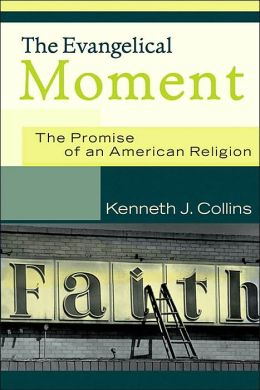
 Kenneth J. Collins, The Evangelical Moment: The Promise of an American Religion (Grand Rapids: Baker Academic, 2005), 288 pages, ISBN 9780801027444.
In his work, The Evangelical Moment: The Promise of an American Religion, Kenneth Collins covers a tremendous amount of territory in a little over two-hundred pages. Collins begins his work by painting a picture of the larger background into which modern evangelicalism now finds itself. By providing this brief but reasonably well-rounded historical backdrop it provides the reader with a sense of awareness of where the evangelical church is located and how we arrived here. Collins then outlines what he understands to be the unique characteristics of evangelicalism: (1) the normative value of Scripture, (2) the significance of the atoning work of Christ, (3) the necessity of conversion, and (4) the imperative of evangelism.1 He quotes liberally from theologians, past and present, in support of his basic contentions; that Scripture is absolutely authoritative, that Christ worked a real atonement, that the need for conversion is essential, and that evangelism, even though attacked,2 is still fundamental to the Christian message.
One of the more distinctive characteristics of Collins’ work is its Wesleyan approach to evangelicalism. Although Collins is obviously not the first Wesleyan to write to/for evangelicalism, it is clear that Wesleyan authors are the minority. Collins recounts a debate that took place between Wesleyan theologian Donald Dayton and reformed author George Marsden. Collins uses the debate as a platform to showcase Wesley’s own words on some very contemporary subjects that have recently come into question within evangelicalism. For example, the authority of Scripture—”if there be any mistakes in the Bible there may as well be a thousand. If there be one falsehood in that book it did not come from the God of truth.”3 The origin of real virtue, “Let reason do all that reason can: employ it as far as it will go. But at the same time acknowledge it is utterly incapable of giving either faith, or hope, or love; and consequently of producing either real virtue or substantial happiness. Expect these from a higher source…Seek and receive them…as the gifts of God;”4 etc. Collins summarizes when he writes, “Wesleyanism is not a species of liberal “Arminian” accommodations to human effort or initiative but is informed by the theological genius of both John Wesley and Thomas Cranmer.”5
One of Collins most helpful sections is his chapter entitled “The Promise of Evangelical Theology.” It is an exceptional introduction to some of the more tricky notions active in modern theological discussion today. For those who are not familiar with terms like “Foundationalism,” “Postfoundationalism,” “Postliberalism,” or “Postmodernism,” and the way are used in theological circles today, this chapter alone is worth the price of the book. Collins doesn’t assume the reader has a background in the field so he starts from the beginning and carefully explains each topic. If you read slowly and carefully through each section, by the time you’re finished with the chapter you should have a reasonably good grasp of these concepts.
However, as even-handed and satisfying as the previously mentioned chapter, Collins chapter “Evangelicals and Feminism” was, perhaps, just as disappointing. This criticism is not about his conclusions per se, but rather his overall methodology. He begins by outlining four positions: “traditionalists or hierarchicalists,” “neotraditionalists,” “biblical egalitarians,” and “quasi-egalitarians.” But even at this early stage one can already see Collins’ bias as he describes one position as “biblical” and the rest with other designations. As he proceeds, it is evident that Collins has researched the matter well. He actively engages with positions considerably more liberal than his own (e.g., Lori Beaman, Mary Daly), and also with those more conservative (e.g.., the Roman Catholic Church, Aquinas). However, what was surprising was that throughout the entire chapter Collins never engaged any of the contemporary evangelicals who have written voluminously on the subject from a perspective that was more conservative than his own (John Piper & Wayne Grudem, Recovering Biblical Manhood & Womanhood;6 H. Wayne House, The Role of Women in Ministry;7 Stephen Clark, Man and Women in Christ;8 etc.). When one considers just how much of an impact that these authors have had over the past couple of decades it is difficult to understand Collins reasoning for simply skipping that entire segment of evangelicalism.
Collins also tackles the difficult and potentially promising subject of ecumenism. One of Collins’ great strengths throughout his work is his complete awareness of the Eastern Church. Unfortunately, many within evangelicalism seem to see the Christian faith divided between Roman Catholic and Protestant Churches. Collins, however, is clearly aware of Eastern Orthodoxy, and nowhere does it come out more clearly than in his section on ecumenism. He begins by looking at the first four ecumenical councils of Nicaea (325), Constantinople (381), Ephesus (431), and Chalcedon (451), and he notes a number of developments within the past several decades that offer some possible reason(s) for optimism. Most significantly, in October 1999, the Lutheran World Federation and the Roman Catholic Church held formal talks in the historic city of Augsburg that resulted in The Joint Declaration on the Doctrine of Justification. This document claimed that there was now a basic unity with respect to the doctrine justification. But as Robert Preus has pointed out, the document “says nothing about the imputation of Christ’s righteousness.”9 In fact, the post-Tridentine Catholicism “continued to regard justification as a process…rather than the imputation of righteousness.”10 So, although there has been some clear progress, there still remains room for further growth.
As stated earlier, Collins covers a vast amount of ground in a very short space. If you are looking for a broad introduction to the subject of evangelicalism this book should be on your list. For a helpful introduction on “Foundationalism,” “Postliberalism,” etc., again, this book should be on your list. If you consider yourself an evangelical and an Arminian/Wesleyan, you’ll enjoy Collins a great deal. However, his segment on evangelical feminism lacked Collins’ typical academic rigor, and reflected more bias than research. All in all, the book is worth the price and the time it takes to read.
Reviewed by Jeffrey Anderson
1 Pp. 41-61.
2 P. 58
3 Reginald W. Ward and Richard P. Heitzenrater, eds. The Works, of John Wesley, vol. 23, Journals, and Diaries, VI (Nashville: Abingdon, 1995), 25.
4 Albert C. Outler, ed., The Works of John Wesley (Nashville: Abingdon, 1984), 2: 600
5 P. 14
6 John Piper & Wayne Grudem, Recovering Biblical Manhood & Womanhood (Wheaton: Crossway, 1995).
7 H. Wayne House, The Role of Women in Ministry (Grand Rapids: Baker, 1995)
8 Stephen Clark, Man and Woman in Christ: An Examination of the Roles of Man and Woman in the Light of Scripture and the Social Sciences (Ann Arbor: Servant, 1980).
9 Robert Preus, Justification and Rome (St. Louis: Concordia, 1997), 114-15.
10 Alister E. McGrath, Iustitia Dei: A History of the Christian Doctrine of Justification from 1500 to the Present Day (Cambridge: Cambridge University Press, 1986), 284.