John Collins: Encounters With Biblical Theology

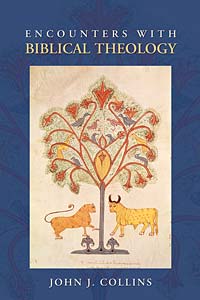
 John J. Collins, Encounters With Biblical Theology (Minneapolis: Fortress Press, 2005), 243 pages, ISBN 0800637690.
In the book Encounters with Biblical Theology,1 author John Collins offers a collection of essays on different aspects of the Biblical Theology movement. Collins is the Holmes Professor of Old Testament Criticism and Interpretation at Yale University, and has written ably in the field of biblical theology. The essays in this volume are selections of Collins’ work, spread over a period of some thirty years; each engaging a different element of biblical theology, and addressing a variety of theoretical issues. Collins, himself, humbly concedes that, “taken together, they have the character of probes and soundings.”2
Fifteen essays that make up the book are clustered under four distinct headings. First, are those that deal with “Theoretical Issues” within biblical theology (e.g., the very viability of a “Critical Biblical Theology,” etc.—pp. 11-46). Second, are topics in the Pentateuch (e.g. Faith and works in the command to sacrifice Isaac, the Exodus of the Israelites, etc.—pp. 47-88). Third, is the category of “Wisdom and Biblical Theology” (e.g., the biblical “Precedent” for natural theology, how the “biblical theology” movement all but ignored the Wisdom literature—pp. 91-117). And fourth, are works dealing with “Apocalyptic Literature” (e.g., the Legacy of apocalyptic literature and how it was used politically, both in ancient Israel and in the modern United States, etc.—129-189). Collins provides the reader with a brief survey of the biblical theology movement. Beginning with J.P. Gabler and Ernst Troeltsch, Collins moves to Wilhelm Wrede, G.E. Wright, Brevard Childs, and to a general examination of historical criticism. The task of the biblical theologian, Collins suggests, is “the critical evaluation of biblical speech about God”3 This, he insists, includes not only historical narrative within the Bible but other genres as well.

Like James Barr, Collins believes that historical criticism is not, strictly speaking, a method, but a collection of methods, such as source criticism, redaction criticism, sociological criticism. He states that throughout this work his goal is uncompromising “objectivity.” Yet, Collins himself acknowledges that objectivity is an elusive characteristic; easy to describe but difficult to attain. He states in the “Introduction” that although he strives for an impartial neutrality (and he believes such objectivity to be obtainable),4 such detachment cannot be attained by those who approach the Bible from a confessional or believing approach. “A confessional approach…wants to privilege certain positions…thus in effect taking biblical theology out of the public discussion.”5 Obviously, this goal for objectivity in interpretation did not begin with Collins but can be traced to the early 1960s.
In an article on biblical theology in 1962, Krister Stendahl posited a sharp distinction between what the Bible meant and what the Bible means.6 Since that time, this characteristic has come to be the accepted norm in virtually all conservative, evangelical interpretation. Popular New Testament author Gordon Fee states as much when he states, “[T]the task of interpreting involves the student/reader at two levels. First, one has to hear the Word they [i.e., the original audience] heard; you must try to understand what was said to them back then and there (exegesis). Second, you must learn to hear the same Word in the here and now (hermeneutics).7 This initial step seeks to be rigorously objective, thrusting all personal and ecclesiastical biases aside. Yet with the rise of postmodernism the claim to “objectivity” has come under intense scrutiny, and has, in many cases, been dismissed as a misguided goal that is little more than a fool’s errand.8 Although some believe Collins to have been successful in his quest for objectivity,9 it does not appear that such unbiased detachment was ultimately achieved by the Yale professor, as he approaches the biblical text with a “hermeneutics of suspicion.” Such suspicion, or mistrust, can be seen in the following examples. Collins writes:
“It is no longer possible to defend the historicity of the stories of Abraham…it cannot be the historical truth” (p. 57); “…the historicity of the individual (Bible) stories cannot be defended” (p. 203); “The story (of Exodus) has a ‘history-like’ character, but nowhere in the biblical corpus has the ‘collapse of history’ been more painfully obvious…” (p. 67); “The Bible cannot support the claim to transcendent authority…The Bible can no more provide us with objective, transcendent moral certainties than can natural law” (p. 78); “Christianity is not a deposit of timeless truth but a religious tradition that derives its identity from continuity with the past” (p. 79); “Daniel 2 was not actually written in the Babylonian era, but some centuries later, under the fourth kingdom…and it does not report the actual dream of a Babylonian king, but a Jewish fabrication” (p. 134); “It is, of course, a notorious fact that the kingdoms predicted in apocalyptic visions (including Revelation) never come, and so…are…nourishing illusions” (p. 140); etc.
This skeptical attitude toward the Bible, however, is interpreted by Collins as a virtue. Of course, everyone approaches the Bible with biases; and it is precisely this point that makes John Goldingay’s warning so terribly relevant. Those who “pretend to be objective and critical and then find their own (Enlightenment or existential or feminist) concerns in the texts they study need to take a dose of self-suspicion.”10
In considering the readership of Pneuma Review, it seems unlikely that this volume will have much appeal. Collins’ radical skepticism toward the biblical record, coupled with his laborious academic language, and the unstated assumption that the reader has a solid grasp on the history of the biblical theology movement, will likely turn away many readers. Yet, despite these cautions, Collins’ work is not without benefit. James Sanders captured the serviceable aspect of his book when he concluded, “As new generations come along with their fresh approaches and methods, Collins’s voice can help to guide new efforts to seek viable ways to bring the biblical past into the present in ever-changing contemporary and responsible terms.” With this in view, then, perhaps some will find this volume helpful as they attempt to understand the depth of the “the unsearchable riches of Christ” (Ephesians 3:8, NIV).
Reviewed by Jeffrey Anderson
Preview the book here: http://books.google.com/books?id=UgY0Q3xsfisC
Notes
- John J. Collins, Encounters With Biblical Theology (Minneapolis: Fortress Press, 2005).
- Collins, Encounters With Biblical Theology, 1.
- Collins, Encounters With Biblical Theology, 18.
- Collins also states, “At the risk of appearing old-fashioned and out of touch with the latest trends in academia, I believe that we can (i.e., move beyond replacing one set of prejudices with another).” See Collins, Encounters With Biblical Theology, 43.
- Collins, Encounters With Biblical Theology, 3.
- Krister Stendahl, “Biblical Theology, Contemporary,” in The Interpreter’s Dictionary of the Bible, 4 vols. (Nashville: Abingdon Press 19621), 1:418-432. Reprinted in Krister Stendahl, Meanings: The Bible as Document and as Guide (Fortress, Philadelphia, 1984), 11-44. Stendahl pointed out that this distinction didn’t really come into focus until the 1920s, with the rise of the critical method known as the “history-of-religion school.”
- Gordon Fee & Stuart Douglas, How to Read the Bible for All its Worth (Grand Rapids: Zondervan, 2003), 23.
- For a helpful introduction to this perplexing question see the chapter entitled “The Promise of Evangelical Theology” in Kenneth J. Collins, The Evangelical Moment: The Promise of an American Religion (Grand Rapids: Baker Academic, 2005); Nancy Murphy and Werner Kelber, eds., Beyond Liberalism and Fundamentalism: How Modern and Postmodern Philosophy Set the Theological Agenda (Trinity Press International, 1996); and Richard Rorty, Philosophy and the Mirror of Nature (Princeton: Princeton University Press, 1979).
- James A. Sanders, for example, describes Collins as “An Irish Catholic with no personal investment in defending any particular view of ‘Scripture’ …Collins is an astute observer of serious efforts to make theological sense of the Bible. He has critiqued such efforts without attempting himself to do a biblical theology.” See Sander’s review of Collin’s work in Review of Biblical Literature (RBL), July, 2006, http://www.bookreviews.org/pdf/4968_5586.pdf,
- John Goldingay, Models for Interpretation of Scripture (Grand Rapids: Eerdmans, 1995), 45.