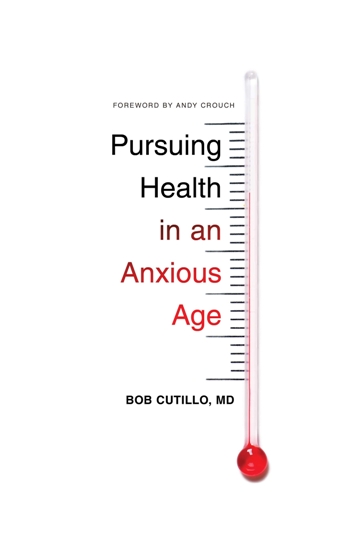
Bob Cutillo: Pursuing Health in an Anxious Age

 Bob Cutillo, Pursuing Health in an Anxious Age (Wheaton, IL: Crossway, 2016), 196 pages, ISBN 9781433551109.
Advances in healthcare have led to increase in worry over one’s own well-being, wasteful spending, and a lack of concern for the well-being of others in our community. Indeed, we have come to view health as a commodity to possess and control. Commodities run out; thus, the fear of loss causes us to focus only on what we have and can maintain, rather than on ensuring everyone has enough. Cutillo urges us to view health and healthcare from the margins, with those individuals who are often unable to afford and thus acquire healthcare. By so doing, we can resist the flow of healthcare as only a multi-billion-dollar industry and pursue justice in the distribution of healthcare at the local level. Moreover, instead of keeping medicine and faith apart, Cutillo argues for a complementary relationship, using Christianity as a means “to explore how we pursue health and practice healthcare” (p. 16). Indeed, this is the purpose of the book.
The book is divided into four parts: The first part discusses how individuals have come to see health as something to control; while the second part suggests that medics need a new way of seeing the patient. Part three addresses the fear of death and how we can view dying differently, and the final section offers a way forward to viewing healthcare as a gift that should be shared within the wider community in light of the intersection of medicine and faith.
Unrealistic Expectations
Cutillo shows how even from the Genesis account, we have the proclivity to want to control our circumstances. Although God has declared all creation good, Adam and Eve sought more—the knowledge of good and evil. Since then, humans have had to make decisions based on what they understand of good and bad. We don’t want what is bad, and because society deems sickness and disease as bad, we try to control outcomes so that we can avoid them at all costs. In turn, we become anxious about those outcomes. Cutillo points out that because God is active in the world, he “is able to incorporate even the things we assume bad into a greater plan [that can] change the way we pursue health and face sickness” (p. 68). Thus, we don’t have to waste our energies in worrying about our health but focus on living.
Disembodiment
Medical students are trained to see the body in parts, but by breaking the whole into parts, they can lose sight of the whole altogether. When healthcare practitioners dissect the human patient into discrete parts, they no longer see the needs of the human before them, only their disease. Moreover, the propensity to tick the heuristic box of symptoms to diagnose disease avoids the altogether larger issue of how the individual is in other contexts of being and disallows the uniqueness of individuals to assist in both diagnosis and remedy. The result is that we separate the body from the soul.
Death De-fanged
Underneath our need for control lies the ultimate fear—death, and that what we have is taken away. Our fear of death exposes our lack of reliance on God. Cutillo shows how the resurrection of Jesus changed death forever. Our hope is in the return of Jesus and a place in heaven, where there is no death. He does not discount the reality of pain and suffering we experience; however, when we can release our fear of death, not only do we learn to rely more on God to sustain us, we then can focus on helping others. We share with others because we have confidence that God will supply our needs. This parting thought of section three leads into the final section on a fairer distribution of healthcare.
It Takes a Village
Cutillo posits that only when we see ourselves as vulnerable, and yet are willing to care for others in more dire circumstances, can the community be healthy. We tend to our health as if it’s a possession to be clutched so as not to lose it, but the reality is that unless we make provision for those who cannot afford healthcare, we belong to an unhealthy community. Cutillo comments, “Most modern political and economic thought and action prioritize private and personal goals over communal care and the common good” (p. 142), as evidenced in the dichotomy between healthcare spending and the number of uninsured in poor health. Cutillo argues that because we are interdependent, we must pursue justice in healthcare and show concern for the poor in our community.
As a doctor and Christian, Cutillo can see healthcare’s problems and possible solutions from both a medical and biblical perspective. His recommendations are radical insofar as we are so caught up in our self-preservation that we are desensitized to the needs of others. We may view caring for the marginalized as risky, but without the whole community healthy, we are merely applying a band-aid to a life-threatening illness. Cutillo’s book encourages us to focus less on our idealized pursuit of personal health and more on our responsibility to the health of the local community.
Reviewed by Michelle Vondey
Preview: https://books.google.com/books/about/Pursuing_Health_in_an_Anxious_Age.html?id=vhUZDQAAQBAJ
Publisher’s page: https://www.crossway.org/books/pursuing-health-in-an-anxious-age-tpb/