John Christopher Thomas, The Apocalypse: A Literary and Theological Commentary (Cleveland, TN: CPT Press, 2012), xvii + 716 pages, ISBN 9781935931270.
John Christopher Thomas (PhD, University of Sheffield; Clarence J. Abbot Professor of Biblical Studies at the Pentecostal Theological Seminary, Cleveland, TN and Director of the Centre for Pentecostal and Charismatic Studies at Bangor University, Wales, UK) has published what should be the standard for Pentecostal commentaries. Instead of offering a commentary on commentaries or commentators (as many do), he has made an original contribution to the field via his focus on the literary and theological elements of the Apocalypse. This commentary serves as a much larger account of Thomas’ interpretation when compared with his upcoming volume being co-authored with Frank Macchia in the Two Horizons Commentary series on The Revelation.
Enter the visual and audible world of the Apocalypse.
This volume should be standard fare in every Pentecostal pastor’s library and the first commentary turned to in any study of the Apocalypse. He does not offer any discussion of Dispensationalist interpretations, but instead drives to hear the text in its context. He follows particular impulses previously explored in Richard Bauckham’s helpful volume, The Theology of the Book of the Revelation (Cambridge University Press, 1993). His introduction to the commentary proper makes plain his objectives for a Spirit-empowered encounter with this Revelation where he even discusses a number of influences that the visionary elements of the Apocalypse have had upon U.S. popular culture.
John Christopher Thomas
While there are scatterings of some brief technical discussions of grammar, it remains significantly accessible for the pastor or learned lay-person. The Greek text is discussed at numerous points, being the foundation for Thomas’ work, but is always translated and discussed for the sake of those unfamiliar with reading Greek. A literary hearing (as opposed to simply reading) of the text of the Apocalypse is followed throughout the commentary along the lines proposed by Thomas’ coworker at the Centre for Pentecostal Theology, Lee Roy Martin’s work, The Unheard Voice of God: A Pentecostal Hearing of the Book of Judges (Deo, 2009). Thomas goes to great lengths to facilitate the reader of his commentary to be able to enter the visual and audible world of the Apocalypse. The text is thus intended to be experienced at multiple levels rather than simply as a “text”. He regularly emphasizes how the churches heard the text (just as John heard and saw what he recorded) and what they might have experienced as Spirit-empowered, prophetically gifted congregations. This pneumatic element is intended to offer not only the manner in which the Revelation was given, but also in which it is best interpreted for contemporary audiences.
The Spirit is the key.
Thomas has demonstrated throughout this work that the Spirit is the key to understanding this last book of our canon and functionally drives the readers (or more particularly, the hearers) to know and glorify God and the Lamb. Thomas’ contribution to scholarship on the Apocalypse is most noteworthy in following this pneumatic element which he points to as the major structural divisions of the book where John is stated to be “in the Spirit” (Rev.1.10; 4.2; 17.3; and 21.10). These broader structural cues are then followed as movements of the Spirit intended to draw on the pneumatic community to be faithful to the Spirit. This provides a thorough-going Pentecostal hearing of this Spirit-delivered, Spirit-interpreted book of Scripture and offers new life to all those who would themselves be numbered among those who will faithfully hear, obey and overcome.
Rick Wadholm Jr., Ph.D. (Bangor University, Wales, UK), is Associate Professor of Old Testament at Assemblies of God Theological Seminary. Rick has pastored several rural congregations in North Dakota and Minnesota for 22 years and is ordained with the Assemblies of God (USA). He is a regular speaker for churches, camps and conferences. He enjoys reading and discussing theology and Biblical Studies, most particularly the works of Dietrich Bonhoeffer and Karl Barth. Rick is an active member of the Institute for Biblical Research, the International Bonhoeffer Society, the Society of Biblical Literature, the Society for Pentecostal Studies, and was the Executive Editor of The Pentecostal Educator published by the World Alliance for Pentecostal Theological Education (2013-2019). Rick is author and editor of numerous articles and books. He has helped found the Society for Pentecostal Studies Student Caucus. He also enjoys blogging on topics of translation, Biblical studies, pastoring and theology by contributing to four different blogs—his personal blogging adventures hosted at rick.wadholm.com. Facebook. Twitter.
Introduction For church leaders, preachers and even ordinary Christians, choosing a Bible translation can be a difficult task. This is made even more difficult for those who study translation in order to make an informed decision. It is unfortunate that discussions of Bible translations tend to be centred on personal opinions (for example Taylor 2007)…
Michael F. Bird, Jesus Is the Christ: The Messianic Testimony of the Gospels (Downers Grove, IL: IVP Academic, 2012), 207 pages, ISBN 9780830828234. Michael F. Bird, lecturer in Theology at Ridley College in Melbourne, Australia provides the reader a study of how each of the four evangelists present Jesus as the Messiah of early Israel’s expectation….
Thomas E. Reynolds, Vulnerable Communion: A Theology of Disability and Hospitality (Grand Rapids: Brazos Press, 2008), 256 pages, ISBN 9781587431777. Difference, normalcy, embodiment, community, and redemption are all topics that relate to disability. Disability studies have greatly increased with the onset of late modernity, and this is a blessing to all those who seek…
Study Bible Series There has been a growing number of Study Bibles released in the last few years and Dony Donev is reviewing them along with some classic Study Bibles. Dr. Donev will be evaluating each of the Bibles by focusing on subjects such as the gifts and ministry of the Holy Spirit, free…
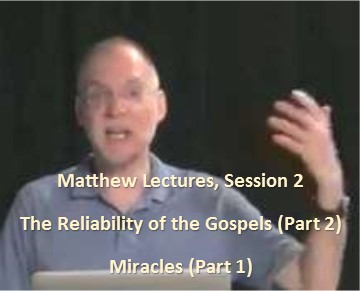
The second in a series of 19 lectures on the Gospel of Matthew by Dr. Craig S. Keener of Asbury Seminary in Wilmore, Kentucky. This session is entitled, “The Reliability of the Gospels, Part 2; Miracles, Part 1.” For further reading: Craig S. Keener, Gospel of Matthew: A Socio-Rhetorical Commentary (Eerdmans, 2009). The…
The simple answer is Yes! It will be a spiritual body—one that is far more appropriate for the new dimension in the new cosmos in which we will be living. It will be a body tailor-made by God, “eternal in the heavens” (2 Corinthians 5:1). Just as God formed our physical substance and frame in…
To provide the best experiences, we use technologies like cookies to store and/or access device information. Consenting to these technologies will allow us to process data such as browsing behavior or unique IDs on this site. Not consenting or withdrawing consent, may adversely affect certain features and functions.
Functional
Always active
The technical storage or access is strictly necessary for the legitimate purpose of enabling the use of a specific service explicitly requested by the subscriber or user, or for the sole purpose of carrying out the transmission of a communication over an electronic communications network.
Preferences
The technical storage or access is necessary for the legitimate purpose of storing preferences that are not requested by the subscriber or user.
Statistics
The technical storage or access that is used exclusively for statistical purposes.The technical storage or access that is used exclusively for anonymous statistical purposes. Without a subpoena, voluntary compliance on the part of your Internet Service Provider, or additional records from a third party, information stored or retrieved for this purpose alone cannot usually be used to identify you.
Marketing
The technical storage or access is required to create user profiles to send advertising, or to track the user on a website or across several websites for similar marketing purposes.


 John Christopher Thomas, The Apocalypse: A Literary and Theological Commentary (Cleveland, TN: CPT Press, 2012), xvii + 716 pages, ISBN 9781935931270.









This is the day that the Lord has made to discuss The Apocalypse
Who’s up for it? Rick Wadholm Jr Charles Page Daniel Rushing @Christopher Hart
http://www.amazon.com/gp/offer-listing/B0007EUFRC/ref=dp_olp_used_mbc?ie=UTF8&condition=used
I am interested in the A-Mil eschatological view. I am a partial preterist and believe christ presently reigns from the heavenlies since AD 70.