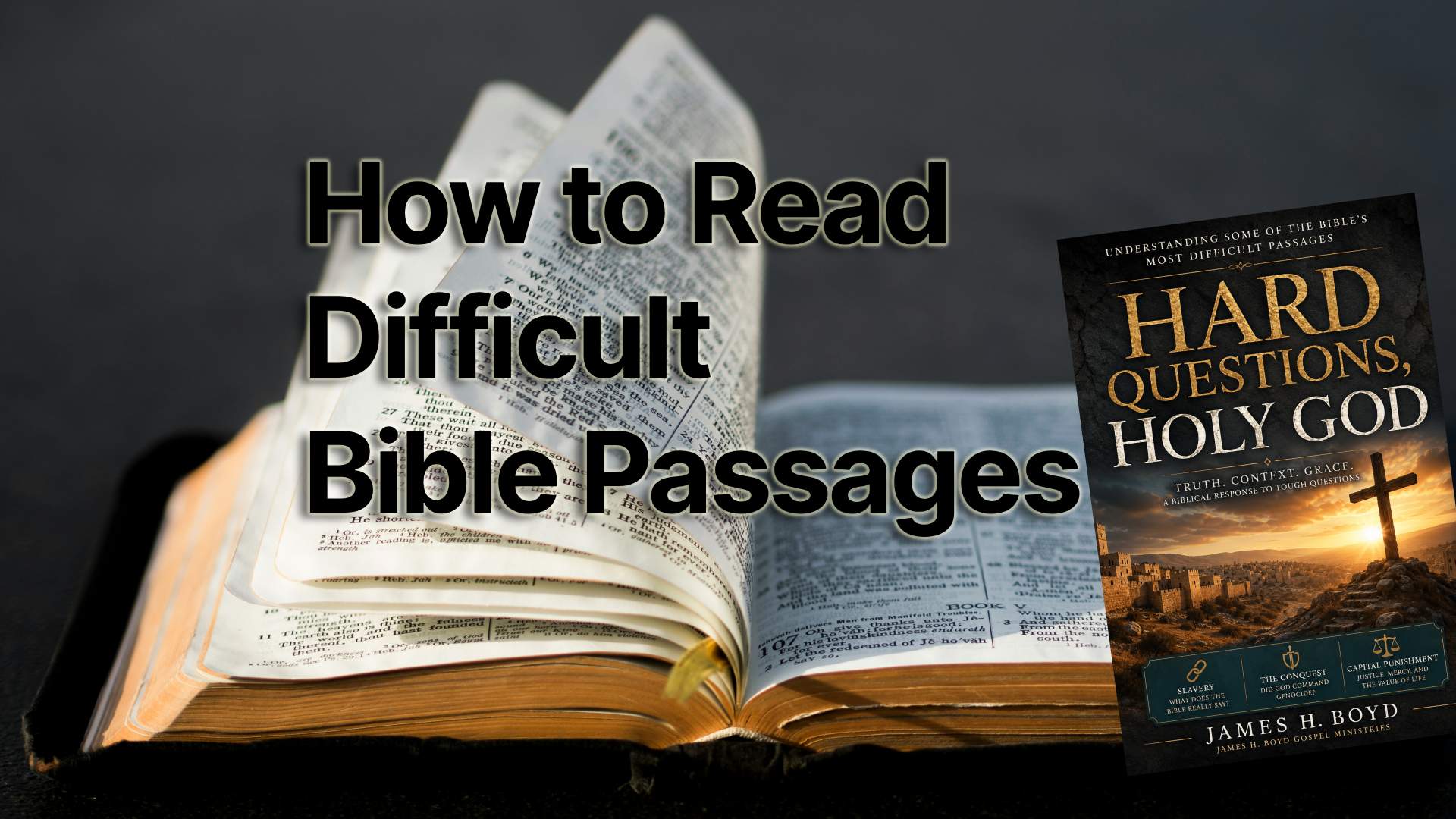
How to Read Difficult Bible Passages

Every Bible student eventually encounters a Bible passage that is difficult to understand. The question isn’t whether those passages exist, but how we should approach them. Before examining specific objections, we need a framework for reading Scripture faithfully and understanding God’s character.
“Shall not the Judge of all the earth do what is just?” (Genesis 18:25)
Imagine walking into the middle of a movie. You watch a single dramatic scene without knowing what came before it or what happens afterward. It would be easy to misunderstand the characters, their motives, and even the story itself. Yet this is often how people approach the Bible. A verse is pulled from its context, placed on social media or quoted in a debate, and presented as though it speaks for the entire message of Scripture.
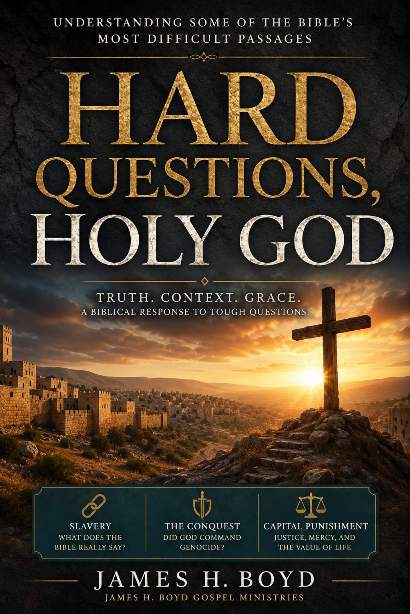
Many of the Bible’s most difficult passages have become internet talking points. Critics point to slavery, the conquest of Canaan or capital punishment and conclude that the God of the Bible must be cruel, inconsistent, or even immoral. Sometimes Christians respond by ignoring the questions or offering quick answers that satisfy neither skeptics nor thoughtful believers. Neither approach is helpful.
Begin with God’s Character
Whenever we encounter a difficult passage, our first question should not be, “How can I explain this away?” Instead, it should be, “What do I already know about God?”
Throughout Scripture, God consistently reveals Himself as holy, just, loving, merciful, patient, and truthful. He does not contradict His own character. When Abraham interceded for Sodom, he asked the question that serves as the foundation for this entire book:
“Shall not the Judge of all the earth do what is just?” (Genesis 18:25)
That is not merely a rhetorical question. It is a statement of confidence. Abraham trusted that even when he did not fully understand God’s actions, God’s character remained perfectly righteous. The same confidence should guide us today.
Read the Whole Story
The Bible is not a collection of disconnected sayings. It is one unfolding story of creation, fall, redemption, and restoration, centered on Jesus Christ. Individual verses make sense only when understood within that larger story.
Remember That the Bible Is Ancient
The Bible was written over a period of roughly fifteen hundred years by dozens of authors living in cultures very different from our own. Ancient Israel had no modern police force, bankruptcy courts, prisons, or representative democracy. Their legal system functioned differently because their society functioned differently. If we automatically judge every biblical law according to twenty-first-century Western assumptions, we will often misunderstand what those laws were actually accomplishing. Understanding historical context does not weaken our confidence in Scripture. It strengthens it.
Distinguish Between Description and Prescription
David committed adultery and murder. Peter denied Christ. Solomon fell into idolatry. The Bible reports these events truthfully, but it certainly does not endorse them. Likewise, when Scripture describes a cultural practice, that does not necessarily mean God intended it as His ideal. Recognizing this distinction prevents many misunderstandings.
Progressive Revelation
God did not reveal everything at once. Just as children learn gradually, God revealed His purposes progressively throughout history. The Old Testament prepares the way for Christ. The New Testament completes the picture.
The Apostle Paul describes the Law as a “guardian” or “tutor” leading us to Christ (Galatians 3:24). The writer of Hebrews calls many Old Testament institutions “a shadow of the good things to come” (Hebrews 10:1). Jesus did not abolish God’s revelation; He fulfilled it (Matthew 5:17). Therefore, difficult Old Testament passages must ultimately be understood in light of Jesus Christ, who is “the radiance of the glory of God and the exact imprint of his nature” (Hebrews 1:3).
Read Through the Lens of Christ
Jesus is not merely another teacher within the Bible. He is the climax of the Bible’s story. When Philip asked Jesus to show the Father, Jesus replied: “Whoever has seen me has seen the Father.” (John 14:9) If we want to know what God is like, we begin with Jesus.
He welcomed sinners while condemning hypocrisy. He demonstrated compassion without compromising truth. He fulfilled the Law while exposing legalism. He warned more about judgment than anyone else in Scripture, yet willingly bore that judgment Himself on the cross. The cross reminds us that God’s justice and God’s love are never in conflict. They meet perfectly in Christ.
Don’t Be Afraid to Wrestle
Some believers worry that asking hard questions demonstrates a lack of faith. The Bible presents a different picture.
Abraham questioned God.
Moses questioned God.
Job questioned God.
Habakkuk questioned God.
Even the name Israel means “one who wrestles with God.”
God is not intimidated by sincere questions. Honest wrestling often becomes the pathway to deeper faith. As R. C. Sproul wisely observed:
“We must know what it means to wrestle with God if we are to experience the sweetness of the soul’s surrender.”¹
Our Goal
The purpose of this book is not to explain away every difficult passage or pretend that every question has a simple answer. Rather, our goal is to examine these passages carefully, honestly, and reverently. We will consider their historical setting, their literary context, and their place within God’s unfolding plan of redemption. Most importantly, we will examine them through the character of the God revealed in Jesus Christ.
When we do, we discover that many of the Bible’s most troubling passages are not obstacles to faith at all. Instead, they become windows through which we see more clearly the holiness, justice, mercy, patience, and love of the God who has revealed Himself in Scripture.
Discussion Questions
- Why is it dangerous to read a single Bible verse apart from its context?
- How does God’s character help us interpret difficult passages?
- What does it mean to read Scripture through the lens of Christ?
- Which principle in this chapter do you think is most important, and why?
Notes
- R. C. Sproul, The Holiness of God, 2nd ed. (Wheaton, IL: Tyndale House Publishers, 1998), 196-197.
See Hard Questions, Holy God for Bibliography