
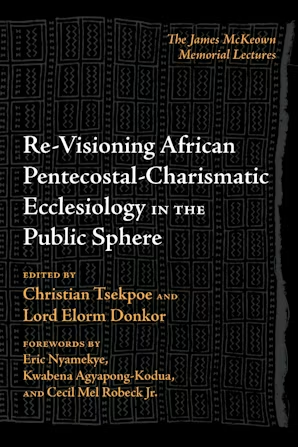
Re-Visioning African Pentecostal-Charismatic Ecclesiology in the Public Sphere

 Christian Tsekpoe and Lord Elorm-Donkor, eds., Re-Visioning African Pentecostal-Charismatic Ecclesiology in the Public Sphere: The James McKeown Memorial Lectures (Eugene, OR: Pickwick Publications, 2024), 207 pages.
Over the past several decades, African Pentecostal-Charismatic Christianity has attracted considerable scholarly attention, much of it focused on revival, spiritual experience, prosperity teaching, healing practices, or explosive ecclesial growth. By contrast, ecclesiology has often remained underdeveloped, frequently assumed rather than systematically explored. Re-Visioning African Pentecostal-Charismatic Ecclesiology in the Public Sphere: The James McKeown Memorial Lectures is therefore a welcome and timely contribution. More than a collection of essays on Pentecostal participation in society, the volume represents a sustained attempt to develop an African Pentecostal-Charismatic public theology through renewed reflection on the church’s identity and vocation within contemporary public life.
One of the volume’s principal strengths lies in its recognition that public engagement is ultimately an ecclesiological question. The contributors repeatedly return to the conviction that social transformation, political responsibility, ethical leadership, and national development cannot be detached from deeper theological reflections on the nature of the church itself. In this sense, the book signals a noteworthy maturation within African Pentecostal theology, one in which ecclesiology increasingly functions as the bridge between spiritual vitality and public responsibility.
The volume’s origin in the James McKeown Memorial Lectures is more than a historical detail. McKeown’s influence continues to loom large within the Church of Pentecost and, more broadly, within African Pentecostalism. The contributors repeatedly return to themes associated with his legacy—mission, discipleship, holiness, communal formation, and public witness—suggesting that contemporary reflections on Pentecostal engagement in the public sphere are deeply indebted to earlier ecclesial visions rather than simply responses to present social pressures. The forewords by Kwabena Agyapong-Kodua, Eric Nyamekye, and Cecil M. Robeck Jr. further underscore the volume’s location at the intersection of scholarship, ecclesial leadership, and ecumenical reflection.
The collection is carefully structured around several interrelated themes. The opening chapters revisit foundational Pentecostal understandings of church identity, particularly within the tradition of the Church of Pentecost. Subsequent essays explore mission, social transformation, education, leadership formation, governance, and anti-corruption initiatives. Other contributions address questions of youth formation, public morality, and ecclesial responsibility within contemporary African societies. While the individual chapters vary in emphasis and methodology, they share a common concern: how Pentecostal-Charismatic communities might inhabit the public sphere faithfully without surrendering their theological distinctiveness.
The chapter also raises a larger question that echoes throughout the volume: whether African Pentecostalism is undergoing a gradual transition from revival movement to public ecclesial tradition. While the contributors do not frame the issue in precisely these terms, the book repeatedly suggests that Pentecostal communities are increasingly being called to articulate not only what they believe or experience, but what kind of social body they understand themselves to be.
A second chapter deserving particular attention is Emmanuel Kwesi Anim’s treatment of Pentecostal mission and social transformation. Here the volume’s broader concerns come into sharper focus. Anim argues persuasively that mission cannot be restricted to evangelistic proclamation alone but must include active participation in processes of social renewal and communal flourishing. Importantly, however, social transformation is not presented as an alternative to spiritual mission. Rather, both are understood as dimensions of the church’s participation in the mission of God.
I found myself particularly drawn to these discussions because they intersect with concerns central to my own work in Pentecostal public theology and pneumatological ecclesiology. The chapter implicitly raises a question that recurs throughout the volume: What ecclesial forms are capable of sustaining meaningful public witness over time? Transformation, after all, is not simply the result of programs or strategies. It requires communities whose common life embodies the realities they seek to promote.
These ecclesiological concerns become even more explicit in Dela Quampah’s chapter on church-state relations and corruption. Arguably one of the most publicly consequential essays in the collection, the chapter addresses one of the most persistent challenges facing many African societies. Quampah refuses simplistic moralism, recognizing that corruption is not merely an individual ethical failure but a deeply embedded social phenomenon requiring sustained institutional and cultural responses.
What makes this chapter particularly valuable is its insistence that the church’s response to corruption must begin with its own internal formation. Public credibility cannot be separated from ecclesial integrity. In this respect, Quampah moves beyond conventional appeals for political engagement and directs attention toward the church’s responsibility to cultivate morally formed citizens capable of contributing to public life. The argument resonates strongly with broader traditions of public theology that understand the church’s social significance to arise not primarily from its political influence but from the distinctive quality of its communal life.
The book is not without limitations. At times, the enthusiasm for transformation language risks outpacing more sustained theological reflection on the nature of ecclesial communion itself. Some readers may also wish for greater engagement with broader ecumenical conversations in public theology and ecclesiology. Yet these observations should be understood less as criticisms than as indications of fertile avenues for future research.
For scholars of African Christianity, Pentecostal theology, public theology, and ecclesiology, this volume offers a rich and stimulating conversation partner. More importantly, it provides a valuable glimpse into a broader theological development in which African Pentecostalism is increasingly reflecting not only on the power of the Spirit, but also on the form of life the Spirit creates. The essays gathered here suggest that questions of public witness ultimately lead back to questions of ecclesial identity. Such questions extend far beyond the African continent, and the conversation this volume advances deserves careful attention from Pentecostal scholars everywhere.
Reviewed by Ciprian Gheorghe-Luca
Publisher’s page: https://wipfandstock.com/9798385210510/re-visioning-african-pentecostal-charismatic-ecclesiology-in-the-public-sphere/
Preview: https://books.google.com/books/about/Re_Visioning_African_Pentecostal_Charism.html?id=cbYfEQAAQBAJ