Inner Healing: Sister Ruth Shares the Gift of Inner Healing Worldwide
Despite a shallow theological foundation, President Jimmy Carter’s sister wrote a book anointed by the Holy Spirit to bring the healing love of Jesus to those in distress from past hurts.
Author’s Introduction
This article is derived from a chapter of my forthcoming book on the history of inner healing, which should see print in 2027. The exact title has not been determined yet. The work will cover the origins of inner healing by Mrs. Agnes Sanford during the 1940’s, its development by her associates at various CFO camps (Camps Farthest Out), and the entrance of the Catholics, such as Fr. Francis MacNutt, into this ministry. The chapter on Ruth Carter Stapleton follows. After the chapter on Mrs. Carter Stapleton, there will be a section on the criticisms of the inner healing movement, followed by a chapter on the work of John and Paula Sandford, who gave inner healing its most theologically sound analysis.
Sister Ruth Makes Inner Healing known worldwide
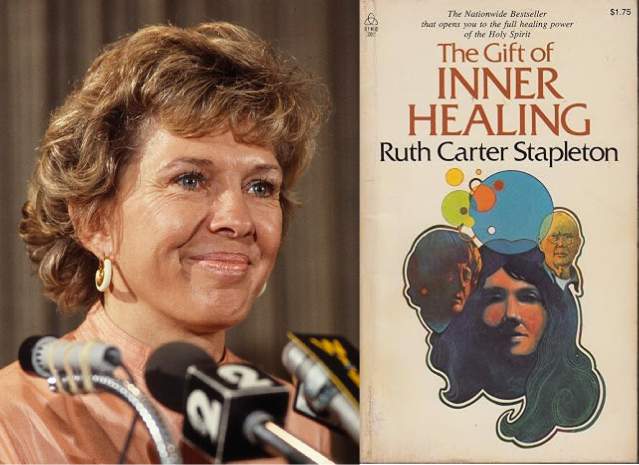
Mrs. Ruth Carter Stapleton (1929-1983) was the most important person in the spread of inner healing as a well-known and practiced ministry. Even today, many people mistakenly believe Mrs. Carter Stapleton to be the inventor of inner healing, rather than Mrs. Agnes Sanford. Ruth’s principal work on inner healing, The Gift of Inner Healing, sold 500,000 copies in its first year and was translated into multiple languages.[1] It continues in print, far outstripping all other books on inner healing combined. Her simple style allowed millions of readers to grasp inner healing as part of Jesus’ restorative love and grace. However, Ruth’s writings and ministry revealed a degree of theological naivety and lapses, which led to unnecessary controversies about inner healing.
Life
Ruth was born on August 7, 1929, in the small town of Plains, Georgia. She was the third of the four children of the marriage of James Carter, Sr., and Lillian Gordy. Jimmy, who became President, was the firstborn and five years older than his sister Ruth. Ruth had an older sister, Gloria, and a younger brother, Billy. Billy achieved considerable notoriety during the Carter Presidency for his carefree, beer-drinking lifestyle.[2]
James Carter Sr. worked hard to become a successful businessman in Plains, establishing a laundry and later purchasing and operating the town’s grocery store. He also purchased a farm five miles outside of town and made it a success. Mr. Carter was a Southern Baptist and segregationist and raised his family in those traditions as most every white person in Plains. Some readers may think this made him morally defective, but such a judgment would be rash. He was a “man of his times” and culture, as we all are. In contrast to many of his neighbors, he treated his black employees with respect and refused to join the Klan. He also encouraged his children to form close friendships with their African American neighbors. In Ruth’s book, Brother Billy, she described the friendship Billy had with his African American neighbor, Bishop.
…they were inseparable buddies. Segregate schools, churches, buses -nothing could segregate these two little boys who loved each other… When Daddy drove his pickup truck into town, if Billy was riding in the bed of the truck, there was Bishop always beside him, …always engrossed in one another or the activities they shared.[3]
Ruth’s mother, Lilian, was a nurse and worked full-time at the nearby hospital. In addition, she nursed the local African Americans who had no access to the hospital, at times without charge. After the children were grown, she joined the Peace Corps, where she did distinguished service in India in establishing several rural hospitals. She used most of her modest Peace Corps wages to purchase medications for those hospitals. [4]
Her daughter, Ruth, was a beautiful child with golden curls and became her father’s favorite. He flattered her incessantly. Ruth later wrote:
I had been raised to believe that I was God’s gift to the world, the most beautiful child ever born – I was led to believe that I was the most talented, the most gifted of persons. I grew up thinking I was queen of the universe.[5]
Like Billy, she had African American playmates and friends. She did not realize until much later that they ceded to her a prominence and victory in games as part of the unwritten rules of White to African American relations of the times.[6]
Ruth and her siblings rarely missed Baptist Sunday School and church. Its teachings were fundamentalist theology filled with “dos and don’ts.” Her pastor believed that Blacks were less than fully human, and mostly preached the fear of hell rather than God’s love, including the idea that all Catholics were going to hell, not unusual for the times.[7] (When I went to Catholic school in the 1950s, I was taught that all Protestants went to hell.)
After high school, Ruth attended Georgia State College for Women but did not finish a degree. Instead, Ruth fell in love and married a veterinarian, Bob Stapleton. She settled in Fayetteville, North Carolina (1948), with her husband, where he had his practice. In the following decade, she had four children. But in their circle of married professionals, she was no longer the designated queen of her group. That transition was difficult.
The pressures of trying to follow the Baptist “dos and don’ts” for a Christian mother and wife, combined with the death of her father (1953), brought her into depression. A serious car accident added to that depression – though thankfully produced no lasting effects. Mrs. Stapleton tried various routes to relieve her depression, such as meditation, yoga, and a brief try at Roman Catholicism.
CFOer and charismatic
That depression was lifted, and her new life as a Spirit-filled Christian began when she went to a CFO camp (circa 1964).[8] The CFOs (Camps Farthest Out) were anti-cessationist, non-denominational summer camps established in the 1930s by Professor Glenn Clark to teach effective prayer and Christian living.[9] The ecumenical Christianity at CFO camps was a radical change from her Southern Baptist upbringing. In fact, Ruth’s first published work was a pamphlet in which she described how she rejected the legalistic pattern she had received as a Baptist and discovered her freedom in Christ by ceasing to strive for perfection and letting the Lord’s grace and promptings guide her life.[10]
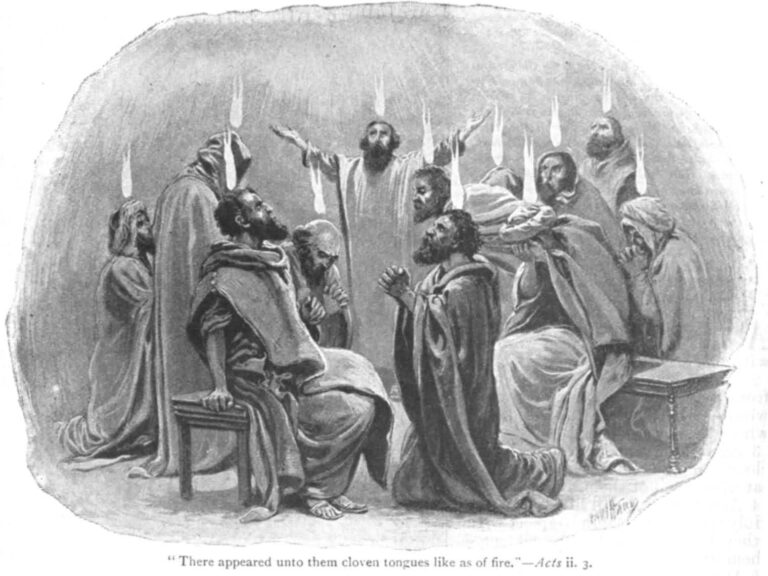
It is unclear which specific camp Ruth first went to. She did share that at the camp, Mr. Norman Elliot, one of the patriarchs of the CFO, ministered inner healing to her.[11] And there she also received the Baptism of the Holy Spirit from the Rev Tommy Tyson. The Rev. Tyson was one of the most prominent CFO speakers of the era. [12] He had a powerful ministry of healing and inner healing as well as an anointing to impart the Baptism of the Holy Spirit.[13] At that first camp, Ruth unexpectedly prayed for the healing of a woman’s ear problem, something Baptists just don’t do. It was healed, much to her surprise.[14] It is not uncommon for the Lord to graciously invite new or inexperienced Christians into the healing ministry with unexpected miracles. Indeed, Ruth developed into a consistent and anointed healing prayer minister.
Ruth became a regular attendee of CFO camps and later a member of a council ring (the local camp’s governing body). By the summer of 1967, she was a speaker at multiple CFO camps. Her first published writing, Power Through Release, was published by Prof. Clark’s Macalester Park Publishing Co., the semi-official CFO press. That was a work based on the devotional classic by A.W. Tozer, Five Vows for Spiritual Power, which she fully credited.[15]
We know from Ruth’s recorded cassette talks that Rev. Tommy Tyson, Rev. Cliff Custer, [16] and Mr. Norman Elliott all shared in guiding Ruth into the CFO/charismatic spirituality and the inner healing ministry. Additionally, these were the years when the pioneer inner-healing ministers, Agnes Sanford, Geneve Parkhurst, and Ann White, made the rounds as speakers at various CFO camps. Ruth must have met and listened to some, or even all of them. She did share in a taped talk that “Agnes Sanford taught me a lot.”[17] We do not know if that was at a camp or through her books and recorded talks, or a mix of these.
Advanced degrees:
During these years (1964-1967), Ruth decided to further her education. She attended Methodist University in Fayetteville, where she earned a BA in English literature. After graduation, she got a job as a high school English teacher. Her initial contract was not renewed due to a low performance evaluation. Her fault was that she spent most of her time counseling students instead of teaching the required materials.
Ruth then went on to earn a degree closer to her calling, a master’s in psychology. She attended the University of North Carolina at Chapel Hill. Note: there she also took courses in “religion” taught in the secularist environment at Chapel Hill. Such courses are generally taught in the tradition of “academic universalism,” where all religions are viewed as equally interesting and equally sharing the truth. This is polite but often obscures the demands of the Gospel (Deuteronomy 5:9), and led to serious negative consequences when Ruth’s ministry was put under the glare of massive publicity (see below).
At the same time, Ruth became a successful Bible School teacher for the women at Fort Bragg. Her reputation grew by word-of-mouth, and she was also invited to start several Bible studies in the Fayetteville area. But Ruth’s first public speaking event was a flop, ironic as she later became known as a masterful speaker and workshop leader. That first event was an invitation by an Army Chaplain, the Rev. Merlin Corothers, later a major figure in the charismatic renewal, to speak at a Fort Bragg prayer breakfast.[18] The event was compressed due to last-minute scheduling problems. Ruth improvised a revision, but that left everyone wondering what her point was.[19] Despite that, the Rev. Corothers invited Ruth to go with him for a visitation round Fort Bragg’s hospital. During the visit, Ruth prayed for and healed a soldier’s foot that had been badly crushed. He was impressed, and they became lifelong friends.
By the early 1970s, Ruth had built up a considerable clientele for her counseling and inner healing ministry, starting in the Fayetteville area, but expanding far and wide. She was even asked to speak in such faraway places as Japan and Thailand. In 1974, Ruth went to Indonesia with other Charismatic ministers to take part in the revival that had begun a decade earlier and was still going strong.[20] All of this was an amazing accomplishment before the readily available publicity of social media.
Ruth’s hectic ministry schedule and lack of family time put a strain on her marriage to the point that the couple decided to separate. At the last moment, Bob received the Baptism of the Holy Spirit and began speaking in tongues. He suddenly became the spiritual head of his household, took a sabbatical from his veterinary work, and became an evangelist. Ruth stayed home, took up gardening, painting, and the piano, and took care of the home and children. This was a time of testing for her, as she could not practice her ministry. It ended after six months when the Lord directed Bob to let Ruth resume her ministry and for him to return to his veterinary practice.[21]
The political side
In 1966, her brother Jimmy ran for Governor of Georgia but was defeated in the primaries by Lester Maddox. Governor Maddox is remembered today for his anti-desegregation stand, and such stunts as riding a bicycle backwards. Jimmy fell into a period of depression after his loss to Maddox. Ruth invited him to walk with her in the woods near his home. There, she led her brother into a prayer of total commitment to the Lord. This changed both his life and his politics.[22]
Jimmy ran again for governor and was elected in 1970. In his inaugural address, he announced a plan to desegregate all positions in the state government, although he had never campaigned on those issues. This shocked many of his supporters, but he was able to carry out those plans. His tenure as governor was generally considered a success.
In 1974, Jimmy began his campaign for the US presidency. Ruth again helped in the campaign. Jimmy was considered a long shot to win. The joke was, “Jimmy who?” But his persistence and an admirable troop of his joyful volunteers who were bused along with his campaign caravan made a great impression throughout the country, and he clawed his way to be the front-runner and Democratic nominee. He then squeezed out a victory against the incumbent Gerald Ford in the 1976 election.[23]
Although Carter’s presidency was considered a failure by most commentators, he did manage to get the Egyptians and the Israelis to sign a truce, the famous “Camp David Accords” (1978). This eventually led to a peace treaty between the two countries. President Carter sent Ruth to the Middle East, where she used her charm and communication skills to encourage acceptance of the Accords among the region’s elites.
Publicity and triumph
Ruth published her blockbuster best-seller, The Gift of Inner Healing, in 1976, a year into Jimmy Carter’s campaign for the presidency. She published it as “Ruth Carter Stapleton.” The use of the family name before the married name was unusual in English usage at the time. But The Gift of Inner Healing garnered a huge benefit in publicity because of this name change. Inner healing prayer spread to audiences that had never heard of the ministry or even had little esteem for the name of Jesus (Philippians 1:15–18). Many people all over the world bought the book simply to learn something about the President’s family. For instance, The Gift of Inner Healing became a best seller in Japan, where it was read by many non-Christians. This name change gave her recognition and publicity not available to Agnes Sanford, Geneve Parkhurst, or the other inner healing pioneers. Ruth talked about her name recognition in an interview with Christianity Today, the banner evangelical magazine of the time.
I think a lot of people come [to my talks] because they want to meet Jimmy’s sister. Some people come because they’ve read about me in the press. Other people come because they hadn’t heard of inner healing until Jimmy’s election and they really need help. At first, I liked it better when people came because they wanted help. Then I began to realize that it really doesn’t matter what their motives are as long as my message is the same. I’ve seen tremendous results with people who would never go to church for any reasons. Journalists come only to get a story, but I’ve been able to follow up and they’ve really become interested, so I’ve had some beautiful experiences.[24]
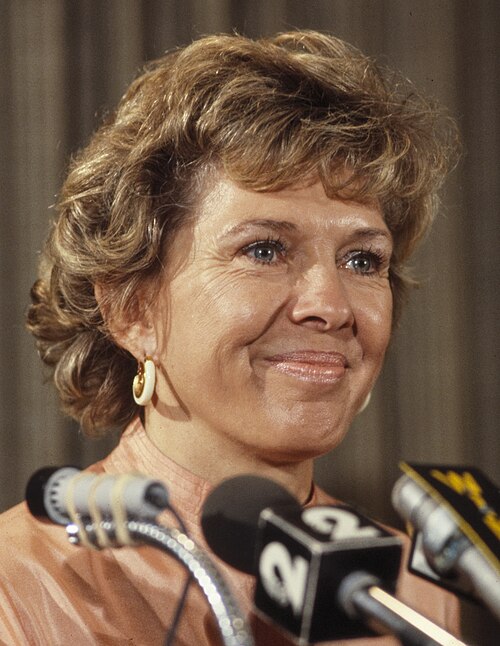
Ruth’s calendar became filled with invitations and speaking engagements both in the United States and throughout the world. She was beautiful, articulate, and charming, so that the publicity from being the president’s sister made for great press articles and photo ops. But that does not mean that her ministry was without opposition. To the contrary, she had a “bullseye” on her that attracted much pharisaical opposition to her books, talks, and workshops. Recall (chapter 2) that the theology of cessationism, predominant in Southern Baptist churches, asserted that present healing prayer cannot be from the Kingdom of God, and must therefore be demonic in nature. In one workshop, the local preacher barged into one of Ruth’s ongoing sessions and accused her of being a witch and a false prophet. He demanded that those women in his congregation leave immediately, effectively ending the workshop. Ironically, Ruth was later notified by one of the ladies of the workshop that the books she had sold were circulated in the town and triggered a local revival.[25]
In spite of this type of local opposition, The Gift of Inner Healing was hugely successful. This was mainly due to the simplicity of her writing style and to her presentation of inner healing as a simple ministry of graced visualization – theological nuances not included.[26] Not mentioned, for instance, was the Eucharistic intercession mode of inner healing used by Agnes Sanford. Ruth called visualization for inner healing, “faith imagination,” and employed it either in individual ministry with a counselee or in guided meditation prayers for groups
Ruth’s dependence on Agnes Sanford was obvious. For instance, she urged the reader to visualize Jesus’ light emanating from him and shining on a person needing healing.[27] This is a basic form of prayer in Mrs. Sanford’s 1947 classic, The Healing Light. Ruth also imports from that book a visualization technique that assists a person in forgiving anyone who has caused serious hurt. That is, imagining the face of the transgressor with Jesus beside that person, then merging both images together. In effect, seeing the “Jesus” in the offending person.[28] This was done without attribution or footnote. In fact. Mrs. Sanford was not mentioned at all in Ruth’s writings. This gave rise to the belief that she invented inner healing.[29] It is important to exercise caution when affirming the charge of plagiarism against Ruth, though it technically qualifies as such. Rather, Ruth was sensitive to the fact that Mrs. Sanford was anathema to most Evangelical leaders, and citing her would have prejudiced many against considering any form of inner healing as legitimate prayer.
Like Mrs. Sanford and the other CFO women (see chapter 7), Ruth was open about the role that secular psychology played in her style of inner healing. She cited various psychologists throughout her works, favoring the popular motivational writer John C. Maxwell, and invoking the psychology of Carl G Jung.[30] But Ruth’s stress on finding early childhood trauma as the focus for healing prayer seems more like psychoanalysis (Freudian). However, she never cited Freud, whose psychology was an Evangelical no-no and something not to be mentioned. All of this was a shrewd way of affirming to the general public that inner healing was not alien to modern psychology, yet not so close as to alienate more traditional Christians. As she explained, psychology can provide analysis and some healing.
…psychiatrists bring a degree of healing into problems into the past and bring understanding of our weak and vulnerable spots, and our angry and fearful reactions, but only the Holy Spirit can move back into these areas and remove the scars.[31]
Her technique in inner healing was very simple and direct. After a root problem or incident was identified by counseling, she guided the supplicant to replay in their imagination the traumatic event in the presence of Jesus. This is demonstrated in the case of “Jeff” (pp.37-39). Jeff was raised on a farm and recalled being five years old and beaten by his strict father. But what he dreaded most was being forced to go out at night, by himself, to close the barn door or do some other farm chore. Ruth directed Jeff to relive that frightening experience; she directed.
“Now, Jeff, before you go outside that door, Jesus is waiting for you. Before you go out, do you see him there, just outside?”
“I do.”
“Do you see him waiting to catch you up in his arms and hold you in his chest?”
“I do.”…
“All right. Now, Jeff, go out that door into the dark where Jesus is waiting…”
“I have…and Jesus caught me into his arms.”
“And they’re so strong, Jeff, that you feel his tremendous strength and energy and power flowing into you. …
“Oh, I do, Ruth, I’ve never felt so strong and – fearless.”
“Alright, Jeff, Jesus is going to put you down– right outside the door – and you, a five-year-old boy, are going to hold Jesus’s hand, are going to walk through the dark…to that barn door.”[32]
In his imagination, Jeff walked to the barn door and closed it in perfect peace. The trauma and pain of the memory were transformed into an image of peace with Jesus. Note how Ruth not only invited Jesus’ presence, but also suggested his actions (we will comment on this below).
At other times, Ruth incorporated Prof. Glenn Clark’s innovation of using mashal prayers (parable prayers), which Agnes Sanford had also adopted in her ministry to groups (see chapter 3). For instance, a mashal prayer Ruth often used when talking to groups went as follows:
Lord Jesus, you are a part of each one of our lives; you know every moment we have ever lived, both the good moments and bad. And so, Lord Jesus, I join with You and picture each of our lives as a staircase, a narrow staircase. It is going up. The staircase is lit with a bright light. Jesus, you are the way, the truth, and the light; you are the life. We acknowledge that each step represents one year of growth in our lives. Jesus, as You stand at the base of the step, we see ourselves as a little baby. We are there at the bottom of the stairs. Take that little baby that we are into your arms. As you hold us, as you rock that little baby, we thank you that your healing love begins to pour through into our hurting hearts. All of the memories of that time. that we spent in our mother’s womb – all the hurts, all the negative emotions that were picked up from outside – ask you to heal…
Together we step onto the third step. And the fourth. fifth, sixth. In the sixth Year, as we begin to know the difference between boys and girls, and new confusions, the new traumatic changes that happen … we thank Jesus, that You are removing and healing all… we don’t have to recall anything because we know that You are picking up things that need healing.[33]
We should credit Ruth with some originality and boldness in the way she encouraged the use of the deliverance/exorcism ministry as part of inner healing prayer. Perhaps more correctly, it is an adjunct to inner healing, just as Jesus’ healing ministry included deliverance/exorcism when the illness was due to demonic entities.[34]
After The Gift of Inner Healing came out, Ruth’s speaking engagements multiplied. These included many secular groups. In 1977, Ruth addressed the West German parliament on spiritual therapy and spent eighty minutes with Chancellor Helmut Schmidt discussing inner healing. That was also the year that Ruth went on a missionary tour through Central and South America with Fr. Francis MacNutt and other leaders of the Charismatic Renewal. It was a tour that bore long-lasting fruit in the area with the rapid expansion of the Charismatic Renewal into those regions.[35]
Theological missteps
But Ruth’s talks to non-Christian groups created problems with her Christian critics. In her defense, note Paul’s desire to bring the Gospel to non-Jews and the flexibility he showed in this regard.
“For though I am free from all, I have made myself a servant to all, that I might win more of them… To the weak I became weak, that I might win the weak. I have become all things to all people, that by all means I might save some. I do it all for the sake of the gospel, that I may share with them in its blessings.” (1 Corinthians 9:19-23)
Ruth ministered in that spirit, attempting to bring the Gospel of Jesus’ healing grace to many secularists, yoga, and New Age groups. Following this evangelical impulse is admirable but tricky, and it takes wisdom and a sound theological basis to avoid compromising the Gospel. A model of this is the way Paul approached his Pagan audience in Athens (Acts 17).
When he first arrived in Athens, Paul was disgusted by the statues of the gods there. It was idolatry of the worst sort. But he began his speech at the Areopagus not reprimanding them, but by commending the Athenians on their quest to know God. He then affirmed the truth of God as Father of all persons by citing several Greek poets and playwrights on that point. Lastly, he proclaimed Jesus as the resurrected Savior. Agreeing with Pagan theology past the truths it held would have undermined the Gospel, but preaching immediately and forcefully about rejecting their multiple gods would have alienated the hearers before they heard about Jesus. All of which is to say that preaching to non-Christians is difficult, and whatever one says may be subject to one error as too “provocative” to the non-believers, or another error as too much of a compromise of the Gospel.[36]
It may be fairly stated that Ruth went beyond the Pauline balance and at times compromised the Gospel. Not when she spoke to Christian groups, for instance, during the Latin American tour of 1977. There everything went fine, and what she learned from her CFO teachers served her well in this setting. She ministered with her gifting in healing and other gifts of the Spirit, such as words of knowledge, especially during her personal counseling. There was little theology presented other than the call to be open to the gifts of the Spirit, because the audience was orthodox in the classic sense.
But recall that her theological foundations were in a legalistic Baptist Sunday School education, which she rejected, plus religion classes taught in “academic universalism,” not exactly a grounding in the classics of sound Christian theology. This lack had already come up at various points in her writings. In her work, In His Footsteps, she reinterprets Jesus’s words to the healed paralytic: “See, you are well again. Stop sinning or something worse may happen to you” (Luke 5: 14), to a secular and unbiblical variant, “Don’t let guilt overcome you again.”[37] This is a serious theological error, as guilt is the conscience’s alarm that sin has occurred and must be repented and confessed.
The July 1978 article in Newsweek, “Sister Ruth,” exposed her lack of theological formation for all to see. In that article, she was quoted as saying, “I believe that Jesus was just a man, but a man ordained by God to carry all of the negative thoughts and feelings of all the human beings who ever lived.”[38] Also, “Personally, I rely on Jesus. But who knows, maybe God was in Buddha just like in Jesus.”[39] This showed that her belief about Jesus was similar to the old heresy of Adoptionism, which claimed that Jesus was not divine, but received God’s special approval at his baptism in the Holy Spirit, or later at his ascension into heaven. This was soundly condemned by the Early Church as a heresy.
In an interview on the 700 Club a short time later, Ruth vigorously denied she made such remarks, and asserted she was misquoted and taken out of context. But later detailed research by Brooks Alexander of the Spiritual Counterfeits Project, an anti-cult organization of great integrity, documented that Ruth had said similar statements on multiple occasions when addressing non-Christian groups.[40] That is, she fell into the temptation to degrade the Gospel to please her audience, or more seriously, her own theology was seriously in error. Since Ruth has long been dead, we cannot interview her for clarification.
The Larry Flynt controversy
The difficulty and controversies of her tight-rope ministry between the secular, New Age, and Christian groups were aggravated in her well-publicized evangelization of Larry Flynt, the publisher of the pornographic journal Hustler. A CBS News employee recommended Flynt to Mrs. Stapleton’s ministry, and he went to her home and spent hours talking with her and her husband. The Stapletons reciprocated and visited Flynt at his mansion for further discussions. Ruth continued the conversation, urging him to accept Jesus as Savior and amend his life.
Flynt became “born-again” after he experienced the presence of God while flying in a chartered jet on business. In the following weeks, he made bold promises about “reforming” his magazine and sex business.[41] None were carried out, and after four months, Flynt renounced his experience of salvation and returned to his atheist status (Matt 13:4-5). Subsequently, he was shot by a white supremacist who was outraged by an interracial pornographic spread in Hustler. Flynt was left paralyzed for the rest of his life, with substantial lingering pain. In that state, Mr. Flynt led his sex empire to ever-increasing levels of vulgar pornography.[42]
Ruth received criticism for her association with Mr. Flynt. But, biblically speaking, her actions with such a notable sinner were nothing more than following the steps of Jesus (Matt 9:10-12). Flynt’s ultimate rejection of the Gospel after the conversion experience is something all evangelists encounter – few succeed in having more than 40% of their converts become stable disciples. Her efforts towards Flint also demonstrated what she always showed in her books and workshops: that Jesus was Lord and one needed to come into relation with him to be healed and saved. Her agreement or disagreement with credal orthodoxy did not undermine her evangelical mission.[43]
Ruth and her husband established a healing and retreat center near Dallas, Texas in 1978 called Holovita. It was funded with the money coming in from Ruth’s books. It was intended as a dedicated holistic Christian community, incorporating organic foods (grown on site), exercise, conferences on healing and wellness, and healing prayer. The well-intentioned project closed down in 1982 as it did not generate the expected public response. Given Ruth’s propensity for the self-help literature of the times, and her theological weakness, the program at Holovita edged into New Age spirituality.[44]
In 1983 Ruth was diagnosed with pancreatic cancer, the disease that had killed her father and several other members of her family. The standard treatment of chemotherapy did little but prolong the patient’s life for a while and was very stressful. Ruth decided not to pursue that path and instead chose herbal and non-standard remedies. Those did not work, and she died four months after her initial diagnosis.
Heritage
Despite Ruth’s theological failings, The Gift of Inner Healing was a great blessing to the Body of Christ. Thousands of Christians learned inner healing from it and began practicing it. (I was one of those, facilitating an effective inner healing before I even finished reading the work). I believe that just like Agnes Sanford’s The Healing Light, it had an anointing to do God’s work – to bring the good news of Jesus’ healing love to those who suffer from the sting, and sometimes paralysis, of unhealed psychological trauma. That she had a sub-credal view of Jesus was unfortunate and only up to God to judge.
The Rev. John Sandford, who had been discipled by Agnes Sanford, and who had a seminary education, immediately understood the theological gaps in Ruth’s ministry, and that these would cause serious damage to the inner healing movement. He set out immediately to write a work that would identify the biblical basis of inner healing and cleanse it of needless psychological terminology. That work was his magisterial book, The Transformation of the Inner Man.[45]
PR
Bibliography
Carter Stapleton, Ruth. Brother Billy. New York, Harper & Row, 1978.
——-. The Experience of Inner Healing. Wako, Word Books, 1977.
——-. The Gift of Inner Healing. Wako, Word Books, 1976.
Stapleton, Ruth. Power Through Release. St. Paul, Macalester Park, 1968.
Taylor, Ron, and Minte Ploll, “Ruth Carter Stapleton Dies at 54.” Atlanta Journal-Constitution. Sept. 27, 1983.
Alexander, Brooks. “Ruth Carter Stapleton” SCP Journal 4, no. 1 (April 1980).
Notes
[1] Ruth Carter Stapleton, The Gift of Inner Healing (Waco: Word, 1977).
[2] Ruth wrote a biography of her brother, Brother Billy, (New York: Harper & Row, 1978), which has charming details of the Carters’ family life.
[3] Carter Stapleton, Brother, 42.
[4] See the docudrama Miss Lillian: More Than a President’s Mother, CJS Productions, aired on PBS, March 16, 2026.
[5] Stapleton, The Gift 16.
[6] Stapleton, The Gift 17.
[7] Kenneth Woodward and Joseph Cumming, “Sister Ruth,” Newsweek, July 17, 1978.
[8] In her later work, The Experience of Inner Healing, (Waco: Word, 1977), Ruth described clearly how this CFO camp transformed her life, 141-143.
[9] Glenn Harding, The Saga of Glenn Clark and the Camps Furthest Out (Privately printed, n.d.) See my detailed description of the CFO in my work, Agnes Sanford and her Companions (Eugene: Wipf & Stock, 2015), chapters 13 and 14.
[10] Ruth Stapleton, Power Through Release (St. Paul: Macalester Park, 1968).
[11] Elliot was a constant companion to Pro. Glenn Clark, he was a frequent speaker at CFOs and the author of several books on prayer, the most prominent of which was How to Be the Lord’s Prayer (Westwood, NJ: Fleming H. Revell, 1964).
[12] Ruth was reluctant to specifically name the Camp as a CFO camp, since by the time she began her public ministry the camps were under attack by conservative Christian ministers as allegedly being occultic.
[13] Ruth Carter Stapleton and Tommy Tyson, “Her First CFO Experience,’ Lord’s Own Tape Ministry STr-S (1974).
The Rev. Tyson never wrote a book, but many of his teachings can be accessed at https://www.tommytyson.org/
I had multiple conversations with the Rev Tyson in the 1980s in which he shared his experiences in the early CFO.
[14] See her audio cassette, “Healing in Every Area of Your Life,” Ardmore OK, CFO 1967. https://www.cfoclassicslibrary.org/library/healing-in-every-area-of-your-life/ Other audio recordings from her CFO talks can be accessed at https://www.cfoclassicslibrary.org/?s=Ruth+Carter+Stapleton&post_type=message
[15] Ruth Stapleton, Power Through Release, (St. Paul: Macalester Park, 1968).
[16] The Rev. Cliff Custer claims he taught Ruth the ministry of inner healing during several months in 1967. See, Dan Stephens, ed., “The Inner Healing Sayings of Cliff Custer and Ruth Carter Stapleton,” Web page: (1994.) http://clcpress.com/inner%20healing/The%20Inner%20Healing%20Sayings.htm#Dedication Custer founded an inner healing center in Oregon in the 1980s called “Christophos” which developed as a covenant community there. It dispersed by 1990.
[17] Ruth Carter Stapleton, “Prayer for Deep Inner Healing,” West Virginia CFO (1971). CFO Classics Library. https://www.cfoclassicslibrary.org/library/prayer-for-deep-inner-healing/
[18] Most famous for his book, Power in Praise (Plainville: Logos International, 1971).
[19] Oklahoma Ardmore CFO 1967 Ruth Carter Stapleton, “Healing every area of your life.” CFO Classic Library.
[20] Ruth Carter Stapleton, In His Footsteps: The Healing Ministry of Jesus – Then and Now, (SanFrancisco: (Harper and Row, 1979), 47. On the revival itself, see: Tari, Mel, and Cliff Dudley. Like a Mighty Wind. (Carol Stream: Creation House, 1971).
[21] Kenneth Woodword, and Joseph Cumming, “Sister Ruth,” Newsweek, July 17, 1978.
[22] Stapleton, Sister, 64-5.
[23] By all counts, Carter should have lost. But despite his embarrassing gaff in a Playboy interview about having “lust in his heart” for other women, her pulled ahead of Gerald Ford after Ford made a bigger gaff, saying Eastern Europe was not under Soviet domination.
[24] Christianity Today, “Walking People Out of Their Past.” Christianity Today (Nov 4, 1977).
[25] Gift, 62-65.
[26] Ruth’s name gave her an entry to public awareness and consideration of her work, not an assurance it would be a success. In comparison, when Mrs. Jill Biden published her account of her husband’s presidency. It was found wanting, received critical reviews, and has not been a commercial success.
[27] Stapleton, Gift, 44.
[28] Agnes Sanford, The Healing Light (St. Paul: Macalester Park, 1947), 64, and Ruth Carter Stapleton, The Experience of Inner Healing, (Waco: Word, 1977), 69.
[29] Repeated by such sophisticated reviewers as Brooks Alexander in his excellent article, “Ruth Carter Stapleton” SCP Journal (April 1980), 12-16.
[30] Ruth made references to Jung’s theory of the male and female aspects in every soul, fodder for those who would accuse inner healing of being “Jungian.” Stapleton, Gift, 40.
[31]Ibid., 10.
[32] Ibid., 39.
[33] Stapleton, Gift, 70.
[34] See chapter 8, “Meeting the Saber lady,” in Ruth Carter Stapleton, In His Steps: The Healing Ministry of Jesus – Then and Now (Harper and Row, 1979).
[35] David Kyle Foster, “A Conversation with Francis and Judith MacNutt,” Pneuma Review (Sept. 20, 2007). https://pneumareview.com/a-conversation-with-francis-and-judith-macnutt-interview-by-david-kyle-foster/
[36] This is the point of the classic book often used to train missionaries, Don Richardson’s, Eternity in Their Hearts (Bethany House, 2006).
[37] Footsteps, 34.
[38] Sister R 65
[39] Ibid 66
[40] Brooks Alexander, “Ruth…”
[41] Time, December 5, 1977. https://time.com/archive/6849551/the-press-ill-be-a-hustler-for-the-lord/
[42] Anthony Bruno, “Adventures of Larry Flynt,” Crime Library (n.p. / n.d.) https://www.crimelibrary.org/notorious_murders/celebrity/larry_flynt/4.html
[43] For instance, Saint Menas (The Miracle Maker) has been the most famous miracle worker in Egyptian (Coptic) Christianity. The Copts do not accept the Nicene Creed and have been considered heretical by Western Christians until recently.
[44] Alexander, Ruth Carter Stapleton, 9.
[45] John and Paula Sandford, The Transformation of the Inner Man (Plainfield, NJ: Logos International, 1982). [Editor’s note: at the time of publication, a digitized version was available at: https://archive.org/details/transformationof00sand/mode/2up]