Robert Bowman: The Word-Faith Controversy

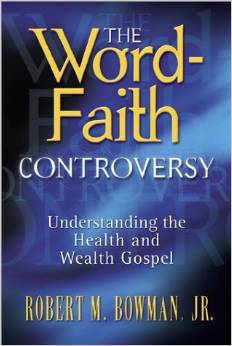
 Robert M. Bowman, Jr., The Word-Faith Controversy: Understanding the Health and Wealth Gospel (Grand Rapids: Baker, 2001), 254 pages, ISBN 9780801063442.
When I came across Bowman’s book The Word-Faith Controversy, I was very interested in his approach and conclusions because I had earlier done my Th.D. dissertation on nineteenth and twentieth century “faith theologies.” Bowman’s book is a significant contribution to the study of the Word of Faith movement. While not uncritical of the movement, he takes exception to many of the conclusions of Hank Hanegraaff (Christianity in Crisis) and D.R. McConnell (A Different Gospel). Contrary to Hanegraaff, he does not portray the movement as monolithic, but recognizes diversity and disagreement within the movement.
Bowman prefers to call E.W. Kenyon the “grandfather” of the Word-Faith movement, citing what he considers three other “fathers”: William Branham and the Latter Rain movement, Oral Roberts (whom he does not classify as Word-Faith), and especially Kenneth Hagin. He recognizes that Kenyon would not accept all that is taught in the Word-Faith movement (e.g., that God has a body or that believers are little gods), nor would Word-Faith leaders accept all that Kenyon taught (e.g., that tongues is not the initial evidence of the baptism in the Spirit). He concludes, “Kenyon is the source of most, but not all, of the distinctive and controversial teachings of the Word-Faith movement” (p. 38). Further, the Word-Faith teachers have sometimes gone beyond anything that Kenyon himself taught.
Taking a more scientific approach than McConnell and Hanegraaff, Bowman lists and compares 23 standard New Thought concepts with Christian Science and Kenyon. From this statistical analysis, he concludes that while there is much in common between Christian Science and New Thought, there is “little resemblance” between Kenyon and New Thought. Further, he concludes that Kenyon is “far closer to orthodoxy than is Christian Science” (p. 46). Kenyon may share some similarity with metaphysical thought, but his views are “fundamentally different” (p. 48). He demonstrates that McConnell’s methodology is faulty, and thus his conclusions regarding Kenyon’s connections with metaphysical New Thought are deeply flawed. While there may have been some metaphysical influence, Kenyon’s views are more unlike such concepts than like.
Bowman goes on to show that Kenyon’s teaching was rooted more in the pre-Pentecostal Higher Life, Keswick, healing and proto-Pentecostal movements. He cites examples of such teaching including Andrew Murray, Hannah Whitall Smith, Charles Cullis, A.J. Gordon, and others, especially concentrating on the teachings of A.B. Simpson and John G. Lake. He is less critical of the Keswick/Higher Life stream than Dale Simmons (E.W. Kenyon and the Postbelllum Pursuit of Peace, Power, and Prosperity), seeing less similarity between the Keswick/Higher Life tradition and metaphysical teaching.
Bowman then evaluates some specific Word-Faith teachings on the basis of Scripture and hermeneutics. In many cases, he concludes that much Word-Faith teaching is vague, inconsistent, contradictory, or unclear, sometimes suborthodox or aberrant, but not often as blatantly heretical as critics charge. Bowman acknowledges the movement has had some good fruit, but also much bad fruit.
Over all, Bowman has presented an irenic critique of the Word-Faith movement, with a more subdued, reasoned, and even-handed approach using scientific methodology and logic, unlike some of the harsh polemic rhetoric and diatribes of earlier critics. Bowman more accurately and fairly describes the Word-Faith positions in their contexts, without exaggeration and caricature. Significantly, Bowman at one time worked with Christian Research Institute (CRI) under Hanegraaff, yet disagrees with many of his conclusions.
Bowman makes a noteworthy point, mentioning that he had read a statement to a fellow-researcher at CRI, who then responded that the statement was heresy (p. 53). It was, in actuality, a statement made by Walter Martin, Hanegraaff’s deceased predecessor at CRI that was almost identical to a Word-Faith teaching condemned by Hanegraaff as heretical. My own research has turned up many such quotes from Spurgeon, Chambers, Simpson, Murray, Bounds, Tozer, etc., that sound virtually identical to statements made by Word-Faith teachers that have been condemned by their critics. Ironically, although Bowman has attempted to be even-handed with the Word-Faith teachers, some of what even Bowman calls “unbiblical” comes from these earlier classic evangelical writers.
In some areas Bowman continues to propagate mistaken conclusions of faith critics. For instance, Bowman perpetuates the error of McConnell and Hanegraaff that all translators and commentators deny the “faith of God” interpretation of Mark 11:22. While that may be the majority interpretation today, it is not the unanimous interpretation of scholars today, nor of evangelicals in the past. No less a theologian than McConnell’s faith critic mentor (and mine), the late Oral Roberts University professor Charles Farah, (Ph.D., University of Edinburgh), had accepted the “faith of God” view as valid.
Further, Bowman paints Simpson as a radical faith-curist opposed to all use of medicine and then shows strong similarity to Kenyon. What Bowman does not show (and perhaps does not know) is that even others outside of the faith-cure movement propagated similar teachings regarding healing, such as Spurgeon, Chambers, Taylor, and Bounds. A comparison of Murray and Simpson shows them almost identical in their beliefs of on healing, even though developed independently and almost simultaneously of each other. Simpson himself eschewed the term “faith cure.”
Being an ordained minister of the Christian and Missionary Alliance founded by Simpson, I have examined most of Simpson’s extant and non-extant writings regarding healing. While it may be true that Simpson was more radical in his views on healing in his earlier days, he and the C&MA modified their views as they matured. Contrary to the claim that he was totally against medicine, he and the C&MA viewed faith without doctors and medicine as an ideal, not as a rule. Bowman cites a seemingly radical statement of Simpson in his book The Gospel of Healing regarding doctors and medicine, but fails to recognize that later in the same book Simpson modifies his earlier statement, advising against presumptuous abandonment of medical treatment. Other writings of Simpson show that he was not opposed to doctors and medicine, assuring believers that there is an appropriate place and time for their use.
Additionally, Bowman makes a common mistake regarding Keswick teaching, saying that it rejected second-blessing theology and “advocated a model of progressive sanctification” (p. 64). In reality, there were several views within Keswick teaching, with the progressive sanctification model eventually taking the forefront. However, earlier Keswick leaders like Murray, Pierson, and Meyers taught a kind of second blessing, or subsequent crisis of sanctification, often called the filling or baptism of the Spirit.
Missing in Bowman’s book are references to two significant researchers of Kenyon, Joe McIntyre, author of E.W. Kenyon: The True Story,and Geir Lie, Norwegian Pentecostal scholar (Masters thesis, “E.W. Kenyon: Cult Founder or Evangelical Minister?”). Although McIntyre’s book is a non-critical defense of Kenyon, it is significant in that he does document Kenyon’s Keswick/Higher Life connections, which (along with Simmons and Lie) debunk the thesis of McConnell and Hanegraaff that Kenyon’s teachings are rooted in New Thought metaphysics. Nor does Bowman make mention of the Hagins’ modifications of their teachings, as can be seen in their books Take Another Look at Faith and The Midas Touch.
While I would not agree with all of Bowman’s interpretations and conclusions, I would concur essentially with his conclusion that the Word-Faith movement is “neither soundly orthodox nor thoroughly heretical” (p. 10). He has demonstrated inconsistent logic and bad fruit in some Word-Faith teaching, yet also the danger of too quickly labeling a statement as heretical.
Reviewed by Paul L. King