Michael Brown’s Authentic Fire, reviewed by Daniel Snape

Are Pentecostals offering Strange Fire? (Panel Discussion)
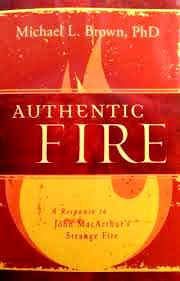
 Michael L. Brown, Authentic Fire: A Response to John MacArthur’s Strange Fire (Excel Publishers, Dec 12, 2013), 418 pages.
Authentic Fire is Dr. Michael Brown’s response to John MacArthur’s book Strange Fire. MacArthur’s Strange Fire launches a scathing attack on the Christian Charismatic Movement and so it comes as no surprise that champions of the charismatic community should launch a defense to MacArthur’s assertions. Dr. Brown leads the charge with a book just shy of 420 pages that seeks to address MacArthur’s main contentions.
Brown’s tone is always respectful towards MacArthur and even conciliatory at times. It is clear that Brown has ample respect for MacArthur, both as a Bible scholar and brother in Christ. His approach is refreshing when contrasted with MacArthur’s blanket criticisms. Beginning by acknowledging that the charismatic church has made mistakes and has its share of controversy, Brown never shies away from the reality that the charismatic movement is far from perfect. Nonetheless, within the first few pages, Brown make his position clear when he writes, “Pastor MacArthur’s criticisms of the Charismatic Movement are inaccurate, unhelpful, often harshly judgmental, sometimes without scriptural support, and frequently divisive in the negative sense of the word … a strong corrective is needed, along with a positive statement of the truth of the matter.” (p2). And thus the agenda is set and Brown’s mission is clear.
Brown begins by addressing a number of sweeping statements that can be found in Strange Fire. To counteract MacArthur’s claim that the Charismatic Movement ”has made no contribution to biblical clarity … interpretation … sound doctrine”, Brown cites many well-known and respected authors and scholars in the Christian world that blatantly contradict MacArthur’s bold claim. Among these are, A.W Tozer, Oswald Chambers, Craig S. Keener, Ben Witherington, N.T. Wright, Wayne Grudem and many others. Brown addresses MacArthur’s claim to guilt by association (the idea that if one is part of a movement that has involved scandal then one is guilty by association), and rightly points out that the pendulum can swing both ways, observing Luther’s anti-Semitism and Calvin’s draconian rules that led to men and women being burnt at the stake. Both Luther and Calvin are darlings of the theological world that John MacArthur walks in, and so Brown fairly asks if we should also associate MacArthur with such doctrinal errors.
Perhaps one of the real gems of Authentic Fire is chapter 6 in which Dr Brown addresses the theological debate regarding cessationism versus continuationism. Documenting his own journey into cessationism and back out into continuationism, Brown observes, “The more I read the Word wanting to prove cessationism true, the more I became convinced that it was exegetically impossible. The scriptures did not teach cessationism” (p165). Brown proceeds to do a convincing job of highlighting the major flaws of cessationism, insightfully noting that often this theological viewpoint is arrived at via subjective experience rather than biblical objectivity. The true value of this chapter, though, is the exegetical work Brown does in examining the miracles of Jesus and New Testament evidence to support the biblical argument for continuationism. No matter one’s position on this theological issue, Dr Brown’s treatment of the subject is worthy of attention to anyone serious about an honest biblical treatment.
As the book develops, it is clear that Brown has a genuine desire to address the seemingly divisive nature of Strange Fire. Taking the reader on a brief tour of church history that includes the aftermath of the Council of Chalcedon and the drowning of Anabaptists by misguided reformers, Brown makes allusions to present day criticism of MacArthur but assures the reader, “Now, to be perfectly clear, I am not comparing the Strange Fire movement to these murderous, dastardly acts. But I am saying that we need to step back in the midst of our self-confident divisions over ‘orthodoxy’ and start listening to each other and making efforts to understand each other before we pronounce each other hell-bound heretics. Surely there are lessons to be learnt from the past” (p231).
In chapter 9, Brown takes on a more personal tone, asking the question, “Are you enjoying real fellowship with God?” (p273). Sharing several personal accounts including his experience as a new believer, he contrasts this against MacArthur’s largely intellectual approach. “What about just having an overflowing outburst of love for Jesus,” Brown asks, “which doesn’t always come from a deeper “understanding of the truth of God?… Is the choice only between “shallow content- less, superficial hysteria’ and rich theology?” (p285-86). Using the context of worship, Brown questions the notion that one style of music or form of worship is more valid than another. There is much food for thought in this chapter but Brown emphasizes that Christians have a God who desires intimate relationship and that this cannot found through the intellect and reason alone.
Dr. Brown ends his book the way he began: with a voice of respect and desire for healthy reconciliation and debate. He also notes, though, that Strange Fire will likely have unintended consequences. Observing that one of the positive outcomes of the Strange Fire conferences will be charismatics looking “more seriously at some of their most glaring serious errors”, Brown further comments that “Everything else will result in the opposite of what was intended.” (p310). Time will tell if Dr. Brown is right or not, but what the reader is left with coming away from Authentic Fire is the seeming contrast of Brown’s honest and humble desire for open and healthy dialogue that both celebrates and criticizes, where necessary, the diversity of the church and John MacArthur’s apparent distrust and disapproval of such diversity.
Reviewed by Daniel P. Snape