As suggested by the title, Kostenberger’s interest in “excellence” has to do with Christian scholarship. For Kostenberger, Christian scholarship is the “pursuit of truth on mission for God in the world” (p. 66). The study of Scripture “must always lead to application” (p.80). The goal is “always obedience” as “there is no place in the Bible where God’s people are enjoined to study solely for the sake of study” (p. 80). The pursuit of excellence is different from the pursuit of perfection. Excellence is to not settle for mediocrity. It is pursued in order to fulfill one’s calling effectively, whatever that calling may be and to “bring glory to God.” Kostenberger’s purpose is “to identify, describe, and encourage those virtues essential to fulfilling the specific call to glorify God in the finest way possible through Christian scholarship. Rather than an end in itself, as adding to our own learning, Christian scholarship is a means of “engaging the unbelieving world with the truth of God’s gospel” (p. 65).
“As His divine power has given to us all things that pertain to life and godliness … so an entrance will be supplied to you abundantly into the everlasting kingdom of our Lord and Savior Jesus Christ.” 2 Peter 1:3,11
Kostenberger presents 2 Peter 1:3-11 as the inspiration, model and scriptural foundation for his entire book. He gains his title from Paul’s letter to the church in Philippi where he enjoins his readers to seek “excellence” (Philippians 4:8). Though the book’s content is concerned with excellence in Christian scholarship, it is not written in a scholarly manner. It is easy reading and lacks footnotes. It is also devoid of scholarly jargon. Excellence is directed to the informed Christian as much as it is directed to the college or seminary student or to their professor. This reviewer also finds the book beneficial for the preacher or evangelist who might want to write as well as speak. Kostenberger makes recommendations on pages 80 and 81 that are germane to speaking in public as well as to what is expressed in print.
Fundamental to “excellence” in Christian scholarship are holiness and spirituality and he relates them not so much to the process of communication as to the person who is doing the communicating. The character of the scholar “bleeds through” what one says or writes and can have either a positive or negative effect upon the hearer or reader. In part two of the book, Kostenberger identifies six different virtues that lead to vocational excellence. These are diligence, courage, passion, restraint, creativity, and eloquence. His recommendations are priceless. This reviewer encourages any would-be writer to take to heart what Kostenberger shares in this part of his book.
The pursuit of excellence is different from the pursuit of perfection. Excellence is to not settle for mediocrity. It is pursued in order to fulfill one’s calling effectively, whatever that calling may be and to bring glory to God.
The third part of the book identifies three virtues which lead to moral excellence. These are integrity, fidelity, and wisdom. “A scholar of integrity will excel and bring glory to God by consistently doing what is right”(p. 164). This reviewer recommends actually purchasing the book and not just checking it out from a library. There are many writing helps in Kostenberger’s Excellencethat you will want to refer to.
Andreas J. KöstenbergerThe areas of concern which particularly arrested this reviewer’s attention dealt with Christian scholarship in which there is disagreement with another writer’s findings. “Because it takes the form of genuine dialogue, scholarship needs to be more understated and focused on the issue and the evidence”(p.130). This came under the discussion on the virtue of “restraint.”
While footnotes are absent from this book, it does have notes on each chapter’s references. Kostenberger also includes an annotated bibliography, a general index, and a Scripture index.
This reviewer regards Kostenberger’s Excellenceas an invaluable tool and resource for student, preacher, professor, and would-be author.
Woodrow E. Walton, D.Min. (Oral Roberts University School of Theology and Missions), B.A. (Texas Christian University), B.D. [M.Div.] (Duke Divinity School), M.A. (University of Oklahoma), is a retired Seminary Dean and Professor of biblical, theological and historical studies. An ordained Assemblies of God minister, he and his wife live in Fort Worth, Texas. Walton retains membership with the Evangelical Theological Society, American Association of Christian Counselors, American Society of Church History, American Academy of Political Science, and The International Society of Frontier Missiology.
Independence is an American ideal, but God-dependency is a believer’s necessity. As Americans we are rightly proud of our Declaration of Independence. It took a lot of courage for those men in 1776 to declare their independence from the mightiest nation on earth at the time, realizing the great cost it would take to actually…
Christians need God’s power in order to live the way he intended. It is clear from the New Testament that the power of God is meant to accompany the gospel, and to find expression through its messengers and in the lives of those to whom the message comes. Each December, Time magazine produces a set…
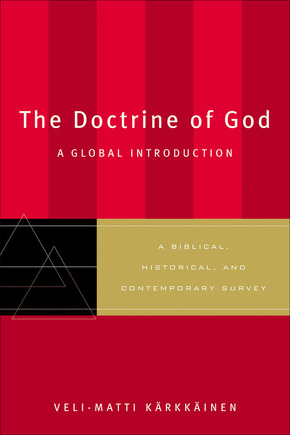
Veli-Matti Kärkkäinen, The Doctrine of God: A Global Introduction. A Biblical, Historical, and Contemporary Survey (Grand Rapids: Baker Academic, 2004), 315 pages. The Doctrine of God is one in a series of books published in recent years by Veli-Matti Kärkkäinen, a Finnish-born theologian who currently teaches at Fuller Theological Seminary. As the subtitle suggests,…
John G. Stackhouse, Jr., “The Seven Deadly Signs” Christianity Today (June 12, 2000), Pages 54-57. What is the mark of success? What is the sign of failure? In this article by John Stackhouse, we are given seven specific statements to measure if our business, ministry, or family is in danger of financial indiscretion. Stackhouse…
From the press release by Alliance Defending Freedom: “Two men filed a complaint with the state of Colorado after they asked cake artist Jack Phillips to design a wedding cake to celebrate their same-sex ceremony. In an exchange lasting about 30 seconds, Phillips politely declined, explaining that he would gladly make them any other type…
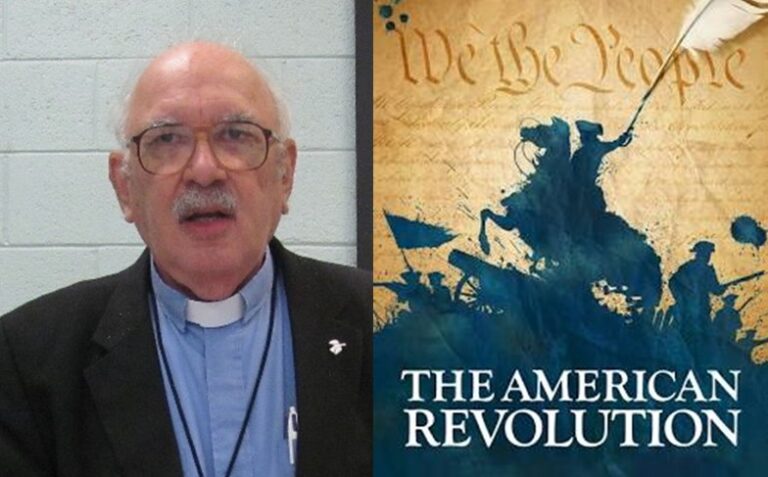
Ken Burns’ six-part, 12-hour PBS miniseries The American Revolution (premiered November 16, 2025) has received praise from most critics for its detailed presentation of the American Revolution, especially for its nuanced portrayal of it as a civil war involving three diverse groups: Indians, Loyalists, and Patriots. It has also drawn criticisms from conservative commentators, historians,…
To provide the best experiences, we use technologies like cookies to store and/or access device information. Consenting to these technologies will allow us to process data such as browsing behavior or unique IDs on this site. Not consenting or withdrawing consent, may adversely affect certain features and functions.
Functional
Always active
The technical storage or access is strictly necessary for the legitimate purpose of enabling the use of a specific service explicitly requested by the subscriber or user, or for the sole purpose of carrying out the transmission of a communication over an electronic communications network.
Preferences
The technical storage or access is necessary for the legitimate purpose of storing preferences that are not requested by the subscriber or user.
Statistics
The technical storage or access that is used exclusively for statistical purposes.The technical storage or access that is used exclusively for anonymous statistical purposes. Without a subpoena, voluntary compliance on the part of your Internet Service Provider, or additional records from a third party, information stored or retrieved for this purpose alone cannot usually be used to identify you.
Marketing
The technical storage or access is required to create user profiles to send advertising, or to track the user on a website or across several websites for similar marketing purposes.
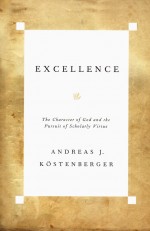

 Andreas J. Kostenberger, Excellence: The Character of God and the Pursuit of Scholarly Virtue (Wheaton, IL: Crossway, 2011), 270 pages, ISBN 9781581349708.
![Kost_books[1]](/wp-content/uploads/2013/08/Kost_books1.jpg)