Will the Real Paul Please Stand Up?

A review essay by pastor, scholar Tony Richie about the new perspective on Paul.

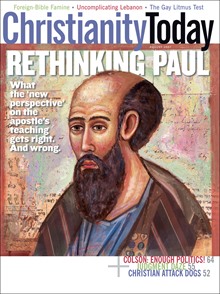
Simon Gathercole, “What Did Paul Really Mean?: ‘New perspective’ scholars argue that we need, well, a new perspective on justification by faith” Christianity Today (August 2007), pages 22-28.
Simon Gathercole is a NT scholar and former Senior Lecturer in New Testament at the University of Aberdeen, Scotland. In 2007, he joined the Faculty of Divinity at the University of Cambridge. Gathercole received his MA at Cambridge, and then completed a MATH and PhD under James Dunn, a renowned NT scholar himself, at the University of Durham. While Dunn is a founding proponent of the so-called “New Perspective on Paul,” Gathercole opposes it. Drawn from his dissertation, his book Where is Boasting? (2002), is a critique of NPP. In this succinct CT article, with a title probably playing on NPP advocate Tom Wright’s What Saint Paul Really Said (1997), Gathercole capably sums up the major issues at stake in the debate, and circumspectly presents his own view. He is appreciative of elements of NPP but ultimately rejects its fundamental thesis. Though at times technical (for those of us who are not NT scholars), as it touches on some of the most complex and important ideas in the NT and in Christian doctrine, especially the nature of justification and faith, this discussion will interest scholars and clergy alike, along with well-informed laity. I recommend it to readers of The Pneuma Review as an exceptional introduction/overview on a complex topic. It is probably not, however, fit fodder for the theologically faint of heart.
The CT editors do a good job of prefacing Gathercole’s article with some explanatory information that will help readers new to the discussion follow along. However, Gathercole himself is adept enough at putting NPP into perspective in the body of the article. One of the main aims of the editorial input is its framing of the debate in terms not confined to Reformed Christianity. Yet, as shown later this may be a debatable point itself. At its deepest level, this is a debate about the question: what is “truly biblical?” The author points out that NPP is not a new topic, but has been around for nearly 30 years (he does not mention antecedents around as early as 1900). It essentially argues that elements of the Protestant Reformation approach were “either wrong or ill-directed.” These concerns controversially include the doctrine of justification. Some Evangelicals, notably James D. G. Dunn and N. T. Wright, think NPP is “a key to unlocking Paul’s original intent.” Gathercole stresses that NPP is not really about Paul’s overall teaching; it is more narrowly about his doctrine of justification, in particular on justification by faith. It explicitly examines Paul’s understanding of works versus works of the law.
Accordingly, NPP understands faith as enabling Gentiles to enter the covenant apart from distinctive Jewish dietary laws, keeping of holy days, and the rite of circumcision. They do not so strongly juxtapose grace and faith with the righteous requirements of the law as expressed in its obligatory moral commandments. Nor do they so strongly juxtapose it with overall human acts of righteousness. These simply were not Paul’s central concerns in developing his doctrine of justification by faith. Gathercole, however, thinks all of this, though not an outright denial of the traditional meaning of justification by faith, is still a refocusing that relocates its accent elsewhere. For him, a close reading of Paul’s letters to the Romans and to the Galatians seriously challenges NPP’s assumptions and conclusions. However, he does not address Paul’s positive proclamations on good works and works of service suggesting Paul perhaps had a multifaceted view of works (e.g., Eph 2:10; 4:12; Pp 2:12-13). That such statements often occur in contexts of discussions of grace and faith challenges tendencies to define all works negatively as rivals to grace (cf. Rom 2:9-10; Titus 2:11-14). Is it just possible that Paul did not always mean only one thing by “works” or even “works of the law”? Is it possible he sometimes meant the one and sometimes the other? That does not fit with our desire for simplicity but it does fit with Paul’s reputation for complexity.
Gathercole does not deny any positive features at all for NPP. He thinks its inclusive accent on “the worldwide focus of God’s dealings in Christ” beneficial. He also applauds its “historical awareness of Paul’s situation.” Becoming more aware of the Reformers’ habit of sometimes reading into Paul their anxiety (and hostility) toward Roman Catholicism is a step in the right direction. Moreover, countering the traditional tendency toward “cheap caricatures of Judaism” is “an important contribution”. Yet he still insists that the oft-expressed high regard for the law in Paul as “holy, righteous, and good” (Rom 7:12) indicates he did not see it as simply “a body of petty rules and regulations”. Accordingly, Simon Gathercole lists “Six Tendencies” in which he judges NPP as at fault. First, though Protestant scholarship has exaggerated Judaism’s attempt to earn salvation through obedience to the law, reading ancient Jewish literature demonstrates they were not wrong about it altogether. Yet for Paul, salvation is simply impossible apart from the Cross, Resurrection, and Pentecost.
Second, that Paul understood the works of the law as only applying to circumcision, Sabbath observance, and food laws is insufficiently supportable from his own writings according to many Pauline scholars. Third, criticism of “‘individualistic’ readings” of Paul, miss his emphasis on personal conversion and faith. Even the Church is an assembly of individuals. Fourth, NPP confuses the “content” of justification with its “applications.” The inclusion of Gentiles is part of the scope of justification made possible by its core reality of how “believers, despite their sin, can be reckoned righteous before God.” Fifth and sixth, NPP tends to downplay sin and the need for doctrinal clarity. Even in efforts to be inclusive and unifying, facing these factors is still necessary. Gathercole, however, admits that NPP is diverse and some of these criticisms may not apply to all. For him, they do nonetheless bear watching.
In his strongest section, in the sense of affirmative accentuation, Gathercole argues that what the Bible says about justification is of paramount importance. Relying mostly on Romans, he concludes: “Justification, in which righteousness is reckoned to us, is both a legal declaration of our status and a statement about our relationship with God. People who are sinners are declared by God to have done all that he has commanded.” Since the debate is not only about justification but also about justification by faith, Gathercole further defines faith. First, faith is an attitudinal reorientation in which one recognizes “the futility” of one’s “own future without God and God’s help.” Second, faith is “also the response to God’s promises.” Third, faith “focuses not only on what God has said [God’s promises] but on God’s character.” For Gathercole, the works of the law are associated with “the flesh”, or the sinful and weak nature of fallen humanity. This includes specific deeds of the law as well as all human acts of righteousness. In his mind, only such a position protects the principles that salvation is “purely by grace”, that “God is the sole operator in salvation”, and that “he alone does the whole saving work.” He concludes, therefore, that the doctrine of justification “says sinners can be miraculously reckoned righteous before God”, and reiterates that this has nothing to do with the law or its works in any sense, that is, either ceremonial or moral. Again, as above, in the present article he does not address positive statements about good works or works of service in the Pauline corpus.
Yet how inclusive is this inclusivism? Is it inclusive enough for heirs of the Protestant Reformation and Roman Catholics to interact ecumenically? Recent developments suggest some room for rapprochement. Conversations between Eastern Orthodox, Roman Catholic, and Lutherans, suggest a move toward a more consensual view of salvation, including on the relations between forensic and effective justification (Veli-Matti Karkkainen, One with God, 2004). Incredibly, Hans Kung quite some time ago demonstrated that Catholic and Protestant views on justification are not as polarized as many propose (Justification, 1964). Is it possible that in the midst of all the angst and animosity of the Reformation some on both sides shared similar concerns and commitments? If so, the force of that conflict certainly overshadowed and overwhelmed them. Could it be that some degree of conciliatory recovery is possible today? Can the NPP help? Though Gathercole appreciates ecumenical inclinations in NPP, does he adequately address anti-ecumenical aspects of the traditional view? That the old view engages in eisegesis in interpreting Paul through reading back into him their contentions with Rome seems generally agreed upon by contemporary scholars of both positions. Going even farther, does it also misread Rome at important points as well? That the Protestant Reformation was justifiable (no pun intended) is not debatable for this reviewer. However, to what extent were the Reformers reacting against abuses that were also betrayals of the best of Roman tradition? The subsequent occurrence of the Catholic Counter Reformation suggests some feasibility to this possibility. To the extent that that may be so, reexamining justification cooperatively and objectively appears recommendable. NPP appears to offer some assistance here with Roman Catholics as well as on Judaism.
Nevertheless, “the old perspective,” an admittedly pejorative description implicitly signaling its own demise but which even its proponents use, is gallantly guarding against compromising essential traditional principles of the Protestant Reformation. No loyal Protestant can afford to take their concerns lightly. Yet casting this discussion in terms of fidelity to sola gratia (grace alone) is patently inaccurate. If I understand NPP devotees, they are not arguing for less grace but for more grace. In other words, they do not wish to minimize the Christian emphasis on grace at all, but rather to maximize Christian acceptance of grace in Judaism. Therefore, caricaturing NPP as laying less stress on grace is incorrect. It actually sounds more like a discussion about whether Christianity has a monopoly on grace. That is a different talk altogether. Even aside from Paul, the Scriptures support the existence of grace in ancient Israel prior to the rise of Christianity or the writings of Paul (e.g., Prov 3:34; Isa 26:10; Jonah 2:8). In fact, obviously Pauline arguments for grace arise out of the Jewish scriptures (cf. Rom 4-5; Gal 3:15-18). Judaism therefore clearly contains a traditional grace motif.
The preceding observation also applies to casting this discussion as a contest between faith and works. Neither does it appear to be the case, as is occasionally implied, that the old perspective values the Cross, Resurrection, and Pentecost more than the new. In other words, the debate between the traditional view and NPP is not (correctly) boiled down to a resurgence of the Pelagian-anti-Pelagian controversy. Gathercole rightly warns against the tendency to read into Paul later historical controversies. We might also warn against reading into contemporary controversies issues from earlier ones. Throughout Church history, some have found it convenient to accuse of Pelagianism or Popery anyone who disagreed with Augustinianism/Calvinism. For examples, though none takes it too seriously today, common charges against Arminius and the Wesleys in their own days were that they were secretly Pelagians or Papists. Part of the problem, of course, was/is that some are all-too-easily persuaded that only their own interpretations are completely compatible with Protestant orthodoxy. Gathercole does not take it that far but the assumption that only a certain version of Reformed theology properly represents Protestantism does seem implicitly evident.
Furthermore, if, as observed above, at its deepest level, this is a debate about the question of what is “truly biblical”, then both sides are making some helpful contributions. Increased attention to what Paul “really said” and “really meant” should only be helpful. This debate may proceed along the line that it is not entirely an either-or enterprise. Admittedly, some basic disagreements exist. However, that NPP does not so much disqualify the traditional view as it qualifies it more carefully, may be a possible conclusion to the discussion. This contention arises out of my major criticism of Gathercole’s article. Though it admits that NPP must not be “written off as a disaster from start to finish,” and even appreciatively enumerates several of its perceived benefits, when it comes down to stating its own view of justification and faith it sounds like the same old standard line. I cannot see how even its own admissions influence its eventual position. It seems if the concessions are so they ought to show. They do not.
Reviewed by Tony Richie
At the time of printing, the full article was available online: http://www.christianitytoday.com/ct/2007/august/13.22.html
Notes
[1] Don Garlington, In Defense of the New Perspective on Paul: Essays and Reviews (Eugene, OR: Wipf and Stock, 2005), viii + 245 pages. Read the full review by Amos Yong, as it appeared in the Fall 2007 issue of The Pneuma Review: /in-defense-of-the-new-perspective-on-paul-essays-and-review.