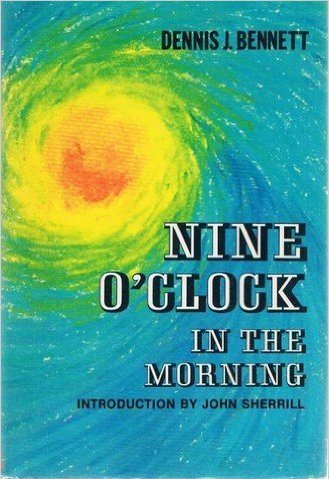
Classics of the Charismatic Renewal: Dennis Bennett, Nine O’clock in the Morning
Dennis Bennett, Nine O’clock in the Morning: The time when the Charismatic Renewal burst out.[1]
 By 1960, there were many mainline Christians in the United States who were “closet Pentecostals.” They received the Baptism of in the Spirit mostly from contact with such para-church groups as the Camps Furthest Out (CFO), the Full Gospel Business Men’s Fellowship International (FGBMFI), and Agnes Sanford’s Schools of Pastoral Care.[2] (Sorry, the OSL was slow in this area and closed to the gifts of the Spirit for decades.) Other Christians came into the fullness of the Spirit through direct prayer encounters with God, as in the case of Rufus Moseley.[3] Most had learned to be prudent in manifesting the gifts of the Spirit in their mainline churches lest they be thrown out or ostracized as “weird.”
Some of those who received the baptism of the Spirit during the 1930s to 1960 were ministers or pastors within the mainline churches, and this posed a special problem for them. They were often asked to resign their charges or leave their denominations if they persisted in their Pentecostal ways. But a few ministers were able to keep their positions despite their Pentecostalism.
The years of “closet Pentecostalism” came to an end when the Episcopal rector in California decided to inform his congregation that he had received the gift of tongues. The subsequent chaos and publicity were providentially molded into what became the start of the “Charismatic Renewal.” The rector, Fr. Dennis Bennett, had begun his church ministry as a Congregational minister before becoming an Episcopal priest in 1950. He was well versed in theology and solidly orthodox in belief.[4] He was called to St. Mark’s in Van Nuys, California, where he presided over a growing and affluent congregation.
In 1959 several members of a nearby Episcopal parish received the baptism of Holy Spirit from Pentecostal friends and were holding “tongues” prayer meetings. The vicar of the church, Fr. Frank Maguire, asked Fr. Bennett to investigate and give his opinion. Fr. Bennett went to see the couple who led the prayer group. After weeks of conversations with them, and of reviewing church doctrine of the Holy Spirit, re-reading the Book of Acts, as well checking the Book of Common Prayer, he concluded that the Baptism of in the Spirit and tongues were legitimate. By November of 1959 both he and Fr. Maguire received the Baptism in the Holy Spirit. The prayer group expanded to include members of St. Mark’s.

Fr. Bennett attempted to keep everything low-key as the renewal continued to spread in his parish. But rumors and exaggerations also began to spread. To clarify the situation, Fr. Bennett felt it was important to go public, and he did so on Sunday, August 3, 1960.
I set aside the preaching scheduled for the day, and went into the pulpit at the three morning services and simply shared what had happened to me. I appealed to the people to dismiss the ridiculous rumors.
The general reaction was open and tender – until the end of the second service. At that point my second assistant snatched off his vestments, threw them on the altar and stalked out of the church, crying, “I can no longer work with this man!”
That blew the lid off. After the service concluded, outside on the patio, those who had set themselves to get rid of the movement of the Holy Spirit began to harangue the arriving and departing parishioners. One man stood on a chair shouting, “throw out the damn tongue-speakers!”
…The contrast was amazing. On the one hand was the unreasoning fury of the “opposition,” while the people who had received the Baptism of the Holy Spirit were quietly moving around telling their story, faces shining with the love of God.[5]
The treasurer and one of his vestrymen joined the opposition and asked Fr. Bennett to resign. Fr. Bennett announced his resignation at the third service. He did not have to but felt he needed time to sort out his wonderful but revolutionary experiences of the past months.
One of the lay leaders at St. Mark’s and among the charismatics, Mrs. Jean Stone, had excellent social and press connections and managed to get national press coverage of Fr. Bennett’s dramatic Sunday in both Newsweek and Time. The Newsweek article headlined “Rector and a Rumpus” (July 4, 1960). Both articles presented the appearance of Pentecostalism at St. Mark’s in surprisingly positive terms. The Time article began:
The early Christians were much impressed by the phenomenon known as glossolalia (literally, “speaking with tongues”), which appeared at the first Pentecost: “And they were all filled with the Holy Ghost, and began to speak with other tongues, as the Spirit gave them utterance.” To the skeptical, the “other tongues” sounded like gibberish, but the faithful found special meanings in the spontaneous outpouring of sounds.
Peter saw the “gift of tongues” in a group of Gentiles as evidence that the Holy Ghost was present, and they should be baptized forthwith. Paul cited it as a notable Christian gift, and though he had it himself (“I thank my God, I speak with tongues more than ye all”), he warned in his first letter to the Corinthians against letting it get out of hand. The general practice lasted into the 3rd century. Now glossolalia seems to be on its way back in U.S. churches—not only in the uninhibited Pentecostal sects but even among Episcopalians, who have been called “God’s frozen people.”[6]
Shortly thereafter, Mrs. Stone organized the Blessed Trinity Society to promote the Pentecostal experience among Episcopalians. The society published various pamphlets on Holy Spirit baptism and Trinity Magazine, and mailed it to extensive list of Episcopalians all over the country. When Dennis Bennett’s witness of how he received the Baptism in the Holy Spirit appeared in Voice Magazine (The FGBMFI journal) the society mailed a copy of the magazine to every Episcopal priest in the country. For five years Trinity and Voice magazines were the only non-Pentecostal magazines that advocated practicing of the Gifts of the Spirit. The Blessed Trinity Society organized meetings and conferences on the Holy Spirit which attracted persons from many denominations.
After Fr. Bennett resigned from St. Mark’s, the Episcopal bishop of Olympia (Washington State) invited Fr. Bennett to take over a small parish in Seattle that was on the verge of closing, St. Luke’s. Bennett accepted the charge and, in a year, increased the membership from seventy-five to over three hundred. More importantly, St. Luke’s became the center of the new Pentecostalism for much of the West Coast. Visitors came to see what tongues were about, or to attend the conferences Fr. Bennett organized on the Gifts of the Spirit. Fr. Bennett also received invitations from all over the country, including many FGBMFI chapters and conventions to share his testimony and experiences as an Episcopalian openly living the Spirit-filled life. At first, these new Pentecostals in the mainline churches, like Bennett, were called “neo-Pentecostals” – an accurate if clumsy name. “Charismatic” was suggested by the Rev. Harald Bredesen in Trinity Magazine and this word soon gained acceptance.
A factor for the wide success of the Charismatic Movement was Fr. Dennis Bennett himself. He was the Episcopal rector out of Hollywood central casting: handsome, dignified, theologically well educated, and a great speaker. He could explain how the Baptism of the Holy Spirit was not only good theology, but how it could help every congregation and denomination of the mainline churches. Significantly, he also reassured his fellow Episcopalians that there was no conflict between being filled with the Spirit and the great liturgies of the church. In fact, one complimented the other. He related that one Sunday, when his assistant was celebrating the liturgy at St. Luke’s, he sat in the congregation with his family:
As I listened to the familiar words of the Book of Common Prayer, and the readings of the Scripture lessons, I was suddenly overwhelmed by the beauty and significance of it. For the first time in my life, to my remembrance, I was moved to tears by a church service!”[7]
In 1973, Bennett and several others initiated Episcopal Renewal Ministries (ERM), an organization dedicated to spreading the charismatic renewal among Episcopal churches.[8] It did this through conferences, literature and through its journal, Acts 29. ERM met with a good degree of success, and by the 1980s over 500 Episcopal parishes were renewed—their clergy and member were predominantly charismatic. Unfortunately, the number of renewed parishes was insufficient to turn around a denomination that numbered over 8,000 parishes and was becoming among the most theologically liberal and apostate of the mainline churches. This was mostly due to the fact that the ERM did not make major headway in altering the various Sadducean, anti-supernatural theologies that were rampant in Episcopal seminaries.[9]
By the mid 1960’s the example of the charismatic renewal in the Episcopal Church had helped rally the closet charismatics in other denominations to form alliances and organizations within their own denominations. Larry Christenson led the Lutherans, Tommy Tyson the Methodists, Harold Brown the Presbyterians. Even some Baptists, generally the most strongly cessationist of Protestants, began coming into the renewal.[10]
Nine O’clock in the Morning has become a classic of the Charismatic Renewal and should be read by all Spirit-filled Believers. It presents and understandable and easy to read account of how the Charismatic Renewal burst out into the public – one of the most important events in modern Church history. The book is especially important for liturgical Christians (Roman Catholic, Episcopal, Anglican. Lutheran, etc.) who might fear that embracing the Gifts of the Spirit will somehow diminish sacramental and liturgical worship and all its beauty. That is disproven today by the fact that there are many vigorously charismatic and liturgical/sacramental churches throughout the world. In fact, there are several “Anglican type” denominations that have been established to live out the fullness of Spirit-filled, plus sacramental/liturgical, plus evangelical life. The first one was the CEC, followed by the denomination I was ordained in the CEEC, the Communion of Evangelical Episcopal Churches.
Further Reading
Historian William De Arteaga introduces us to the beginning and early years of the Charismatic Movement, when Pentecostalism and the gifts of the Spirit publicly and dramatically entered into the mainline churches. [Editor’s note: This article about Dennis Bennett and his Nine O’clock in the Morning is an updated excerpt from this 2016 article.]
Demos Shakarian and His Ecumenical Businessmen
Historian William De Arteaga introduces us to the Full Gospel Business Men’s Fellowship International and its founder, a ministry that has brought the gospel to millions of men all over the world and introduced them to the contemporary ministry of the Holy Spirit.
Agnes Sanford: Apostle of Healing and First Theologian of the Charismatic Renewal
Christian Historian William De Arteaga introduces us to Mrs. Agnes Sanford, who played a significant role in moving many Christians within the mainline churches away from cessationism, led them to the pastoral practice of healing prayer, and introduced many to the gifts of the Spirit.
Notes
[1] There are now many fine studies of the Charismatic movement from various perspectives, among the best are Peter Hocken’s, The Glory and the Shame: Reflections on the 20th Century Outpouring of the Holy Spirit (Gilford: Eagle, 1994) and the more recent work by Vinson Synan, An Eyewitness Remembers the Century of the Holy Spirit (Grand Rapids: Chosen, 2101). Both authors played significant roles in the renewal, with Dr. Synan being perhaps one of most important facilitators of the renewal.
[2]I have given details of both the CFO and Agnes Sanford’s Schools of pastoral Care in my work, Agnes Sanford and Her Companions: The Assault on Cessationism and the Coming of the Charismatic Renewal (Eugene: Wipf & Stock, 2015) chapters 14 and 18.
[3] On the pivotal importance of Rufus Moseley, see my Agnes Sanford, chapter 14.
[4] For an excellent overview of the Charismatic Renewal in the Episcopal Church see: Dr. William Faupel, “Touched by the Wind: The Charismatic Movement in the Episcopal Church,” Pneuma Review, posted 8/20/2000.
[5] Dennis Bennett, Nine O’clock in the Morning (Plainfield: Logos International, 1970), 75.
[6] Time, August 15, 1960.
[7] Bennett, Nine O’clock, 59.
[8] Initially called “Episcopal Charismatic Fellowship’ it changed its name to Episcopal Renewal Ministries to avoid complications with the word “charismatic” had in the eyes of many of the more traditional Episcopalians. In 2001 it changed its name again to “Act 29 Ministries” as the Episcopal Church imploded in heresy and apostasy.
[9] On this see my work, Agnes Sanford, chapter 5, “From Cessationism to Secularism,” and chapter 23, “The Villains in the Story.”
[10] For instance, Dr. Howard Irvin, one of the earliest charismatic theologians, was a Northern Baptist pastor.