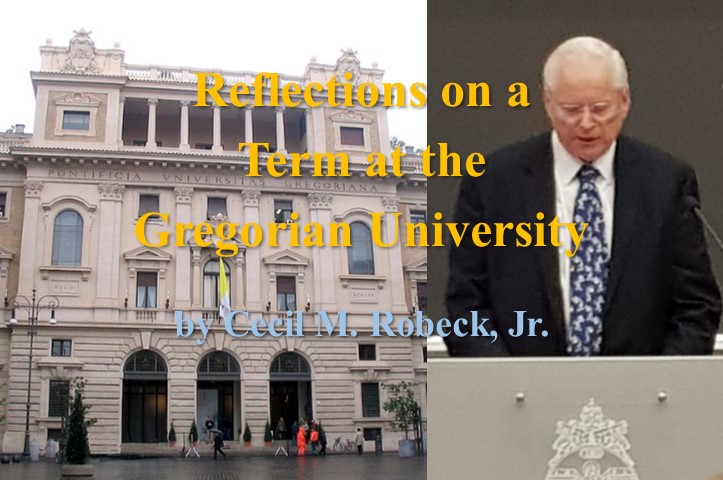
Reflections on a Term at the Gregorian University

A Pentecostal in Rome: Fuller Seminary Professor Mel Robeck shares his story about teaching a course at the Gregorian University in early 2018.
 Over the past thirty-one years, I have flown 127 round trips between Los Angeles and Europe. Eighteen of those trips have been to Rome, nearly all of which included work with the Catholic Church. During these years, I have met with and spoken for many different Catholic groups, such as the Focolare Movement, the International Catholic Charismatic Renewal Services Committee, the Chemin Neuf community, the Community of Sant’Egidio, the Pontifical Council for Promoting Christian Unity, and several others. I have been privileged to have thirteen papal audiences with Popes John Paul II, Benedict XVI, and Francis. I traveled with Pope John Paul II and with Pope Benedict to Assisi, where we prayed for world peace. I sat on the platform in front of St. Peter’s Basilica during the inauguration of Popes Benedict XVI and Francis, and listened as they preached their first public sermon as Pope. I processed into worship services with John Paul II and Benedict XVI, where I was invited to offer public prayer or lead the congregation in the Creed. I have learned much from all of these events and meetings. I have never sought any of these privileges. I view them solely as manifestations of God’s grace in my life that are consistent with His calling for me to work in the field of ecumenism.
About three months later, the Dean withdrew the invitation with deep apologies. I was informed that Dr. McCarthy, who funded this visiting professorship was dying, and because his medical expenses had run so high and he was trying to get his fiscal house in order, he had announced that he could not afford to provide the funds for my course. I was disappointed, of course, but I felt for the McCartney family at this time of loss. There was no further follow-up on this invitation. Dr. McCarthy died, and within three or four months, the Dean, Fr. Donath Hercsik, S.J. died suddenly at age 45. I had not given any further thought to teaching at the Gregorian.

Image: Luigi Santoro, Wikimedia Commons
On November 27, 2016, I once again received a letter from the Gregorian. This one came from Professor Fr. Felix Körner, S.J, who invited me to offer a course under the auspices of a five-year Atelier Ecumenico or “Ecumenical Workshop” grant. He had no knowledge of my previous contact with the university’s Dean. He requested that I offer a course on Pentecostalism for students in theology during the 2017-2018 academic year. The invitation came at a moment when I had just chosen to change my status at Fuller to Senior Professor of Church History and Ecumenics and Special Assistant to the President for Ecumenical Relations. The seminary gave me a multi-year contract, with substantial guaranteed funding for all of my ecumenical meetings and relief from all faculty meetings and committees. After some discussion with Professor Körner, I agreed to offer a course titled “Global Pentecostalisms: Developments, Doctrine, and Dialogue”. At the same time, Professor Körner invited me to prepare a “Public Lecture” on some aspect of ecumenism that would be given at the Gregorian sometime during my time in Rome.
The university provided my wife, Patsy, and me with an apartment in a small student community known as the Lay Centre. It is located on a hill overlooking the nearby Coliseum. It was about a ten-minute walk from the Lay Centre, which is home to about two dozen students from all over the world, studying various subjects in different Roman universities. They came from Slovenia, the Ukraine, Italy, Greece, Norway, England, Syria, Egypt, Nigeria, Malawi, Cameroon, China, Brazil, and the US. Patsy and I thoroughly enjoyed our time living, worshipping, and eating with these students. Many of them were both studious and highly committed to the Lord as well as to their church. Others struggled with what it means to be Catholic. Some were Orthodox. One was a Muslim. Patsy and I often sat at separate tables, changing our conversation partners throughout the nine weeks we were there. We listened as they told of their hopes, their fears, and their dreams. We shared our faith, gave advice when asked, and prayed with them. They viewed us as a new set of parents.

The Lay Centre occupies two floors in a building owned by the Passionists, an order whose members vow to bear witness to the passion of Jesus every day. The grounds are beautiful, covering several acres with lawns, trees, and various gardens. It sits quietly behind a twelve-foot high wall with a steel gate controlled with a code. In spite of its peaceful surroundings, the Lay Centre offers several public gatherings each month, which draw people such as Archbishop Bernard Ntahoturi, from Burundi, head of the Anglican Centre in Rome and his wife, Mathilda, and Dr. Timothy Maquiban, Pastor of the Ponte Sant’ Angelo Methodist Church, and his wife, Angela.
It is about a two-mile walk from the Lay Centre to the university. Upon my arrival, I was given an office and a library card, and I was shown my classroom. That evening, Patsy and I enjoyed dinner with Professor Körner and about 70 Jesuit priests in their private dining room at the Gregorian. Professor Körner announced everywhere that I was the first Pentecostal professor ever to offer a course at any Pontifical University. He is very proud of this “first”. He is a very warm, affable, and a delightful conversation partner and host, whose specialty is Catholic-Muslim relations.
I had several surprises that came from the lack of clear communication on the part of the university. We arrived in Rome on the day specified in my letter of invitation, only to find that they had given me dates from the 2016-2017 calendar while the course would begin one week later in 2017-2018, so we were a week early. Second, while my course, which met from 10:30 AM-12:15 PM each Monday and Wednesday was published on the Gregorian website, no one informed me that the university would be closed during Holy Week (between Palm Sunday and Easter) as well as Easter week. As a result, we had to extend our trip by two weeks in order to complete the course that I had outlined. Fortunately, I had the space in my calendar to do so.

Image: Wikimedia Commons
In all of my trips to Rome in the past, I have spent perhaps 3 days sightseeing. Mostly, I have known the road from the airport to the Vatican, and a series of rooms inside the Vatican such as Santa Marta house, where Pope Francis now lives, and various convents, abbeys, and retreat centers around the city. I had hoped that since I was teaching two days a week, I would have some free time to look around the city. That was not to be. I learned on the first day of class that my students had no textbooks. The university had failed to order any of the five books I had twice requested that they order, and their library did not have any copies either.
Since the students had no textbooks, I loaned out the 15 or so books I had brought with me for research, and I sent them a 300-page bibliography on “Pentecostalisms” that I use in the course I teach at Fuller. As the course continued, I ended up preparing nearly 300 pages of extended typewritten notes covering the lecture material, many of them from scratch. That meant that nearly all of my free days were spent preparing lectures. In the end, I had only a day and a half to look around the city. Still, the students loved the notes and were effusive in their appreciation of the work I have done on their behalf. I sent out the notes one or two days before each class, which gave us the opportunity to talk specifically to issues raised by my material, as well as new insights or concerns that they had.
The course began with an introduction and a definition of terms, an overview of the Pentecostal pre-history in the Wesleyan-Holiness tradition, and the cultural context in which it emerged. We talked about the revivals that occurred both immediately before and immediately after 1900 around the world. We went on to explore various models of theological development, especially related to baptism in the Spirit, evangelization and mission, disputes over sanctification and the nature of the Godhead, and the nature of the four/fivefold Gospel. We looked at a range of Classical Pentecostal denominations and organizations such as the World Assemblies of God Fellowship, the Church of God in Christ, the Church of God (Cleveland), the International Church of the Foursquare Gospel, the Apostolic Faith Mission of South Africa, and the Pentecostal World Fellowship. We talked about the various approaches to polity found in Pentecostal churches around the world, from the radical congregationalism found in Scandinavian churches, to the episcopal model found in the Pentecostal churches stemming from Methodism and the Holiness Movement, as well as the mix of Congregational and Presbyterian models in the Assemblies of God. We looked at the impact of the Latter Rain revival of the late 1940s. We talked about the nature of Pentecostal worship.
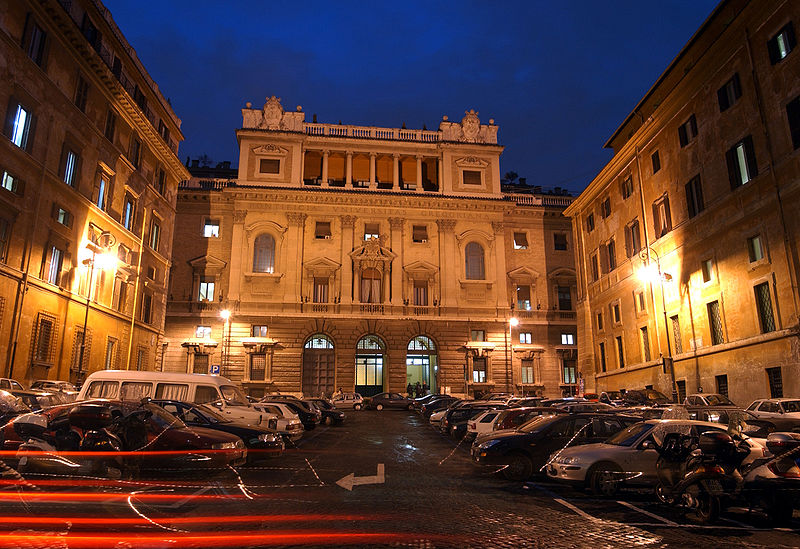
Image: Wikimedia Commons
Most of my students were Catholic priests. Some were diocesan priests, others were either Jesuits or they came from another smaller community or order. They came from Cameroon, Malawi, Vietnam, Ireland, Italy, Israel, and the United States. I also had one Jewish student. He was a PhD student at the Hebrew University in Jerusalem. His mentor sent him to the Gregorian so that he could learn something about Christianity. His dissertation topic will be on Pentecostal and Charismatic churches in Israel. He was very excited as he told me how his mentor in Jerusalem had sent him to the Gregorian to study Christianity. When he saw my course on Pentecostalism and found it was available in English, he was ecstatic! “What a coincidence that the Gregorian would offer such a course at precisely the time that I need it”, he informed me. I responded with, “I don’t really believe in coincidence. I believe that it was God, who brought us together”. In any case, he is not a Christian convert, though he attends a large charismatic church in Jerusalem, is enjoying it very much, but needs to understand it better. He was constantly asking questions about Jewish-Pentecostal relations, Pentecostal understandings of “eschatology”, and Pentecostal views on “replacement theology”.
All of my students were anxious to take what they were learning and apply it at home. One priest from Ireland has been a missionary in Beijing for the past twenty years. One morning, he asked me if I had ever heard of a Pentecostal minister named Rob Burkhart. He and Rob were neighbors in Beijing. When I told him that Rob had been my neighbor years ago when he was a student at Fuller, he practically fell over. “Two of the biggest life-changing influences in my life”, he reported, “are Rob and you. And it is amazing that the two of you should know one another”.
 One of the biggest surprises that I faced was how bad the weather was. For the first 35 days or so, it rained heavily for 85 to 90% of the time! I was beginning to feel a bit like Noah. They tell me that this much rain is unusual. I live in southern California, so with temperatures hovering at 50 degrees, I was forever freezing! Rain was not enough, however. We had 6 inches of snow on Sunday night, February 25! On Monday morning, I slogged my way the two miles up and down hills on cobblestone streets in borrowed shoes. When I arrived at the university, the guard informed me that it was a “snow day” and the university was closed. Why, I wondered, didn’t anyone call to let me know? I turned around and slogged back to the Lay Centre and climbed back into bed to thaw out. As I walked past the Coliseum, there were hundreds of people, children to adults and from many countries, having a massive snowball fight. People on surrounding roofs were tossing them down on those of us walking below. A little bit of snow had turned everyone into children once again. The next day, the snow had turned to ice, and I slipped and slid to the university. Fortunately, I had a good class that Wednesday. The temperature had risen to 65 degrees – almost beach weather!
As I noted earlier, a number of people in Rome know who I am. Many of them have followed my writings on issues of interest to Catholics. Patsy and I visited the Pontifical Council for Promoting Christian Unity, which oversees the Catholic – Pentecostal Dialogue, where we spent a morning with Monsignor Juan Usma Gomez, a Colombian priest who oversees all dialogues with Pentecostals, Charismatics, and Evangelicals for the Vatican. Bishop Brian Farrell, a longtime friend and Secretary of that office met with us for two hours, and Cardinal Koch, the President of the office took time out to have coffee with us.
Professor Teresa Francesca Rossi, Assistant Director of the Centro Pro Unione, an ecumenical think tank in Rome, also teaches theology at the Dominican run Pontifical University of St. Thomas, otherwise known as the Angelicum. She invited me to give a 75-minute lecture on “Pentecostal Preaching” followed by a 45-minute time for questions and answers with about 20 students on March 13.
Pentecostals anticipate that from the invocation through the benediction, the Holy Spirit is both present and waiting to speak. It may come through a charism of speech or more commonly in Pentecostal preaching. They believe that God will speak through the preacher by means of the Spirit. They not only listen to the words spoken by the preacher, but they listen for the voice of the Holy Spirit who leads the preacher. The sermon is a place of Divine – human encounter. They believe that they are in the presence of God as the Word of God is preached.
I went on to speak about various preaching forms and the styles of preaching found in Pentecostal churches. I told them that it ranged from a “jumble of Scripture and shouting” to well-planned expository sermons, to sermons based upon the preacher’s personal testimony, sermons that work on solutions to daily problems, as well as topical studies. I explained that Pentecostals do not usually follow a lectionary, so sometimes pastors preach on their hobbies, or from the Pentecostal “canon within the canon”, the Book of Acts, 1 Corinthians 12-14, Romans 12, Ephesians 4, and 1 Peter 4:10-11. As a result, many Pentecostal congregations are not well rounded. Many years ago, Dr. Russell Spittler noted that Pentecostals place a high value on spontaneity.[1] I noted that
Spontaneity is valued because Pentecostals believe that it signals the openness of the People of God, both preacher and congregation, to the interventions of the Holy Spirit. As a result, Pentecostals often protest against preaching based upon manuscripts. They prefer to hear a thoughtful sermon that has been prepared in a meeting between God, the biblical text, and the preacher, one that may follow a simple outline, but which allows space for the Holy Spirit to take the initiative and move among the people of God at any given moment during its delivery.
I also explained that Pentecostal pastors learned how to move and in some cases manipulate people from studying Charles G. Finney, and his appeal to the emotions. Finney argued that if he could get his audience to laugh, or to cry, to feel happy or sad, or if he could strike fear in their hearts, such things would open the hearts and minds of the people to hear the Gospel message, to repent, and to be “born again”. Many Pentecostal preachers understand and work with this method still.
I pointed out that ignorance is not a Pentecostal virtue, even though many Pentecostals still do not trust those with formal theological training. This leads to obvious challenges that Pentecostal preachers face. The limited amount of education that most Pentecostal pastors have when compared to the clergy in most other denominations is revealing.[2] The need for a specific, formal, rigorous, theological education and the elements that are part of that education varies from culture to culture. A robust theological education may provide its recipients with tools that can make them more effective in a wider range of ministry opportunities than if they would have without it. On the other hand, just because one has received such an education, does not guarantee that the recipient will become a great preacher, pastor, or leader. The same is true for one who has little more than a Divine call and a compelling testimony. Still, for Pentecostals, these latter two factors are typically valued more than is a formal education, though they may limit the preacher in what issues he or she might address effectively.
I closed with some reflection on the relationship between the Holy Spirit and the Word of God. The Holy Spirit played an active role in its writing of Scripture, and the Holy Spirit of God continues to play an active role in its application to the hearts and lives of people. The Holy Spirit takes the text and transforms it into a living and life-giving testimony to Jesus Christ. Through this means, the Spirit transforms the lives of those who read/hear it.
For Pentecostals, preaching is a complex activity that seeks to carry the message that God wants the world to hear. It begins with God’s loving Word, spoken to a fallen human race that declares His love for us. It demonstrates the extent to which God has gone to pay the cost of our redemption and restoration through Jesus Christ. It is a living Word because the Holy Spirit was present in its writing, is present in its application, and is also present in the signs and wonders that confirm the Word as it is preached. In the end, a mutuality emerges when God gives the Word, the Holy Spirit enlivens it, the preacher proclaims it in the power of the Spirit, and the community hears the Word as it is proclaimed in words accompanied by signs and wonders.
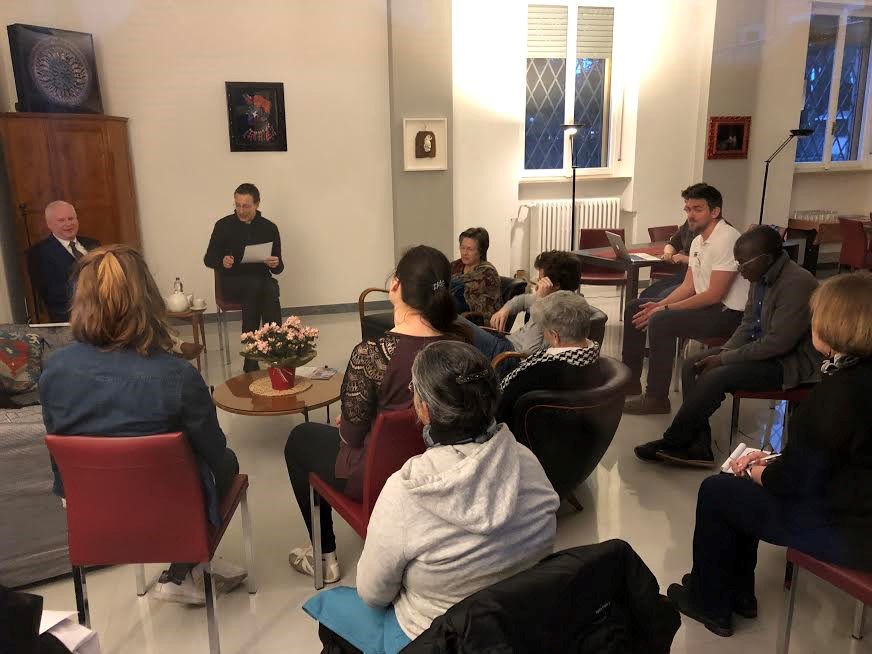
Later that evening, Professor Körner and I engaged in a discussion at the Lay Centre on “Interfaith Dialogue through and Ecumenical Lens”. There were about 20 students present, along with a few other guests. Two nuns and two laywomen from the class at the Angelicum came for the discussion as well.
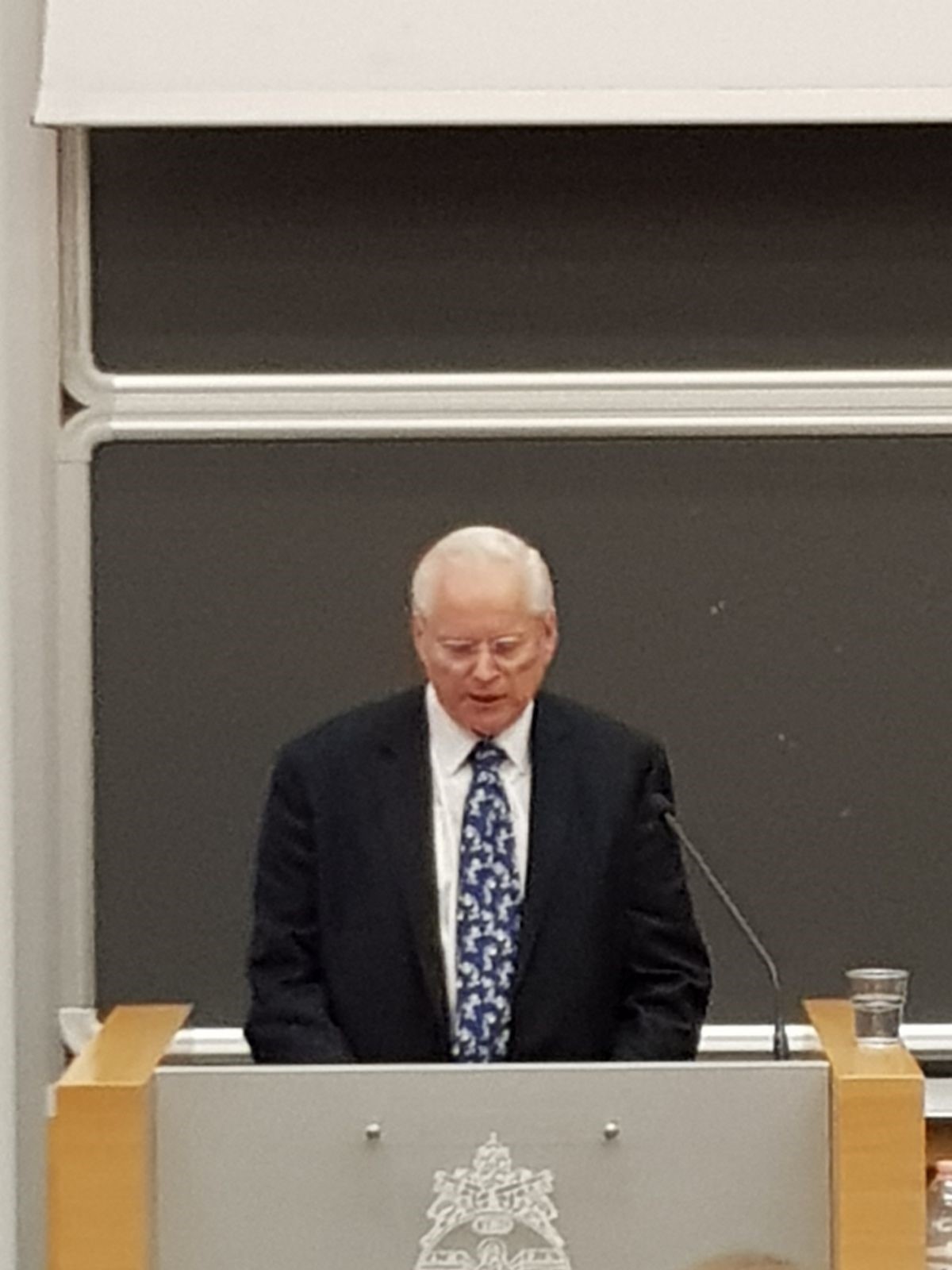
One of the highlights was the opportunity for me to give a public lecture at the Gregorian on March 19. The Gregorian advertised the lecture with large posters placed throughout the academic community, at the Lay Centre, in various Vatican offices, among the Jesuit and Dominican communities, and among other communities like the Focolare and Chemin Neuf. About 100 people attended, including some of the Gregorian’s Jesuit community. Some of my students attended, as did others from schools such as the Biblicum, across the street, and the Angelicum. My address was titled, “Can We Imagine an Ecumenical Future Together?” It lasted 75 minutes followed by 45 minutes of Q and A. The discussion was rich. There were many positive comments. Many of those who spoke said that they had been challenged to think differently about Pentecostals and noted that they had learned something new. [Editor’s note: For what may be a limited time, the flyer about this lecture is here. Read the PneumaReview.com announcement about this lecture.]
I began the paper, reading from Matthew 16:1-4 (NRSV), in which the Pharisees and Saducees, wishing to test Jesus, asked Him for a sign. Jesus refused to give one, saying that they had failed to read the signs they already had. I then asked whether such signs exist today and if so, what are they, and are we reading them as we should. I mentioned, for instance, the massive global migration currently in process, new challenges to various cultures as a result of this movement, and the persecution of religious minorities like the Rohingas in Myanmar. I made the point that at the beginning of the Pentecostal Movement, there were those who believed that the very existence of this Movement was a sign of the imminent return of the Lord. I outlined the classic Restorationist reading of history, played so well by Aimee Semple McPherson in her annual sermon, “Lost and Restored”.
In some ways, Pentecostals are not really Protestants. We did not emerge until 400 years after the Protestant Reformation. The fights of the 16th Century are not necessarily our fights. Because most churches rejected us, we have often stood against the whole Church, not merely the Catholic Church. I explained that Charles Parham, William J. Seymour, and Warren Carothers suggested that the Pentecostal Movement was a sign not only that the Second Coming was imminent, and that the unity of the Church was now possible, but that Pentecostals believed that they were the key to that unity.[3] The earliest Pentecostals sought to avoid the deadness that they saw in many churches, and the wildfire that they saw in others.[4] They tried to promote a middle way between the two.
The next section I told them that an Oxford professor had prodded me to think new thoughts when he responded to the question, “How do you see the future of the Church”? He began by saying, “In 300 years, there will only be two religions left in the world. One will be Christianity and the other will be Islam.” He went on to claim that the only Christian Church that would survive was the Catholic Church. That conversation led me to ask what I thought was an obvious question regarding the hundreds of millions of Pentecostals and Charismatics. Where do they end up? His response was that they would find their home in a restored, revivified Catholic Church.
As I have pondered these statements since I first heard them over a decade ago, I have become convinced that such a scenario is, indeed, possible. As a result, I tried to demonstrate how I thought this scenario might play out. First, the level of rapprochement between the Orthodox and Catholic Church in 2018 is remarkable when compared to the events that split the Church in 1054. The Ecumenical Patriarch, Bartholomew, and Pope Francis continue to work on issues between them. The Moscow Patriarch, Kirill, and Pope Francis are enjoying a better relationship. The fact that an initial “Pan-Orthodox” meeting was undertaken in 2016, though without the full participation of Russia are all evidence of new possibilities for future recognition between East and West. Is it not possible to imagine a reunited Eastern and Western, Orthodox and Catholic Church in 300 years? [Editor’s note: Read Harold D. Hunter’s review essay of the biography of Ecumenical Patriarch Bartholomew, “Journey with the Orthodox.”]
Maria Wienken invited us to visit the headquarters of the Focolare Movement at Rocca di Papa for a day. Chiara Lubich founded Focolare in 1943, led by her reading of John 17:21. Today Focolare is a global reality, with over 140,000 members around the world. It is a movement of women and men, who volunteer their time to work for greater Christian unity. Their international headquarters and a large hotel and conference facility are in the hills outside of Rome. Popes have traditionally spent their summer holiday in this area at Castel Gandolfo, and the conference center across from Lake Albano is where Pope John XXIII used to hold his summer audiences. Pope John Paul II, however, donated the hall to the Focolare Movement, and today it is used for large conferences (up to 3000) among lay Catholics. We toured the grounds, and enjoyed a very nice lunch. A large conference was dismissing at that moment, but it was not difficult to see the joy on the faces of the thousand or so guests, who had come to worship and learn together. We spent a good part of the afternoon engaging with their leadership hearing the history of Focolare and discussing the challenges related to Christian unity.
The university hosts many conferences. Most of them are free to whoever can gain entrance. A young Chinese woman at the Lay Centre told us that a conference on Christianity in China would begin the next day. Patsy and I decided we would attend two afternoon lectures. I was surprised to find Dr. Kim-Kwong Chan, an old friend and a specialist on the Church in China, serving as chair of the two lectures we attended. We had a very nice visit with Dr. Chan during the break, and promised to remain in contact with each other. The first lecture was on how to count Christians in China. The Chinese government purposely report low numbers, while Christian organizations estimate high numbers, each for its own constituencies. The first speaker was a social scientist who has introduced new questions into census material in several provinces. His findings demonstrate that the true numbers lie somewhere in the middle, between 40-50 million people. The second speaker explained how the alignment of the poor with Christian missionaries, in part through their treatment of various illnesses with western medications, but often including opium, led to the charge that their medications were addictive, making the people subject to these Western “spies”. Such claims allowed the upper classes to popularize an anti-western ideological position that ultimately gave rise to Mao Tse Tung and a takeover of the country by the Communists.
The Gregorian University arranged for Patsy and me to have a private conversation with Pope Francis. Professor Körner had asked me if I would like to have such an audience, and I had told him that it was not necessary. After all, the Pope is very busy, and Patsy and I had met with him twice before. In spite of my concern, Professor Körner moved ahead and several weeks later, the Pontifical Council informed me that we would meet Pope Francis at the end of the Wednesday public audience on April 4. I wrote to Bishop Farrell noting that they should feel free to cancel the meeting, but they insisted that we go ahead with it in any case. So, we went. We arrived at the front door of the offices of the Congregation of the Faith, promptly at 8:30 AM. Bishop Farrell took us through the door to the back side of the Vatican, avoiding the long lines and security. The Wednesday audience attracts many thousands of people, who sit or stand on St. Peter’s Square. We were taken through the front portion of the basilica where we stood, talking with Bishop Farrell. He gave us each a special pass, and took us forward onto the platform. A papal assistant placed two plastic chairs beside the platform, and invited Patsy and me to sit there by ourselves. It was cold and windy, and it rained for the nearly two and a half hours we sat there. Fortunately, we had our umbrellas and Patsy had a heavy coat.
Pope Francis arrived at 9:30 AM on his Popemobile, and traveled among the crowd for about 20 minutes. He then limped slowly up a long ramp to the platform from which he speaks. The audience began about 10 AM and ran for over an hour. Choirs sang. A bell choir from Florida, made up of about 20 people with Downs Syndrome, played beautifully. Greetings were given in eight different languages. Pope Francis gave a short homily, which was then summarized in several languages. Following the Pope’s benediction, the crowd began to disburse. Pope Francis met first with about a dozen bishops, and then Patsy and I were ushered to the platform where Pope Francis met with us for about ten minutes. [Editor’s note: for photographs of this meeting, see this link: Vatican Media.]
I began by introducing us to him, explaining that we were with the Assemblies of God, that I was ordained, and that we were in Rome because I had been invited to offer a course on Pentecostalism at the Gregorian. “Ah, good”, he responded. I then told him that we have three mutual friends. One is an Argentine Pentecostal pastor, Dr. Norberto Saracco, in whose church in Buenos Aires I have preached. A second one is Mrs. Julia Torres, the elderly Argentine Catholic Charismatic who ate with us at the Chemin Neuf house. She knew and worked with him for many years when he was Archbishop of Buenos Aires, and she introduced Pope Francis to the Charismatic Renewal. The third was Pastor Giovanni Traettino, the pastor of the church in Caserta, Italy where Pope Francis apologized to the Pentecostal community for what Catholics had done to them in the past. I have known Giovanni since 1995, and in 2016, Dr. Jean Daniel Plüss and I both spoke in his church. When I mentioned these three people, Pope Francis became quite animated and spoke of them as being close friends. He commented that they were all “one in unity”. He then encouraged us to work for unity as well. We told him that we would.
I explained that I have served as co-chair of the International Catholic – Pentecostal Dialogue for 25 years, and thanked him for his support of the dialogue. I brought greetings to him from an Evangelical – Catholic Dialogue in the Archdiocese of Los Angeles, which I also co-chair. Since he is under considerable criticism from a small but vocal minority of Catholics, I tried to encourage him regarding his recent interventions among the various strands of the Catholic renewal. Bringing them all together, as he is trying to do by Pentecost 2019, has raised some resistance by a few strong personalities. He appreciated our support in this effort. Finally, as is his custom, he asked us to continue to pray for him. “I really need it,” he said. Patsy and I assured him of our continuing prayer, and told him that we have prayed for him often since we first met him in 2013. He thanked us and then gave each of us a silver medallion commemorating his 5 years as Pope. On the one side is his Coat of Arms. The other side portrays Jesus welcoming a boatload of migrants. It features the Latin words based upon Matthew 25:35, “I was a stranger and you invited me in.” It is a fitting memory of his work on that issue. We thanked him for his time, and left, as he made his way back to his Popemobile. He looked exhausted, and he probably was, given the long hours that the Triduum and Easter had demanded of him.
There were no classes the week after Easter, so the day after we met with Pope Francis, Patsy and I rode with a Fr. William Henn, OFM Capp. to Venice. After so many weeks of gray skies and rain, it was a refreshing break to drive north for 5 hours on a day filled with sunshine, green fields, blossoming orchards, and large stands of mustard. Bill and I have worked for years either in the Catholic – Pentecostal Dialogue or on the World Council of Churches’ Commission on Faith and Order. The occasion was a meeting between the staff of the Institute for Ecumenical Research run by the Lutheran World Federation in Strasbourg, France, and the Instituto di Studi Ecumenici “San Bernardino” located in Venice and run by Franciscans. We were given a very nice room in a building that overlooked a two-acre garden and the lagoon.

My students have now submitted their papers. They cover a wide range of topics that range from healing to prosperity, from West Africa to Vietnam, the relationship between Pentecostalism and globalism, and the role of women in Pentecostalism in which the writer hopes ultimately to bring about change in the Catholic Church. Given the limitations they faced without adequate textbook support, their work is admirable. I will pray for their success as they seek to follow God’s call upon their lives.
After meeting with various members of the Jesuit community over meals, I was invited one last time to sit with a good-sized group of them, including the Dean of the university for a two-hour time of conversation. Questions came from many of them. Some wanted more information about various aspects of Pentecostal and Charismatic history and theology. Others wanted to know how I view the Catholic Church. The conversation was free ranging, but genuine, respectful, and hopeful throughout. In the end, several of them remarked that they hoped I would return. All of us were very pleased with the exchange. They dismissed for dinner, and I returned to the Lay Centre, where Patsy and I were treated as first-time guests at a special dinner arranged by the staff and students alike. It was a delightful evening, with speeches, and prayers, and singing, and laughing throughout.
When I was young, I committed myself to follow Jesus. When He called me to work ecumenically, I argued with Him, but ultimately decided that I must follow Him. During my theological training, it never crossed my mind that I would be given the opportunities and privileges that I have had. I can only testify to being the recipient of grace upon grace. My prayer is that my Pentecostal and Charismatic sisters and brothers will look again at what God is doing in His Church, and set aside those things which keep us from trusting Him completely. The results can bring fruit that we could not have imagined. All they require is faithfulness to His call.
PR
Further Reading:
On June 12, 2018, the Lay Centre published an interview with Mel Robeck entitled, “Professor follows Jesus’ call in commitment to ecumenism” about his stay at the Centre.
Notes
[1] Russell P. Spittler, “Implicit Values in Pentecostal Missions,” Missiology 16 (1988), 409-424.
[2] “Pentecostal Ecumenism: Overcoming the Challenges – Reaping the Benefits,” (Part I), The Journal of the European Pentecostal Theological Association 34:2 (2014), 113-132; (Part II), The Journal of the European Pentecostal Theological Association 35:1 (2015), 5-17.
[3] W. F. Carothers, The Baptism with the Holy Ghost and Speaking in Tongues (Houston, TX: W. F. Carothers, 1906-7), 25.
[4] This claim appears in “The Apostolic Faith Movement,” The Apostolic Faith [Los Angeles, CA] 1.1 September 1906), 2.1. This statement also appears in “Declare Parham Is Gaining,” The Waukegan Daily Gazette (September 28, 1906), 6, as coming from a “circular” distributed by Charles F. Parham, Projector.
[5] B.H. Streeter, The Primitive Church: Studied with Special Reference to the Origins of the Christian Ministry (London, England: Macmillan and Co., 1929), 69.
[6] At the request of the university, I submitted the paper too the university’s quarterly journal, Gregorianum. It is slated for publication.