Veli-Matti Karkkainen: I Believe. Help My Unbelief!

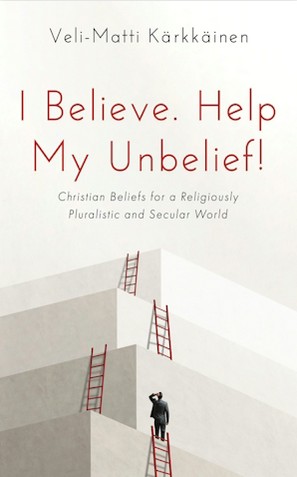
 Veli-Matti Kärkkäinen, I Believe. Help My Unbelief! Christian Beliefs for a Religiously Pluralistic and Secular World (Eugene, OR: Cascade Books, 2024), 456 pages, ISBN 9781725276673.
There is a certain honesty in the title I Believe. Help My Unbelief! that immediately signals both the ambition and the vulnerability of Veli-Matti Kärkkäinen’s book. Borrowed from the anguished prayer of the father in Mark 9:24, the phrase functions not merely as a rhetorical hook but as a hermeneutical key for the entire project. What follows is neither a defensive apologetic nor a diluted catechism. Instead, Kärkkäinen offers a theologically confident yet dialogically open exposition of Christian doctrine for readers who inhabit a world shaped by religious plurality, scientific rationality, and pervasive secular suspicion.
Kärkkäinen is uniquely positioned to undertake such a task. A long-standing professor of systematic theology at Fuller Theological Seminary, he is widely known for his five-volume Constructive Christian Theology for the Pluralistic World, a massive academic achievement that few theologians would dare to condense. This book is precisely that condensation, though “simplification” would be the wrong word. What is offered here is rather a careful transposition: the intellectual architecture of a major constructive project rendered in a register accessible to pastors, students, and reflective believers without forfeiting conceptual rigor.
The introduction sets the tone by refusing the false dichotomy between faith and knowledge. Kärkkäinen rejects both naïve fideism and scientistic dismissal, proposing instead a chastened epistemology influenced by Michael Polanyi’s notion of tacit knowledge. Belief, he argues, is neither blind assent nor empirical certainty but a reasoned trust that remains open to testing, critique, and growth. This epistemic humility becomes a recurring virtue throughout the book and helps explain its unusual generosity toward secular interlocutors and other religious traditions alike.
Chapter 1, on revelation, is among the strongest in the volume. Kärkkäinen navigates the post-Enlightenment crisis of authority by articulating revelation as trinitarian, incarnational, and historically mediated. His treatment of Scripture as “God’s Word in human words” avoids both fundamentalist inerrancy and reductionist liberalism, framing inspiration instead as divine–human synergy. Particularly noteworthy is the comparative engagement with Jewish, Islamic, Hindu, and Buddhist accounts of revelation. Revelation here is not domesticated; it remains scandalous, yet intelligible.
Chapter 2 turns to the doctrine of God, where Kärkkäinen’s ecumenical breadth and conceptual discipline are on full display. Rather than beginning with abstract metaphysical attributes, he situates Christian talk of God within the lived realities of religious plurality and philosophical contestation. Classical trinitarian theology is presented not as an inherited formula in need of defense, but as Christianity’s most daring and constructive proposal about ultimate reality: that God’s being is irreducibly relational, communicative, and self-giving.
What gives this chapter its distinctive force is the sustained comparative engagement. Jewish covenantal monotheism, Islamic tawḥīd, and Buddhist non-theism are treated not as foils but as serious theological interlocutors. Kärkkäinen responds to Islamic critiques of the Trinity not defensively but by clarifying how, in Christian theology, relationality does not dilute divine unity but intensifies it. Likewise, his engagement with Buddhist critiques of personal theism exposes how deeply Christian claims about God are bound to incarnation, history, and relational love rather than metaphysical abstraction.
In Chapter 3, creation is explored in sustained conversation with the natural sciences. Kärkkäinen affirms evolutionary accounts without surrendering theological claims about divine purpose, goodness, and providence. Creation is not treated as a closed past event but as an ongoing, Spirit-sustained reality. The chapter’s refusal to pit faith against science gives it particular resonance for readers formed by contemporary cosmology.
Chapter 4 addresses theological anthropology, asking what it means to be human in light of evolutionary biology, cognitive science, and cultural diversity. Kärkkäinen’s insistence on the imago Dei as relational and dynamic allows him to integrate scientific insights while retaining moral and theological depth. His engagement with Buddhist and Hindu views of the self is especially illuminating, clarifying both points of convergence and irreducible difference.
Christology, the focus of Chapter 5, is treated with careful balance. Kärkkäinen affirms classical Chalcedonian orthodoxy while exploring how Christ can be meaningfully confessed in religiously plural contexts. He resists both relativism and triumphalism, presenting Christ as uniquely revelatory and salvific without reducing other religious figures to mere negations. The chapter models a Christology confident enough to listen and humble enough to learn.
Chapter 6 deepens this trajectory by interpreting reconciliation through a plurality of atonement motifs rather than a single controlling theory. This integrative approach reflects both biblical diversity and pastoral sensitivity, particularly in a global context marked by violence, injustice, and historical trauma.
The doctrine of the Holy Spirit, explored in Chapter 7, bears the marks of Kärkkäinen’s Pentecostal formation without becoming sectarian. The Spirit is presented as active not only in the church but in creation, culture, and beyond ecclesial boundaries. This expansive pneumatology reinforces the book’s overarching vision of a God who remains dynamically engaged with the world.
Chapter 8 addresses salvation with notable restraint. Kärkkäinen maps the theological options regarding exclusivity, inclusivity, and hope without forcing premature resolution. Salvation remains decisively grounded in Christ, yet its ultimate scope is entrusted to divine mercy rather than theological anxiety.
Ecclesiology, the subject of Chapter 9, is framed in explicitly public and pneumatological terms and speaks with particular force to ongoing conversations in Pentecostal public theology. The church is not imagined as a protected enclave nor as a moral lobby, but as a Spirit-constituted communion whose very existence is itself a form of public witness. Kärkkäinen resists both withdrawal and domination, articulating instead a vision of the church as porous yet identifiable, hospitable yet disciplined — a communio sanctorum sent into the world without being absorbed by it. Particularly significant is his engagement with secularism and post-secularity, where the church is called neither to nostalgia for Christendom nor to anxious relevance-seeking, but to patient, Spirit-led presence. For Pentecostal readers attentive to the public implications of ecclesiology, this chapter offers a compelling reminder that charismatic vitality and communal formation belong together.
The brief epilogue returns to the book’s governing prayer. Faith, Kärkkäinen reminds us, is always accompanied by questions, and theology at its best does not silence them but teaches believers how to live with them faithfully.
In an age marked by polarized certainties and shallow dismissals, Kärkkäinen offers something quieter and more demanding: a theology that believes deeply, listens carefully, and hopes patiently — refusing to confuse faith with the absence of questions. That may be this book’s most timely gift.
Reviewed by Ciprian Gheorghe-Luca
Publisher’s page: https://wipfandstock.com/9781725276673/i-believe-help-my-unbelief/