Good News to Change the World: An Interview with Lisa Sharon Harper

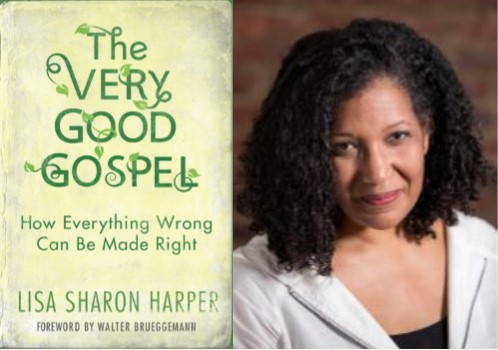
Lisa Sharon Harper is a follower of Jesus calling all followers of Jesus to love every person the same and seek their flourishing. PneumaReview.com speaks with her about her story and how God is inviting each of us to participate with him in making his Gospel of Peace real in our communities today.

PneumaReview.com: Please share with us some of your story. Where are you from? What Christian traditions do you most identify with? What have you been involved with for which you are most grateful to God?
Lisa Sharon Harper: To know me you must know my ancestors. God laid the foundations of who I am through them.
As a teenager, my mother was a member of the Philadelphia chapter of S.N.C.C. (Student Non-Violent Coordinating Committee) in the mid-1960s. Her job was to connect Stokely Carmichael and others, such as James Farmer, with churches to speak in when they came through town. Her branch of our family tree reaches through the great northern migration, to enslaved and indentured family members in Maryland, Virginia and South Carolina as far back as 1650. Great grandfathers and uncles fought in every war this nation has ever seen; from the Revolutionary War through the Civil War to World War I, World War II, Korea and Vietnam. And one branch of the family, the Fortens of Philadelphia, served as primary financial backers of the abolitionist movement and helped build and lead the very first women’s equality gathering in Philadelphia in
My father was a member of C.O.R.E. (Congress of Racial Equality) in New York City. He attended the meeting where Freedom Summer participants were introduced: They were about to head to Mississippi to help register black Mississippians to vote. My father was considering joining Freedom Summer, but realized he needed to stay back and work for the summer. He met Andrew Goodman and Michael Schwerner at that meeting. My father’s father emigrated to the U.S. as a child joining his family in the South Bronx in New York City. They had arrived in waves over a period of years, directly following the United States’ annexation of the island. The earlier generation hailed from St. Kitts/Nevis where they were likely enslaved in extremely poor and brutal conditions. My great grandfather and his brother island-hopped looking for work throughout the turn of the century. His brother found work in Panama, building the canal.
My father’s mother was the daughter of an itinerate preacher who preached in all fifty states, according to family lore. She told me her father was college educated in British Guyana at the turn of the 20th century. Most of her family, in fact, were college educated business people, she said. While the question of how black men were college educated businessmen in British Guyana at the turn of the century remains unclear. The Census revealed one clue: that my great grandfather was born in Holland and lived in a Dutch quarter of a French section of British Guiana.
I was born in Flushing Queens, New York City, January 1969. My mother tells me I was conceived the day that Rev. Dr. Martin Luther King, Jr. was assassinated. She needed comforting, she says.
My mother was raised as a Black Episcopalian, but she was disillusioned in the 1960s and kind of exchanged her faith for civic engagement. That was the choice she thought she had to make because so few churches were engaging in the Civil Rights Movement.
It’s no wonder, then, that I was not raised in the church. I was raised to be good, but not to be religious. I only saw the inside of a church about a handful of times that I can remember, throughout my childhood in Philadelphia.

Image: Jray0203, Wikimedia Commons
So, I’m grateful that I found Jesus in high school. I’m grateful for the little Wesleyan Church that led me to faith during my first year in high school. I’m grateful for the area-wide youth group and the Methodist church where I was discipled throughout the rest of my high school years. I’m grateful for my time in Cru Inner City (then Here’s Life Inner City). It was there where I was introduced to the writings of Dr. John M. Perkins that showed me, in the middle of my all-white evangelical world, the word that God loves people who look like me and that racism and poverty matter. And I am grateful for the value for Bible-based leadership, along with inductive Bible study skills, that I received from InterVarsity. These things lay the foundation of my current ministry. I would not trade them for anything.
Most recently, I am grateful for the six years I served with the Sojourners community in Washington DC. In those years, I saw glimpses of glory as our work actually impacted the lives of millions at a time: from mobilizing evangelical clergy in Ferguson to fasting for Immigration reform to training congregations on how to love the neighbor they’ll never know through the U.S. Appropriations Budget. That, in combination with the true wisdom of Jim Wallis and the profound of intentionality of community they have been able to maintain even after shifting to a more organizational model: It really is beautiful. My feet have touched holy ground. For that I am eternally grateful.
PneumaReview.com: The subtitle of The Very Good Gospel is “How Everything Wrong Can Be Made Right.” That brings to mind some of the most important ideas we wrestle with including hope, redemption, and acknowledging the reality of evil. What were you hoping to accomplish with this challenging investigation into what the followers of Jesus are supposed to be doing today?
 Lisa Sharon Harper: Honestly, I was compelled to write this book by a disturbing question that I have been facing and wrestling with for 13 years: “What does my understanding of the gospel have to say to the deepest cries for good news that rise from the oppressed, impoverished and broken?” I took a pilgrimage 14 years ago, now. For four weeks I traveled with 25 other people, including their children and families, in one bus across 10 states, retracing two major stories of oppression in the U.S.—the Cherokee Trail of Tears and the African experience on this land from slavery to Civil Rights. My own family experienced all of these oppressions. At the end of the summer I imagined myself sharing my understanding of the gospel with my ancestor, Lea Ballard, after she had been raped for the 100th time and her children and husbands kept dying or being sold way: I imagined explaining that God has a wonderful plan for her life, but she’s sinful and, therefore, separated from God, but Jesus died for her sin, all she needs to do is pray the prayer at the back of the gold booklet and she will get to go to heaven. I imagined saying this to her. Then I imagined her response.
“Would Lea receive this as good news?” I asked. “Would this news make Lea jump and shout?”
The answer rocked me: “No.”
That sent me on a 13-year journey in the book of Genesis to investigate the biblical concept of shalom; which is what the Kingdom of God smells like. Shalom is the character of God’s rule and shalom-building is what the Kingdom of God requires of its citizens.
PneumaReview.com: The word Gospel can have so much baggage with it. Why must we get this word right?
Lisa Sharon Harper: How you interpret the gospel impacts everything. If you understand the gospel to refer exclusively to humanity’s relationship with God, not with each other and not with the rest of creation, then “The Four Spiritual Laws” works. But those laws fall mute when faced with the brutal realities of racialized oppression and economic inequity in our world.
In typical evangelical circles, we often talk about bringing our friends over the line into the Kingdom of God. In the first chapter of Mark’s Gospel, Jesus declares: “The time if fulfilled, the Kingdom of God is at hand. Repent and believe the gospel.” (Mark 1:15) For Jesus the coming of the Kingdom is directly linked with good news. So, it matters what the Kingdom looks like. It matters what the Kingdom requires of its citizens. It matters how God’s reigns compares with the reign of the kingdoms of men. And it matters how those Jesus called “the least of these” respond to God’s Kingdom.
If we don’t understand these things, then “inviting our friends to the Kingdom” could effectively be to invite our friends into our white-centered churches with our white-centered worship and our white-centered ways of doing things and our white-centered worldviews and white-centered concerns and our white-washed understanding of history—calling that the Kingdom of God. This is the definition of white supremacy.
We must dethrone whiteness in our conception of the Kingdom of God. If the Kingdom of God is not “white,” if its norms are not white, if its concerns are not white, if its center is not white and western, then what is it? For that, we must go to the beginning—Genesis.
On the first page of Genesis we find a text written by oppressed peoples for oppressed peoples. We find a world under the reign of God and in that world all serves all. In that world all relatedness is intricately interdependent. And in this world all humanity has been made in the image of God. And in the same breath all humanity is created with the call and capacity to exercise dominion—to steward the world.
Within three chapters we see the break in all of the relationships God declares very good in the very beginning. And with that one by one the impetus to dominate the other (and even the self, through shame) enters the world. The snowball of broken relationship starts with broken relatedness with God. Next is relatedness with self. Next is relatedness between genders. Next between humanity and rest of creation. Next between humanity and life itself. Then within families. Then between ethnic groups. Then between nations—and that’s just the first 15 chapters of Genesis. The fall marks the epic shift between the rule of God to the rule of men. Under God’s rule there was reciprocity, truth, trust, choice, shared dominion. Under the rule of men there is domination, oppression, impoverishment, and ultimately the image of God on earth is crushed.
In Psalms 85 we hear the people cry out asking God to restore shalom. God answers and this is what God says: I will bring shalom and this is what it will look like: Justice and peace will kiss. Truth will spring from the earth. Justice will look down from heaven. This is what God’s rule looks like.
I have come to believe that Jesus came to confront the kingdoms of men, to restore the image of God on earth, and to re-establish God’s rule on earth.
Would this understanding of the Kingdom of God and the good news of Jesus compel my ancestor, Lea, to jump and shout for joy?
Yes.
PneumaReview.com: Justice for the marginalized in our society is very important to you. Why is this part of the calling of every Jesus-follower? How can church leaders embody justice through their work?
Lisa Sharon Harper: Every single human being is made in the image God and, therefore, has the divine call and capacity to exercise dominion—to steward the world. The construct of race was created to do one thing: to define and limit who could exercise dominion on particular land. Wherever colonization laid its talons the construct of race was established to ensure, protect, and maintain European dominance and control of land and resources. In effect, racial categorization established and protected white supremacy.
Consider this: Is it possible to live under the reign of God while simultaneously diminishing, ignoring, or crushing the image of God on earth? The answer is “No!”
The church must actively work to protect, serve and cultivate the image of God and, hence, the ability of all people to exercise dominion in every corner of every town, in every city and every nation on earth. That work must not be limited to that which individual churches, denominations, and non-profits can do. All of these efforts are good and needed. But millions of crushed images of God are not reached by those localized efforts. The church must work to free the image of God from oppression and poverty levied by local, state-based, national and international public policy and business practices. That is what citizenship in the Kingdom of God requires.
PneumaReview.com: How would you relate your work with the traditional emphasis Pentecostals and other Evangelicals place on the Great Commission?
Lisa Sharon Harper: At Pentecost, the Holy Spirit came and began the reversal of the broken relatedness of the Fall in Genesis 3. Whereas at the Tower of Babel languages were confused and the people were scattered, at Pentecost the people were together and different languages were no longer a barrier to mutual understanding. And immediately the women were empowered to lead the church through prophetic leadership. Then we meet Priscilla (the lead evangelist) and Aquilla (her husband) and later we meet Junia (an apostle). And, immediately, the Spirit led those Pentecostal followers of the Jesus way to share all things in common so that the image of God in all who had need under oppressive Roman rule would be restored.
Then, in Galatians 3:27-29, Paul establishes the first baptismal liturgy when he declares an end to the power differentials established by empire and tradition. In Christ there are no power differentials. There is neither Jew nor Greek, slave nor free, male nor female. All are one in Christ. But how are all one? We are one in that we all bear the image of God. We have all been called and created with capacity to serve, protect and cultivate the world.
If this is true, then the Great Commission takes on fresh meaning. The mission is not to simply get as many people as possible a pass into heaven. It is to change the world. The Great Commission is Jesus’ charge to make disciples that understand and emulate his teaching and action that confronted the kingdoms of men and rescued the image of God on earth, restoring God’s reign on earth.
PneumaReview.com: The Very Good Gospel is an invitation into a conversation about living in shalom. You put forward biblical arguments for how pursuing shalom should affect every part of our lives. Please share with us a story of how you have seen this made real.
Lisa Sharon Harper: The entire book is full of stories. Without doubt, the stories that surprised me with their power, the stories in my life right now, are the stories of my own reunion with God when I decided to follow Jesus. That transformation was real and began immediately. The other story that touches a deep part of my heart is my struggle against shame; having survived sexual abuse and my parents’ divorce, the power of shame ruled my life. Through inner healing prayer and counseling God has been healing those deep broken parts of my soul.
PneumaReview.com: What is your new book going to be about and why did you write it?
Lisa Sharon Harper: I’ve come to believe the great gulf between most white evangelicals and Pentecostals and those of color is the gap between the stories we tell ourselves about ourselves and how we got here. As a result, we have competing visions of what it will take to make our nation (and the church) great. My next book will aim to help shrink that narrative gap through the power of story. I will retrace my own family’s story in the U.S., through their stories from 1650 to present readers will glimpse through windows that reveal God’s work to confront the kingdoms of men, save the image of God on earth, and bring the healing restoring Kingdom of God in our midst.
More from Lisa Sharon Harper:
“Health Care and Judgment Day” Huffington Post (May 18, 2010).
“The Zimmerman Verdict and the Resurrection of the Old Jim Crow” Sojourners (July 18, 2013). Part of the “Remembering Trayvon” series.
“A Call to Transform Politics” QIdeas.org. In response to Ross Douthat, “How Should Christians Engage Politics?”
“The Lie” The Exchange (August 24, 2014). Part of Ed Stetzer’s “It’s Time to Listen” series.
“The Other Lie” RachelHeldEvans.com (September 9, 2014).
“Four Easy Ways to Be a White Supremacist: At its heart, white supremacy is not about white hoods and burning crosses” Sojourners (September/October 2015).
“When Your Good News Isn’t Good Enough” RedLetterChristians.org (June 29, 2016). An excerpt from The Very Good Gospel.
“The Stories of Us” Sojourners (March 20, 2017). Part of the “Faith in Action” series.
David Swartz, “A Highly Trained Nonviolent Peacekeeping Force” Patheos (August 30, 2017).
“When Lisa Sharon Harper marched in Charlottesville to protest white nationalism, she felt fear. ‘It really felt like every step you take could be your last,’ she said, later adding: ‘With each step, I just kept holding on to the call to love.’”