Craig S. Keener: Miracles

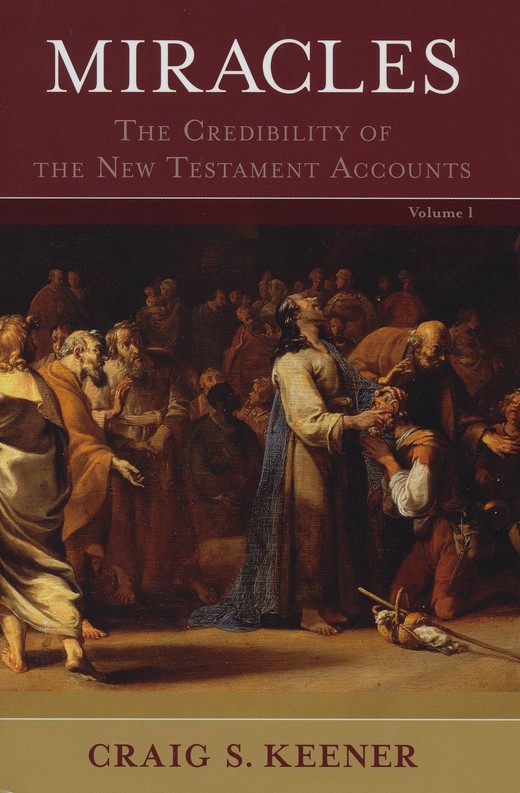
 Craig S. Keener, Miracles: The Credibility of the New Testament Accounts, 2 Volumes (Grand Rapids, MI: Baker Academic, 2011), 1172 pages, ISBN 9780801039522.
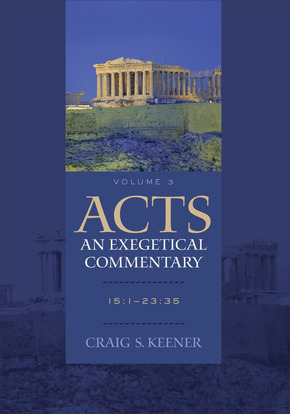
All of Keener’s books that this reviewer has seen and read are lengthy. This reviewer owns Keener’s two volume work on The Gospel of John as well as Miracles, the thick one volume on Matthew, and the two volumes so far published on Acts. This is no criticism at all but an observation on the detailed research that Keener undertakes on anything that he does. This reviewer has met Keener in person at Evangelical Theological Society events and have heard him speak, and sat in on a panel discussion with Keener discussing Miracles at the November 2012 Evangelical Theological Society meeting in Milwaukee.
Keener not only looks at the biblical data, particularly that of the New Testament, but also at the miracles reported from the mission field, from reports cited by physicians, and from testimonies by former skeptics. One of the missionaries Keener interviewed and relied upon in composing his work on miracles was Warren Newberry, who just last year—2013—retired from the mission field. This reviewer is personally acquainted with Warren Newberry. What really gives credibility to Keener is his research scholarship evidenced by the massive footnotes which sometimes takes up more space on the page than the text itself. One of his methodologies is that of comparative analysis as between New Testament citations and citations from other ancient sources both extra-biblical and non-biblical. Extra-biblical sources include the Dead Sea Scrolls, the apocryphal and pseudepigraphical writings, and the Targumic, Rabbinic, and Talmudic writings as well as early christian writings outside of the New Testament text. Keener also furthers the comparative study by examining the patristic writings of Ambrose, Athanasius, Augustine, Basil, John Chrysostom, and other early Christian authors as they relate to both biblical reports and modern testimonials.
A little over one half of the second volume is a sixty-five page bibliography of secondary sources reporting miraculous events and healings attesting to an open universe in which healings and supernatural interventions happen (pages 885-1050). This is followed by a seven page bibliography of personal correspondence and interviews between Keener and individuals who are identified by name, place, and occasion. Subsequent to these two bibliographies is a three-fold index: an index of authors, an index of scripture references from the Old Testament and the New, and lastly an index of ancient sources running from page 1057 to 1149.
Keener’s two volume work is also formidable. Critics face a daunting task if they wish to take issue with the reliability of the reports. They can do so only by questioning the integrity of all of the testimonies Keener has gathered. It is the overwhelming number of reports collected and their insistence that the miraculous has occurred that has made Miracles the center of attention in both print and public discussion. Both The Pentecostal Evangel of the Assemblies of God and Christianity Today have carried full articles on Keener and the presentation he makes in Miracles for the credibility of miracles in the Bible and of the miracles testified to by people around the world.
Miracles is worth the time it takes to read, whether the reader be a preacher, evangelist, lay worker, or even a skeptic.
Reviewed by Woodrow E. Walton
Read excerpts from Miracles: The Credibility of the New Testament Accounts, by Craig S. Keener as appearing in Pneuma Review Fall 2013.