Jacob Chengwei Feng: Spirit(s) and Chinese Religiosity

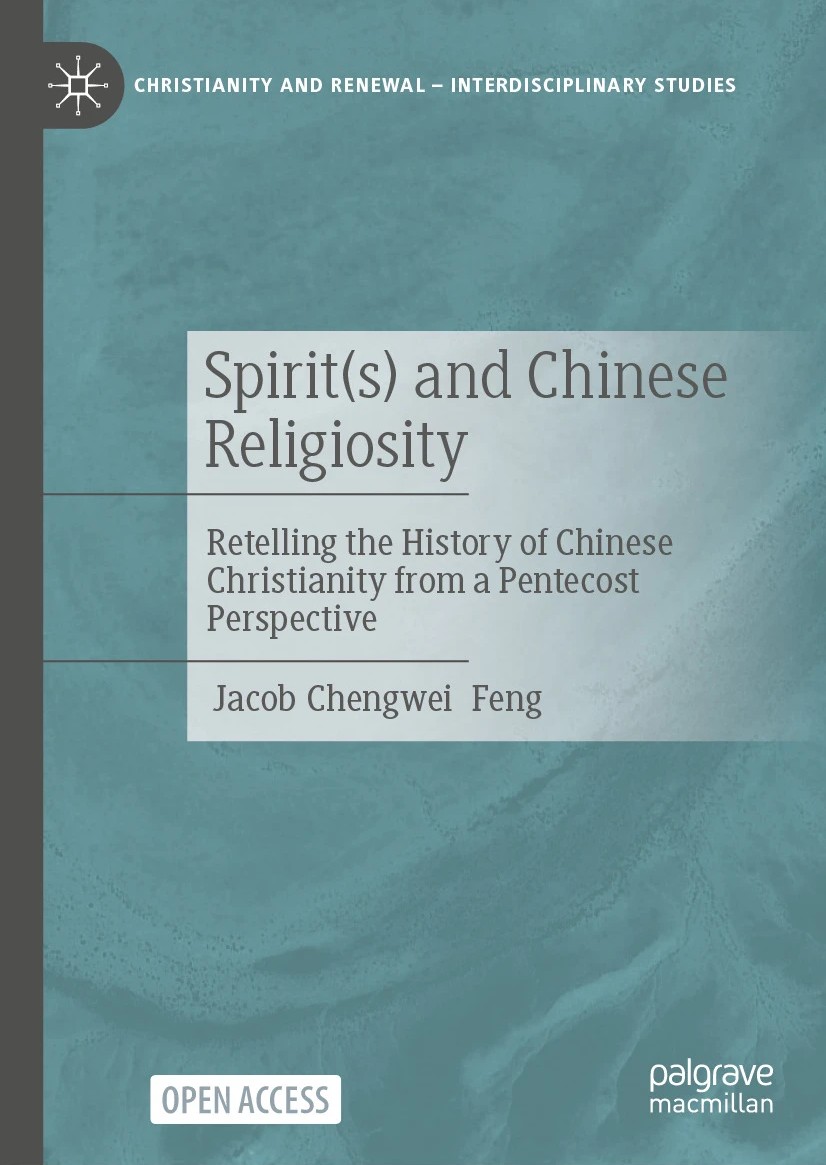
 Jacob Chengwei Feng, Spirit(s) and Chinese Religiosity: Retelling the History of Chinese Christianity from a Pentecost Perspective, Christianity and Renewal – Interdisciplinary Studies (Cham, Switzerland: Palgrave Macmillan, 2025), 307 pages, ISBN 9783032004758.
Jacob Chengwei Feng, an affiliate assistant professor of theology and leadership at Fuller Theological Seminary and an adjunct at Pepperdine University’s Seaver College, argues that the common approach of studying the Chinese Pentecostal movements has overlooked Chinese Christianity’s spiritual roots by focusing on the arrival of modern Pentecostal missionaries in the early twentieth century. He attempts to formulate a Chinese Pentecost theology using a “Pentecostal historiographical” methodology that examines the historical development of Chinese Christianity (290). This methodology treats the Pentecostal event (Acts 2), as well as the person and work of the Holy Spirit, as focal points for interpreting the spiritual world within Chinese religiosity, spanning from primordial to contemporary China.
After introducing the spirit world in ancient Chinese religiosity (Chap. 1) and including the concepts of spirits, gods, and ghosts (Chap. 2), Feng proceeds to examine seven major historical periods of development in Chinese Christianity over 1400 years, this includes the Jingjiao景教 (the Luminous Teaching) in Tang dynasty (Chap. 3), Yelikewen 也裡可溫 (Church of the East) in Yuan Dynasty (Chap. 4), the Jesuit missionaries in the late Ming and early Qing dynasties (Chap. 5), the Protestant missionaries in the late Qing dynasty and the Republican Era (Chap. 6), the spread of the modern Pentecostal movement in China (Chap. 7), the indigenous Spiritual Gifts Movement (Chap. 8), and Watchman Nee and the “Little Flock” which extended into the twenty-first century (Chap. 9). He concludes in the final chapter with theological implications regarding Chinese Pentecostal theology after exploring the Chinese historical Pentecost religiosity.
A significant contribution of Feng’s work is his advocacy of interfaith dialogue, introduced through the powerful imaginative metaphor of the “ideal dancing floor” (47), and describing China’s richly populated spiritual world as the “dancing floor” upon which Christian understandings of the Holy Spirit encountered Chinese religiosity in different periods. He points out that Jingjiao writers interwove Buddhist and Daoist terminology and associated the Holy Spirit with qi and feng, and employed the term Jingfeng淨風 (the Pure Wind) as a strong metaphor of the Holy Spirit; the Yelikewen Christians embodied aspects of Pentecost through spiritual experience including dreams, visions, prophecy, and poetic imagery of lingyu靈雨 (Spirit-rain) and Shenling神靈 (God [as] the Spirit), and the Jesuits engaged creatively with concepts such as Tian (Heaven) and Shangdi (Above God). Yet, Feng also offers a critical interpretation of their accommodation to Confucianism, arguing that it sometimes diminished the dynamic and charismatic dimensions of the Holy Spirit’s power and spiritual gifts, and contributed to introducing a more dualistic anthropology into Chinese Christianity. In the later chapters, he demonstrates how Pentecostal themes and experiences such as outpouring of the Spirit, speaking tongues, signs and wonders appeared more explicitly through Protestant missions, Pentecostal missionaries, and indigenous Spiritual Gifts communities, including Zhen Yesu Jiaohui 真耶穌教會 (True Jesus Church) and Yesu Jiating耶穌家庭 (Jesus Family), and eventually with Watchman Nee and his founded community Xiaoqun小群 (‘Little Flock’). Particularly valuable is Feng’s inclusion of Nee, who did not identify with Pentecostalism, yet interacted with the Spiritual Gifts Movement and developed what Feng describes as an increasingly Pneuma-Christocentric theology. This “ideal dancing floor” metaphor proves useful because it portrays contextualization not as a simple Christian replacement of Chinese ideas or as uncritical religious synthesis, but as an ongoing process of interfaith engagement that avoids simply demonizing the Chinese religious traditions.
An additional significant contribution of Feng’s work lies not only in providing the definitive history of Chinese Pentecostalism but also in demonstrating how history can appear different when the Holy Spirit, lived religious experience, and indigenous Chinese categories are repositioned from marginal elements in the historical narrative to become central historiographical lenses, which has huge implications for Chinese Christian history, global Pentecostal studies, and contextual theology. Feng’s study moves from historical retrieval toward constructive theology, and he proposes a Chinese Pentecost theology that takes the embodied and sensory experience, qi, holistic theological anthropology, mission, and interfaith engagement seriously. To him, Chinese Christianity should be a contributor to global Christianity through “reverse mission’ rather than be the recipient of the Western mission.
Despite the limited availability of direct resources on Chinese Christian religiosity concerning the Holy Spirit during various early historical periods and Feng’s interpretations of these sources, which call for further academic research, this book remains an important resource for subsequent research. It also motivates scholars to reevaluate the relationship between Chinese religiosity and Pentecostal spirituality in a more historically grounded and culturally sensitive way. Finally, the reviewer hopes this book will be translated into Chinese to benefit the Chinese Christian academic community.
Reviewed by William W. L. Toh
Read the full text of Spirit(s) and Chinese Religiosity. Available in open access at the time of publication.