Candyce Roberts: Help for the Fractured Soul

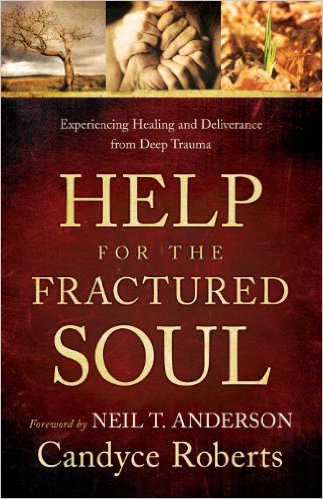
 Candyce Roberts, Help for the Fractured Soul: Experiencing Healing and Deliverance from Deep Trauma (Minneapolis, MN: Chosen Books, 2012), 203 pages, ISBN 9780800795320.
“I have written this book,” writes Dr. Roberts, “to help those who want to bring the healing mercy of Jesus into the despairing and confusing world of the traumatized” (p.23). More specifically Dr. Roberts addresses the trauma caused by abuse and what can be done to facilitate recovery from the wounds caused by abuse. The abuse most often discussed is sexual abuse which appears to be her specialty.
Roberts gives considerable space to discussing the dynamics of “dissociative identity disorder” more recently identified as a condition affecting memories and inner conflict affecting personality. She relies on research done by Dr. Dan Allender, author of The Wounded Heart. This reviewer is well aware of the resource and Allender’s other book The Healing Path. Roberts chose well. Allender is also on the board of the American Association of Christian Counselors, an association with which this reviewer is a charter member.
Roberts writes for pastors and Christian laity in ministry. She advises her readers to not make any diagnosis of the traumatized but to assure them of the healing that comes through prayer and comforting care. The author uses the word “fractured” and “fragmented” in place of “split” personality. They are also not “hopeless.” Anyone who has experienced childhood abuse “has some defense system in place” (p.29).
For this reviewer, by way of critique, this is what makes Help for the Fractured Soul both unique and helpful for student, pastor and christian worker. It steers the reader away from a psychological or therapeutic model. She also avoids reliance upon prominent theorists, whether secular or Christian, as “no one shoe fits” all situations. She keeps to a course that is strictly biblical and theological. The author also cautions that “the greater the denial, the stronger the walls of defense, the more divided the house, then the greater chance that those seeking help have not experienced freedom” (p.55).
Also to her credit, Dr. Roberts keeps theory and explanations to a minimum and offers insight by citing individual situations and giving only first names rather than disclosing the full identities of those with whom she ministers. Another attractive element in the book is that the author admits her own limitations. “I never agree to minister inner-healing with those who are trapped in substance abuse”(p.63). She makes referrals and works alongside professionals more capable than herself in areas outside of her own concentration (pp. 65-66). She acknowledges that pain and trauma can be trapped in the physical body as well as hidden in the mind (p.94). “Inner healing,” she explains, “is wholistic, it has an effect on the mind, body, and spirit” (p. 93). Some causes require long-term ministry from several months to “a few years.”
Another feature of Help for the Fractured Soul worth one’s attention is her discussion on the importance of physical health, forgiveness and mental health. She distinguishes forgiveness from exoneration of the abuser and explains the effect that unforgiveness has upon the victim’s emotional, physical, and mental health. She depends upon insights from Larry Crabb (p. 102) and also Daniel Goleman’s work on emotional intelligence (p. 103).
Roberts devotes all of chapter eight to little children who have suffered from abuse. This reviewer invites the prospective reader to spend time on Roberts’ insights on how to minister to them and present God’s love in Christ in such a way that they do not harbor any guilt or self-incrimination concerning the abuse experienced.
Chapters nine through twelve deal with life after wholeness which includes what she calls “internal congruence,” empathy/compassion, and an unconditional positive regard for others and for one’s self. She also counsels the person with which she ministers to consult with a physician for a physical examination and also an allopathologist–physicians who specialize in the roles of stress and nutrition upon health and well-being. Unconditional positive regard for self and others includes developing positive feelings and the goodness of God and developing new life skills.
Roberts also addresses the working of the Holy Spirit within the person receiving ministry, as inner healing is not a systematic science with a set of laws to be applied precisely.
One other important point the author stresses is that of setting boundaries for both the one who ministers and the person receiving ministry. One cannot afford to be attached to the individual who seeks help for one thing; neither can one solve all the problems or encourage dependency within the recipient. Independency needs to be encouraged within the recipient as the Holy Spirit administers encouragement.
The author also encourages the role of the church and the fellowship of believers in and out of the gathered believers in worship. She writes about cultivating intimacy without being wholly intimate within “a healthy spiritual community” (p. 171).
Dr. Roberts closes her book by giving the top ten keys to healing: choosing to live in truth (John 8:32); choosing to give God permission to search your heart (Psalm 139:2); choosing to forgive (Matthew 6:12); choosing not to remain offended (Matthew 5:44); choosing to accept your true identity (1 Peter 2:9); choosing to connect with God (Psalm 37:4); choosing to ask Jesus for help (Matthew 21:22); choosing to reassess the supernatural working of the Holy Spirit (John 16:13); choosing to engage in Kingdom community (1 Corinthians 12:14); and choosing to commit to a lifestyle of intimacy with our Father God (1 John 4:19).
Reviewed by Woodrow E. Walton
Preview Help for the Fractured Soul: https://books.google.com/books?id=Y59zeCNyrvgC