
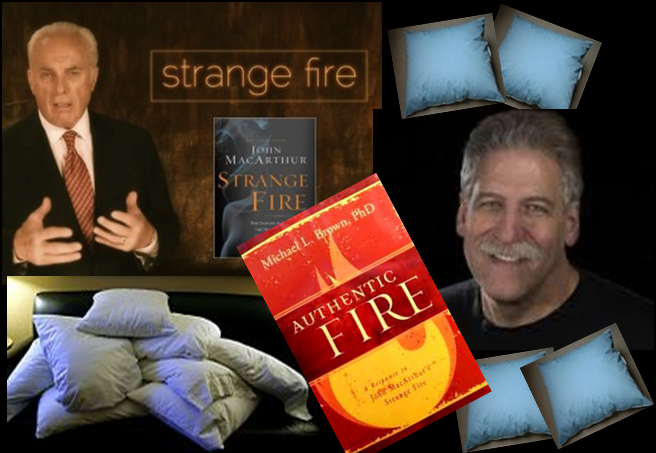
The Theological Pillow Fight from the Nosebleed Section

Are Pentecostals offering Strange Fire? (Panel Discussion)
In this review essay by Rob Wilkerson, he reflects on his background as a disciple of John MacArthur, his becoming a continuationist anyway, and his look at Michael Brown’s book, Authentic Fire: A Response to John MacArthur’s Strange Fire (Excel Publishers, 2013).
I loved pillow fights when I was younger. I haven’t enjoyed one in a while, which is remarkable seeing as how three of my four children are boys. Given my dear wife’s deep dislike for our boyish antics like spontaneous, combustible wrestling in the house (or in public), I can’t imagine she would like pillow fighting either.
 The last time I remember a good pillow fight was the time I cheated. I was fighting my high school friend Charles Hardman. He was a black belt in Karate and always won when we wrestled, which is kind of like him cheating. So I figured I’d even the playing field at that night’s sleepover…by putting a phone book in my pillow! Yellow Pages, to be exact. I won. No surprise there, of course. It was easy. I did it in one hit. And he was still my friend. But my tender conscience made me feel like a putz for it later.
Friendship makes all the difference in the world, doesn’t it? This is especially true when some topics of conversation feel like a pillow fight between friends. How much more is this true when friends are Christians, rooted in the grace of God in the love of Jesus Christ! Christian friends can do life together, hang out, talk, argue, discuss…and even horseplay! Christian friends also rub each other the wrong way, and even sin against each other at times. But in the end, the grace of God seems to be a supernatural oil that lubricates an otherwise very unstable and unhealthy relationship.
I’m Privileged to be a John MacArthur Disciple
The secret to a great friendship is really no secret at all. It’s just plain, old-fashioned, biblical grace. And that’s what I found missing in John MacArthur’s recent Strange Fire Conference and accompanying Strange Fire book. I met John MacArthur when I was eighteen years old. He stayed a couple of days at my house. I almost wet my pants when my dad introduced me to him. I’d had the privilege of being assigned The Gospel According to Jesus as a required text my last year I of high school (Yeah, I was homeschooled. My parents pulled out my senior year. But this isn’t an article about teenage therapy). At that age I thought John was just one-half level below Jesus.
I went on to spend more time with John and some staff members a couple of years later when he came back to my dad’s church, where an East Coast Shepherd’s Conference was held a few times back in the early 90’s. I went through my theological puberty with John, and I’m very thankful for it! I consumed hundreds of hours of John’s preaching for years and loved his approach to Scripture. A few years later when the elders of the church I attended discussed seminary with me, there was only one that they would commit to pay half my tuition and books. It was a no-brainer for me to attend The Master’s Seminary because of my deep respect for John and his ministry. I wanted to learn the Word and learn how to preach and teach the Word just like John did, and still does.
The Master’s Seminary and John MacArthur’s ministry may be well known for their stances on dispensationalism and against the charismatic. But they are also even more renown for equipping men to discover God’s Word and lead the flock with it. I can’t say enough about the equipping I got while enrolled there. God was with me and my family during some difficult and dark days, including the loss of our second son after completing my first year, and my wife’s conversion to Christ during my fourth and final year. Thinking back on those formative years, I can’t help but recall the gracious love and care, in particular, from Dr. Irv Busenitz (V.P. for Academic Administration, and OT Professor), and his wife, Karen, who were like bookends during our time at The Master’s Seminary. I think of Dr. David Farnell who condescended to our level with humor only a friend knows. And I can’t forget the trials and tribulations of New Testament Introduction with the famed Dr. Robert Thomas, with whom I shared too many breakfasts to count. Finally, my few months working on staff with guys like Steve Camp, Tom Pennington, Jerry Wragg were invaluable in terms of shepherding the flock. And then there’s my old friend, Lance Quinn, who talked my wife and I into coming to The Master’s Seminary to begin with. I am privileged to be considered partners in the same gospel with these men.
I Feel Like I Got Burned with Strange Fire
But here’s the rub. I feel like John loaded his pillow with his Strange Fire book and conference, and hit me over the head last Fall. To be sure, John probably has no idea that I am one of a handful of graduates from The Master’s Seminary who went to the dark side and am now a charismatic. While doing my due diligence about ten years ago in preparation to preach through Romans 1, I used what I learned at seminary and ended up embracing what I would call a biblical-charismatic theology. Combined with my reformed(ish) theological foundation, my experience in the charismatic is grounded and guided by sola scriptura.
There are many other charismatic friends out there who are also just as biblically grounded. I think we all felt a pretty big knot rising on the top of our head, dizzy with stars, when John hit us all with the Strange Fire phonebook inside his expositional pillow. And it still hurts. But love doesn’t keep a record of other people’s offenses, so forgiveness has won the day. He’s my grandfather in the faith, after all. I mean, how can a guy be mad at grandpa? Even if he does floor you with a knock-out swing.
The knot on my head has a thought bubble right above it. The caption inside is, “Where the heck is grace?” There’s my primary rub with the Strange Fire book and conference. Grace feels largely absent. When I use the skills John and his friends at the seminary taught me about hermeneutics and exegesis, especially as applied to Paul’s letters to the Corinthians, Colossians and Galatians, I find something scandalously fascinating. Regardless of the false doctrine, lawsuits, immorality, prostitution, greed, favoritism, abuse of the poor, cliques, divisions, and outright stupidity, Paul still calls them saints. Then he commends them for the abundant outpouring of grace they experienced and exercised.
You know why he talked to them this way? Because we live by grace. I never see Paul taking the tone with the saints in Ephesus, Colosse, Phillipi, Corinth, Thessalonica, etc. that John does with charismatics. Galatia is arguably the exception, of course, and for obvious reasons. True, Paul was tough and firm when he needed to be. But there is fatherly and motherly tender love and compassion and graciousness oozing from his heart, through his pen, and onto his papyrus. The grace of God was abundant toward these churches who believed outrageously erroneous things.
Grace is mysterious and glorious, and yet somehow completely disagreeable to human nature. It is that love which covers a multitude of sins. It does not somehow lessen the extent to which God abhors sin. It merely takes the blood of Jesus and applies it once-and-for-all to the sins of His people. Then, in the name of Jesus, it abundantly pours out wisdom, blessing, gifting, love, and miracle without regard for a person’s performance or even obedience.
The fact of the matter is that God’s grace abounds even in the midst of a group of saints who believe false doctrine and are theologically aberrant. This was too radical for me fifteen years ago. Today, it is at home in my heart. It definitely makes me squirm, especially when I see certain TV preachers who make my stomach hurt. Such persons would have made Paul’s stomach hurt.
Do you want to know what I felt like after listening to hours of the Strange Fire conference talks? I felt like grace had been suddenly made a reward for sound doctrine and good behavior. That can seem harsh, especially if I’m saying it to a reformed friend. But it’s true, and here’s why. Ask any biblical-charismatic if they felt like John was gracious to them at Strange Fire and they’ll all say the same thing. “Absolutely not!” Grace is not communicated through broad-brushed, abrasive, scornful statements about brothers and sisters for whom Jesus shed his blood.[1] Nor is grace displayed when one questions their salvation.[2] Even Paul didn’t go that far with the Corinthians. He simply asked them to examine themselves, in the last chapter of 2 Corinthians. He didn’t examine them himself and then say they weren’t saved.
God’s grace was not a tone I found in the Strange Fire book and conference, unfortunately. Instead, they seemed focused on the heresies and aberrations of charismaniacs (a minority, at best, among half a billion charismatics worldwide), and called for a stand against it all. In comparison, look how Paul handled the Corinthians in all their mess. He stood against their mess. But he stood with the Corinthians. One cannot read the last chapter of the 2 Corinthians without coming to that clear conclusion. Let me say that again. Paul stood against false doctrine, heresy, and aberration while simultaneously loving those people and calling them a people of grace and treating them like it. That’s because the Holy Spirit does not withhold His grace-gifts when His people sin or believe dumb doctrines. That’s because His gifts are based on grace, and not on performance. Disorderly, weirdo, chaotic, disobedient, divisive Christians were given the most abundant outpouring and display of spiritual gifts in the entire New Testament. How’s that for grace?
With my first-degree Strange Fire burns healing, interacting with Michael Brown’s book, Authentic Fire[3] was a salve to my soul. Readers of my review will probably remark that it’s really more like a semi-review. There’s a good reason. My deep respect, love and indebtedness for John MacArthur has intersected with my journey with Jesus in a unique way. Writing a review about one book by a guy I have just gotten to know, which reproves and rebuts a book by a guy I know a lot better, is really tough. It’s especially tough when the subject matter is what it is.
As a graduate of The Master’s Seminary, I was taught the historical-grammatical method of hermeneutics, the critical nature of exegesis, and the tools to faithfully exposit the Bible. But four years after graduating from seminary I found myself using those tools in preparation to preach on Romans 1. Facing “the power of God” (Rom 1:16). I set out to discover afresh, as I was taught, the meaning behind Paul’s language. Six weeks later I then faced the fact that I had to become a biblical charismatic. I’ll never forget falling out of my chair to my knees asking God to forgive me of all the messages and teachings I’d given over the years in which I had vehemently criticized and even maligned my charismatic brothers and sisters. Ten years later I’ve given myself to the discovery and practice of spiritual gifts in the local church and find myself growing in my own experience.
Authentic Fire is a Gracious Response
As a recovering and repenting fundamentalist of sorts, Michael’s book hit a soft spot inside of me, one which reminded me of the ungracious and oftentimes unloving attitude I used to have toward charismatics. I felt the old me while listening to Strange Fire talks and reading the book. After reading Authentic Fire, I felt a welcomed, gracious, loving response of the Father to the old me, as well as to the Strange Fire camp. I read Michael’s work finding gracious overtones throughout the book.
In short, his response in writing, as well as on the radio, seemed to contain none of the harsh, critical, judgmental, negative, demonizing that I heard in the Strange Fire talks, and even practiced myself when I was part of that camp. I got done reading the first couple of chapters and thought to myself, “Wow! This guy’s writing emanates the gracious speech Paul was talking about in Colossians 4:6!” Authentic Fire is a book I would have wanted to write. Sometimes I find myself deeply desirous of being an apologist of sorts for a biblical-charismatic theology toward my TMS and reformed friends. Michael could not have expressed my feelings better than when he stated, in chapter five,
[M]any have faulted the Strange Fire camp for what appears to be a conspicuous lack of love in their circles towards those they criticize and reject, to the point that it is all to common to find related posts and blogs mocking and vilifying charismatics in the strongest of terms. Yet somehow, this is considered acceptable and even godly…
Some sections of Strange Fire read like the National Enquirer more than they read like a book written by a seasoned Christian leader, especially when detailing the failings and fallings of other leaders (p. 148).
My praise for the book aside, let me sum up the gist of Michael’s book before I go much further. There are several particularly troubling facets of John’s book and conference that left Michael, as well as thousands of other charismatics all dazed: the facts, the feelings of others, separationism, biblical love, and Jesus’ teaching on handling offenses in Matthew 18. The rest of my semi-review will focus on these elements which were significant to me personally.
Facts are Important
I penned this thought in the margin of these pages: “John cherry-picks details that strengthen his case.” It is clear from reading Charismatic Chaos[4] and Strange Fire that John has spent an unfortunate amount of time watching charismaniacs on television. It is entertaining, I’ll admit. There is some crazy stuff I’ve seen on television before that I’ve never personally experienced in the variety of churches I’ve been in over the years. Perhaps it’s on television for a reason. However, the obvious problem with watching too much TBN is that one can begin to think that this is all there is to charismatics. That’s the terrible conclusion John came to. According to John,
I don’t watch much television, and when I do I generally avoid the Trinity Broadcasting Network (TBN). For many years TBN has been dominated by faith-healers, full-time fund-raisers, and self-proclaimed prophets spewing heresy. I wrote about the false gospel they proclaim and the phony miracles they pretend to do almost two decades ago in Charismatic Chaos (Grand Rapids: Zondervan, 1992. See especially chapter 12). I had my fill of charismatic televangelism while researching that book, and I can hardly bear to watch it any more.
Recently, however, while recovering from knee-replacement surgery, I decided to sample some of the current fare on TBN. From a therapeutic point of view it seemed a good choice: something more excruciating than the pain in my leg might distract me from the physical suffering of post-surgical trauma. And I suppose on that basis the strategy was effective.
But it left me outraged and frustrated—and eager to challenge the misperceptions in the minds of millions of unbelievers who see these false teachers masquerading as ministers of Christ on TBN.[5]
His entire blog post, from which that clip came, is about the evils of TBN. John’s hospital stay definitely led him to think about TBN, but to the wrong conclusion. His conclusion didn’t include all the facts. But that’s not how we were taught to study things at The Master’s Seminary. We were taught to discover both sides thoroughly, even trying to walk in the shoes of the other person to see things from their perspective. We were taught never to begin a study of Scriptures with emotional hang ups, like frustration. It was emphasized over and again that our approach to Scripture must be objective. Facts are important. They are everything. Problem is, a person’s ability to see facts are influenced by their own presuppositions and preconceptions.
Fundamentalism Can Introduce a Fog into the Facts
Michael probably didn’t know this, but John is a successor in the theological tradition known as fundamentalism.[6] From its infancy onward it seems to have always been a theology of fear and reaction, first and foremost. It operates in degrees like anything else, from peaceful (seen in churches who simply mind their own business and do their ministry to the glory of God to best of their ability) to militant (seen in churches who publish books, host conferences, and advance movements, including the ridiculous and downright anti-christian Westboro Baptist Church.). The spirit or attitude of fundamentalism seems to always be reacting to something in the culture (social, intellectual, or political) or in Christianity, and often reacts to elements and ideas which form at the intersection of the two. It reacts to whatever it perceives as a violation of orthodoxy, particularly as it arises in mainline denominations,[7] though not exclusively focused there today, to be sure.
Theological fundamentalists seem to be watchdogs, and seem to have operated in that capacity with some degree of consistency. Watchdogs and their “watch-blogs” are always on the lookout to chase and devour trends and concepts and ideas that violate what the fundamentalist perceives to be unbiblical.[8] A preacher, scholar, theologian, or pastor in the stream of fundamentalism will often demonstrate an impaired ability to see all the facts as it relates to something they are watch-dogging. This turns to fact-fogging. If they even think it may be unbiblical, their ire has already been raised and they are ready to attack. Soon, everything they begin to see is bad, evil, unbiblical, and possibly even demonic. They become a hammer and everything they see is a nail. Select facts are chosen to support the case for the warning call, all the other facts are often ignored or rejected using a schema that leaves one in confusion. While this mentality is present in the stream of fundamentalism, and while John has roots in fundamentalism of one version or another, this watchdog mentality is clearly present in John, while other pitfalls of fundamentalism are not.
John’s fundamentalism and watch-dogging definitely turned into fact-fogging. Michael’s book has many examples which show plainly that John simply did not seem to get, discover or investigate all the facts. But the real question is, why? There are so many examples of this that if I were to start sharing them now, you’d probably quit reading this review. Chapter three, “A Great Big Blind Spot,” offers many of these examples, and appropriately opens this way.
“According to a popular blog, Pastor John MacArthur spends thirty-two hours putting together a single sermon, meaning eight hours a day for four days. That speaks of precision, care, detail, focus, and preparation of devoting oneself carefully to a subject before addressing it. How then can a man of this caliber make such patently false statements about charismatics, statements that even common sense would preclude?” (p. 49).
In Strange Fire I read zero concessions to even the possibility, much less the probability, that John might have said something that went too far, was oversimplified, exaggerated, or ungracious. This is not a manifestation of grace, and it is not being responsible with the facts. In all humility, I say, “John, that’s not the way you taught us to study.”
Fundamentalism Can Introduce a Fear of Feelings
I still feel the knot on my head when I read this statement made by John—dealt with by Michael in chapter three.
I’ll start believing the truth prevails in the Charismatic Movement when its leaders start looking more like Jesus Christ (p. 74).
Frankly, that’s probably the most judgmental statement I’ve heard in a long time. And it comes from someone I’d lay down my life for.
This version of fundamentalism negatively affects communication by disconnecting one’s facts, reasoning, argumentation and conclusion from the human being they are talking to. Talking to someone quickly turns into talking at someone, which almost always sounds like talking down to someone. One becomes so passionate about what they perceive as truth that they exalt that truth over the person. The effect is that the person they think they are trying to help with truth is actually hammered with something else in the name of Jesus, and sound doctrine, and the right music, and Bible version, and haircut, and dress code,[9] and all that. Honestly, it’s just a rerun of the Galatian fiasco, except instead of Jesus+circumcision it becomes Jesus+reformed theology, or Jesus+dispensationalism, or Jesus+fill-in-the-blank-with-your-favorite-theology. And I still like reformed theology today. And to use John’s confession of being a “leaky dispensationalist”, I’d say I’m probably a dispensationalist with a few small drops left at the bottom of the cup.
In that world in which I once lived, something or someone I disagreed with was never allowed to be just different. Their viewpoints, if different from what the church or seminary espoused, was looked at with distrust. Michael did a great job putting this reality on the table in the second best chapter in the book, Chapter eight, “Spirit and Truth, Right Brain and Left Brain.”[10] He wrote that, “it seems as if we sometimes have fundamentally different ways of looking at the same things – fundamentally different perspectives and, in a sense, fundamentally different ‘spiritual personalities’” (p. 251). But that doesn’t seem to be allowed in the camp I came from. Personality differences were never allowed to affect or influence anything.
Instead, when I was in that world, if I disagreed with someone, they were always wrong, because in my view, they were doctrinally divergent and dangerous. Therefore, they stood in need of reproving and rebuking. This usually came across with a judgmental attitude, usually to my congregation, as well as mocking and scorning them behind their backs to my friends. Sometimes this trended toward villainizing and demonizing people, an attitude not uncommon in conversations about charismatics. But we always believed we were doing it in love. If I had read Michael’s book eleven years ago this would have been my behavior. I would have preached a sermon series against it. I would have followed it up with a watch-blog series. I’m ashamed of that. I can’t imagine Paul or Jesus doing this with the guys they were discipling.
Now, let me set a few things straight. I may have heard John opine about the possibility of charismatics being deceived by the devil or perhaps even demon-possessed. But I’ve never, ever heard John do anything that I would personally consider to be mocking or scorning someone he disagreed with theologically. Nor did I ever hear him talk to anyone with a judgmental harsh attitude.
I have, however, participated with other staff members there who did mock and scorn. I don’t believe John would have put up with that if he were to have overheard it. I would have been rebuked, if caught. And I would have deserved it. The Bible calls that slander and malicious talk. That said, John’s mindset about this charismatic issue can often lead to a scorched earth philosophy. When you argue for truth but fail to demonstrate love and grace you can hurt those you are supposed to be helping.
This was what I did and I still shudder at my past attitude. People’s feelings are important.
For this reason, I think Michael’s chapter entitled, “Shall We Burn One Another?” should have been the first chapter in Authentic Fire. In Michael’s opinion, John’s “strategy is tantamount to blowing up an apartment building filled with law-abiding civilians because there are terrorists inside” (p. 245). John seems to have eclipsed the sunshine of God’s grace, which shines on all of His children, with a smoldering cloud of “I call it like I see it, no matter who it may hurt.” At least, that’s what I felt when listening to and watching Strange Fire talks. John seems to be okay with his biblical version of acceptable spiritual losses and casualties, which is biblically unethical and frankly destructive to the unity Jesus prayed for in John 17.
The Sin of Separationism
Fundamentalism as a whole, regardless of which denomination or religion, is also guilty of one of the most heinous sins today: separationism. I remember attempting to complete a semester at Pensacola Christian College. I had been there four weeks. My previous ministry experience had gained me a place among the sophomore leadership and I was asked to lead the Sunday School for the men. A couple of days later, when the Sunday School leader saw my John MacArthur books on the shelf in my dorm room, they immediately removed me from any position of leadership, stating that I was reading heresy and that I needed to get my head screwed on straight.
As a strange turn of events many years later, after becoming a charismatic, I learned one day that my name and church were no longer on The Master’s Seminary alumni list or map.[11] When I contacted the seminary to inquire, as I recall, I ended up talking to a friend and former fellow student. He explained that I should not be surprised since my views no longer represented those of the seminary. So let’s get this straight. I got mildly persecuted for following John MacArthur in college. Then I get blacklisted by his seminary. Christianity is a strange place to be sometimes. More often than not, it seems that among the Strange Fire camp there is little urgency and attention given to the prayer for unity that Jesus prayed in John 17. The fact of the matter is that we can all get along because we are all forgiven by King Jesus, and because the evangelization of the world depends on it!
In my personal experience, as well as the experience of others, both institutions (PCC and TMS), while nothing alike in many ways, are similar when it comes to the fundamentalist bent toward separationism. If you are involved in something they deem unorthodox or unbiblical then you find yourself without their fellowship any longer. That’s called first degree separation. If you currently or have in the past associated with someone else whom the ministry believes is unorthodox or unbiblical, then you may also find yourself without fellowship any longer. That’s called second degree separation. I have experienced both. It hurts. Jesus’ blood runs through my spiritual veins too, and it is that and that alone which unites us at the throne of God. So why can’t we live like that here and now?[12]
In chapter four, “The Genetic Fallacy and the Error of Guilt by Association,” Michael writes the third best chapter in this book. I think if Michael had done a little more digging he might have made the connection between fundamentalism and John MacArthur.[13] This would have perhaps given Michael more perspective on the reason why the genetic fallacy, guilt by association, and separationism seems so deeply rooted in John. And as a heart-check to me in writing this article, I humbly acknowledge that a blind spot may be leading me to commit this same error, so I want to tread with care and courtesy.
Just reading the first page of chapter four led me to see that the logical end of John’s views (my former views) on the charismatic, combined with the genetic fallacy, would have brought him to repudiate Paul’s ministry in Corinth. He’d never say that of course. But trains of thought have a destination, whether we like where they are going or not. In short, John applies an unreasonable prejudice toward charismatics, and Michael calls him out graciously, even going so far as to apply the same principle to John’s dispensational theology and its roots (pp. 93-94), as well as John’s reformed theology and its roots (pp. 100-110).
The result is that “Strange Fire critics use unequal weights and measures, attacking charismatics with one standard while defending the Reformers (and those in their own camp) with another standard” (p. 110). I am thankful for Michael’s gracious tone in answering and dealing with a particularly troubling set of paragraphs on pages 110-111 that had me furrowing my brow in frustration. As I noted in the margin, “It takes a great deal of grace to deal graciously with people who boldly make such intensely ungracious statements like this.”
Going back to “Shall We Burn One Another?” in pages 236-240, Michael lists five simple principles by which “we can avoid unnecessary casualties.”
- We really do need each other. “Rather than despise others who appear to be weak where we are strong, we should instead ask, ‘How can I serve that brother or sister? And what do they have that I need? How can I learn from them?” (p. 237)
- Surgeons cut carefully. “If I start my sentence with, ‘Let me tell you something about those Baptists,’ whatever I say afterwards is virtually guaranteed to be inaccurate, since not all Baptists are the same [except on the most basic of doctrinal points]. It would be the same if I said, ‘The problem with those charismatics is that…’ Whatever comes next is not going to be accurate, even if it applies to many. And that means I will be guilty of speaking falsely against many others at the same time. Why can’t we be more nuanced in our words? Wouldn’t that better honor the Lord?” (pp. 237-8).
- Don’t be hasty to call others false prophets or false teachers. “It is therefore unbiblical to use the ‘false prophet’ or ‘false teacher’ moniker for believers who are in error, and we can deal with their error effectively and strongly without damning them to hell.” (p. 238).
- Before we differ with each other we have to understand each other.
- Major on the majors. “We might have different burdens and callings …but that doesn’t mean we’re not part of the same Body, saved by the same Lord, working against the same devil, trying to reach the same world, and going to the same eternal destination. If you keep the main things the main things and concentrate on driving down the center of the road, you’re far less likely to fall into a ditch” (p. 240).
Loving People is a Part of Sound Doctrine
A significant part of the DNA of fundamentalism seems to be the belief that truth must be honored over everything else, including people. If I heard that sentiment once in my previous camp, I heard it a thousand times. It is as if truth is this esoteric-but-intellectual, intangible-but-concrete, expositional-shekinah-glory where all of God’s people sit and bask and soak in the information in Scripture? I personally believe that the lie which abounds too much in western Christianity is that information leads to transformation. It doesn’t. That’s not a good interpretation of Romans 12:2. The transformation that occurs as a result of renewing the mind is something that we are led into by the Holy Spirit. If one could be transformed by an exposition of the Scriptures, then the Pharisees would all have been Christians and some other group would have had to kill the Savior. The Holy Spirit transforms us and He certainly uses Scriptures to do that. But here’s the kicker: we know the Holy Spirit is transforming us not when we know more Bible but when we love one another. After all, Jesus made it pretty clear in John 15 that loving one another is the goal of our transformation.
More often than not it truly feels that in the Strange Fire camp, as well as the reformed camp in general, healthy Christianity is about being able to verbalize sound doctrine well, so much so that Christians are willing to sin against each other if they disagree. That usually happens these days in the form of bloggers who gossip and slander, as well as multiple violations of the ninth commandment.
For me, during that season of my life in that camp, there was this undercurrent of grace that was flowing abundantly when dealing with people whose beliefs nicely fit in the cubby-holed, neatly-organized system of truth I held to. But when encountering or relating to people with truth that was messier than mine, the environment seemed to coach me to reprove, rebuke, reject, then repudiate them. That’s because in that world friendships seemed to be based around doctrine instead of the two greatest commandments. The last time a religious group operated that way, they killed Jesus. And today it looks and feels very much as if many Bible-believing, Jesus-loving, God-fearing charismatics are being doctrinally and spiritually killed by other well-meaning religious people.
Here’s the thing I’d express strongly to my friends in the Strange Fire camp: people are a part of the truth. People are an inseparable, integral part of sound doctrine. Jesus said the second greatest commandment is to love one another. Jesus died for people, not doctrine. And the fact that He died for people is sound doctrine. But when doctrine is elevated above people, then it’s easy to sin against each other because we can say it’s all about the glory of the truth. Those who cry blasphemy are often the ones who are the most unloving and ungracious. Yet how does this square with the treatment believers are to give each other, the attitudes they are to have toward one another. “Love one another fervently from the heart” (1 Peter 1:22). “Be devoted to one another in love. Honor one another above yourselves” (Romans 12:9-10). That’s just a start.
As Michael so aptly put it in chapter 2, “Embracing the Authentic Fire,” “it is one thing to address serious errors and abuses … It is another thing to fail to recognize and, worse still, mock the contemporary work of the Spirit, to vilify godly leaders, and to damn to hell countless millions of brothers and sisters in Jesus” (p. 33). But John’s version of fundamentalism almost seems to require him to trend in this direction because of what feels like an exaltation of truth over people.
What About Matthew 18?
One particular area in which this fact is most noticeable is in John’s seeming refusal to contact, befriend, and meet those he disagrees with. Notice I used the word “seeming.” That’s because it seems like John doesn’t want to reach out to these people. It seems like he just wants to take them at face value in the things they’ve written and launch from there, assuming he completely understands what they mean. Conversely, Michael stated several times in Authentic Fire that he has made, and continues to make efforts to reach out to John in order to talk it out. But to date, John has not replied. That’s weird to me.[14] This response simply perpetuates this separationism inherent in fundamentalism.
Michael asked the question, “should we always name names?” (p. 32). For John, the answer is yes. I asked him once about that when I worked on staff at Grace Community Church. It is just a plain matter of fact for John that if a person puts their beliefs in print then it’s public and therefore fair game to critique and rebuke where necessary. However, I’m not sure John is handling the truth of Matthew 18 with integrity when he sees a book in print (or any public communication by another leader, pastor or author, for that matter) as a loophole to having to follow Jesus’ teaching on this matter. It’s a sort of shoot-first-and-don’t-ask-questions-ever mentality that, I believe, does dishonor to Jesus’ teaching and the people He died for. And this practice has led countless seminary students to carry forth that same attitude in the churches they pastor, spreading the pain and suffering even further.
Michael has attempted to do what John has not done, and that is apply the principles of Jesus in Matthew 18:15-17 to interpersonal conflict. While in seminary, listening to John preach awesome expositions of Scripture on Sunday mornings and nights, I recall the bewilderment in my young head as to why John was speaking publicly against a well-known leader and author whom I thought had offered so much to the body of Christ. I sat there, hearing his name repudiated, wondering if John had followed Matthew 18 in an attempt to make contact, confront, and reconcile things.
On another occasion I heard John speak against a dear friend of mine, John Armstrong. When I was visiting with Armstrong in his hotel room one night, after he had preached at a church I was pastoring in Michigan, I asked him about MacArthur’s comments and whether or not MacArthur had called Armstrong. Armstrong said that he had not received a phone call nor had he had any correspondence with MacArthur. Sadly, Armstrong said that it was not the first time he had been criticized publicly by MacArthur from the pulpit without having previous conversation with Armstrong. As a result, Armstrong’s ministry has suffered greatly under this fundamentalistic separationism, having ultimately lost well over half of his followers and supporters. I wonder how many times this has happened with others?
I think if we are wanting to follow the spirit of the law instead of the letter, we should apply Jesus’ teaching in Matthew 18 to the authors of books we feel we disagree with. That means attempting to contact them, befriend them, and relate to them as brothers and sisters in Christ. The aim is to seek first to understand, and only then to be understood. Again, it’s just as much about people as it is truth. This is a better way. It’s more gospel-led. It’s more in keeping with the letter of the second greatest commandment to love one another as we want to be loved. I don’t want someone to write bogus stuff about me or try to bring public correction or rebuke in writing or at a conference if they’ve never even attempted to contact me and ask me questions or get to know me. That just plain doesn’t make sense. I would be thinking, “I can be found on Facebook, Twitter, Linked-In, and my blog profile. Why was I not contacted first, if only to at least comment?”
On this point some have responded to me that this is an unreasonable expectation or flat out preposterous. They cite a variety of reasons which certainly seem like practical obstacles to these kinds of conversations. But I have two questions in response. First, shouldn’t you at least try? Romans 12:16 commands us to “live in harmony.” Two verses later, Paul commands, “If it is possible, as far as it depends on you, live at peace with everyone.”
While reading Michael’s book I had a disagreement about a couple of things. I thought he wasn’t properly representing John, and was almost making him out to be a hard cessationist, completely discounting the miraculous in anyway. I thought that wasn’t fair. And I also thought that the numbers he was using to represent the fractional minority of charismaniacs was also not really accurate. So the first thing that popped into my head was, “Hey Rob, you should probably talk to Michael to get him to clarify these things.” So I pursued it. The editor at Pneuma Review emailed Michael’s people, Michael’s people emailed them back providing Michael’s email address to me. I emailed Michael personally and asked to speak with him by phone, and we did on June 23 at 4:30 PM EST. It wasn’t that hard. I asked him my question first, which he answered, which gave me clarity, which then totally precluded me from having to disagree with him.
This leads me to my second point. If you cannot get a hold of the person for further comment or conversation, then do you even really need to say anything to rebuke or reprove them personally in public? No, you probably don’t.[15] Especially if they claim to be a brother or sister in Christ. It is possible to reference things that are not spiritually healthy or perhaps false teachings without slamming the person in public. I love that about Terry Virgo, the founder of Newfrontiers. He happily shares the pulpit with men who differ, even sometimes greatly. And in following them he often feels no need at all to correct them publicly. A friend of mine even asked him once why he didn’t correct what so-and-so said. Terry replied that he felt like his people were mature enough to see the problems and respond to them correctly and graciously.
I personally think R. T. Kendall does an extraordinary job at this, as well. I watched a Youtube interview from the Daystar channel a few weeks back, where R.T. was talking about his book, Holy Fire. Not once in thirty minutes did he mention the name of John MacArthur, even though his book is an attempt to answer Strange Fire with biblical truth. I love his spirit, his tone, his attitude. It’s all about peace in the kingdom. Terry Virgo, R. T. Kendall, and Michael Brown all show me that as saints we want to err on the side of being more gracious than more critical. If we are wrong, we have to answer to Jesus because we are erring against his brother or sister. And if you justify your public criticism by saying that this person isn’t really a brother or sister, then you’re probably in more serious trouble than you think.
Conclusion
I believe Michael’s book is a must read by members of Grace Community Church, The Master’s Seminary students, Grace To You followers, and all my reformed friends in general. Proverbs 18 has much to say about this subject. For those who have started rumors, “Rumors are dainty morsels that sink deep into one’s heart” (v. 8). For those who choose a pathway of reaction instead of relationship-then-response, “Spouting off before listening to the facts is both shameful and foolish” (v. 13).
The Bible says that wise people are the opposite: “Intelligent people are always ready to learn. Their ears are open for knowledge” (v. 15). And to everyone who just flat out refuses, for whatever reason, to even read Michael’s book to get the other side, “The first to speak in court sounds right—until the cross-examination begins” (v. 18). Overall, the atmosphere we should seek to engender is one that believes that, “Arguments separate friends like a gate locked with bars” (v. 19). In the end, friendship is marked by relationship instead of destruction: “There are ‘friends’ who destroy each other, but a real friend sticks closer than a brother” (v. 24).
Is this level of friendship possible with the Strange Fire camp? I hold out hope because grace is powerful. I’m praying for a suitable response from my friends there to meet me halfway on the bridge I’ve tried to build between us. Meet me there. Let’s talk. Come let us reason together. We’ve been purchased by the same Jesus Christ. I am pursuing God’s mission for the church just like you are.
Michael concluded our phone call together with this awesome thought. Christianity is already an exclusivist religion that says to the Hindu, Buddhist, Jehovah’s Witness, and Mormon that they are going to hell when they die if they don’t choose Jesus. That automatically makes us a minority in the world today, and inseparable partners in suffering for it. Do we have to divide that minority even more by expecting and even demanding that brothers and sisters believe every little thing we do, and say it all exactly as we do?
PR
[1] Per John, “I understand that some reviewers will find my tone too harsh and my brush too broad…And I’m willing to be accused of broad-brushing in order to get that message out.” http://blogs.christianpost.com/overflow/john-macarthur-answers-his-critics-18633/
[2] Per John, “There are others who criticized by saying, ‘You’re attacking brothers.’ I wish I could affirm that. We’ve said this one way or another this week: this is a movement made up largely of non-Christians…” http://thecripplegate.com/strange-fire-a-call-to-respond-john-macarthur/. This seems like a pronouncement of judgment, and is contrary to his words from Reckless Faith. “At the same time, we must acknowledge that some people are tempted to wield fundamental doctrines like a judge’s gavel and consign multitudes to eternal doom. It is not our prerogative to exercise such judgment. As Witsius sagely observed, ‘It does not become us to ascend into the tribunal of God, and to pronounce concerning our neighbour, for how small a defect of knowledge, or for how inconsiderable an error, he must be excluded from heaven. It is much safer to leave that to God’ [Witsius, 29]. Wise advice. We dare not set ourselves up as judges of other people’s eternal fate” (Reckless Faith). In fairness to John and the context of that quote, he doesn’t mention charismatics when he describes a “people whose religion is fundamentally in error.” But based on Strange Fire it seems safe to conclude such.
[3] Excel Publishers (Lake Mary, FL: 2014).
[4] Zondervan (Grand Rapids, MI: 1993).
[5] http://www.gty.org/Resources/Print/Blog/B091211
[6] Grace Community Church (GCC) where John MacArthur pastors hails from the Independent Fundamental Churches of America (IFCA), despite however much that fact is downplayed on campus. While GCC does not owe anything at all to the IFCA, nor does it seem to participate in that denomination as far as I could tell, John MacArthur’s approach to the Scriptures is fundamentally rooted in fundamentalism. On Friday, June 20, 2014 during a private phone conversation with Michael, he confirmed that while he was somewhat familiar with fundamentalism and its connection to J. Gresham Machen in the 20’s, he was not aware that John had a connection to fundamentalism.
[7] http://www.theopedia.com/Fundamentalism. The article states that fundamentalism included and attracted, “a growing breed of premillenial and dispensational independents such as D. L. Moody, R. A. Torrey, and the independent Bible college and Bible church movement.” GCC and TMS’s views on premillenial, pretribulational, and dispensational theology are set in concrete.
[8] Wheaton College’s Institute for the Study of American Evangelicals writes, “Since the 1940s, the term fundamentalist has come to denote a particularly aggressive style related to the conviction that the separation from cultural decadence and apostate (read liberal) churches are telling marks of faithfulness to Christ…” For me personally, this seemed to be in the DNA of The Master’s Seminary where I studied. The article continues, “Concerns over doctrinal purity and issues of ‘first-degree separation’ (the refusal to associate with groups who endorse questionable doctrinal beliefs or moral practices) and ‘second-degree separation’ (refraining from association or identification with groups or individuals who do not practice first-degree separation) have meant that self-identified fundamentalism has been prone to constant disputes and splits” (http://www.wheaton.edu/isae/defining-evangelicalism/fundamentalism). This “separationism” is also in the DNA of the church and seminary, as sermons, journal articles, book reviews, papers, and talks abounded, while I was there, all of which usually seemed to have a tone of exclusivity about our version and grasp on the truth as contrasted with others. It was unfortunate to hear early on in my first year of seminary that Master’s grads were known for splitting churches and better known for what they were against.
[9] Neither TMS or GCC had any teachings or policies against certain styles of attire or haircuts. But my Jr. and High School upbringing in a fundamentalist independent Baptist christian school did, along with my eight-week tribulation period at Pensacola Christian College. The environment was ruled by a spirit or air of Pharisaism, as there seemed to be a Talmud of behavior for almost everything. It was there that I received demerits for borrowing my roommates sportcoat (because Proverbs says that the borrower is servant to the lender), which I was required to wear to dinner Monday through Thursday, in a cafeteria with assigned seating … for adults…who were treated like children. It was also there that I received a demerit for “eye intercourse” which I was evidently guilty of when I didn’t hand a girl a pencil properly at the dinner table one night. (I was coached that the proper way to hand a girl a pencil is to lay it down and let her pick it up, because otherwise we might lock eyes and have a moment of visual pleasure with each other. I kid you not.)
[10] I personally felt that unfolding John 4:24 in depth would have been more salient to Michael’s point on spirit and truth, as opposed to opening with the right-brain/left-brain scenario.
[11] See http://www.tms.edu/AlumniList.aspx?Filter=W. I just checked again to make sure it hadn’t changed. This really confuses me to be honest. I paid over $25K to go to school there, worked four years in the bookstore, a year on staff at the church, made awesome friends, made decent grades but get blacklisted in the end because I’m a charismatic?
[12] Recently, when I posted on Facebook about my phone call to Michael, one fellow seminary student mocked, “ I’m sure Benny Hinn would have loved to join the conversation. He and Dr. Brown seem to have a good relationship.” Later, when I clarified that Michael had been trying to reach out to John for discussion, my friend responded, “I’m not sure why John would take his time to meet with a guy who considers Benny Hinn a brother. If he doesn’t have enough discernment to see the errors of Hinn, then a conversation has no chance of changing his views on the matters under discussion.” It did not seem to matter what my responses were to my friend and others who replied disapprovingly. Instead, the responses were similar. “So Rob, no concern for his palling around with Benny Hinn? You don’t question his discernment on that? What about with Sid Roth? Not a problem either?” My point is that my friend, as representative of many in the Strange Fire camp, insists on an attitude of separationism from Benny Hinn (first degree separationism), as well as from Michael Brown (second degree separationism) because he associated with Benny Hinn. (Source: https://www.facebook.com/rfwilkerson/posts/10204117175799691)
[13] “The attempt to discredit a major movement by tracing it back to its alleged (and often disputed) roots is often misguided, especially when it is done with a critical spirit” (p. 90). Well said, Michael. On this point I humbly admit a susceptibility to the genetic fallacy by making a connection between John MacArthur and fundamentalism’s roots.
[14] Another friend and former fellow seminary student replied to me on this point one day: “ He [Michael] has attempted to get John in public debate, not just talk with him personally. He’s talked personally with a number of folks from GTY and TMS. We have also explained to him that John doesn’t want to do a radio interview or debate him because we don’t want him to get steamrolled like he did Phil. Plus debate is not John’s thing.” (Source: https://www.facebook.com/rfwilkerson/posts/10204117175799691)
[15] I realize I’m walking a thin line here in my accolades to Michael’s book as compared to what I just said. But my intended audience for my review are primarily pastors of less-than-mega-or-giga-church sized flocks who will probably be reading this review. As I once did, they may sometimes (or often) feel the need to follow in John’s footsteps by publicly saying critical things about authors or preachers they disagree with but have never met. To them I ask this question: Are the people in your churches really being affected by that stuff? Or are you just irked with it and you’re looking for a platform from which you can vent your irritations? Perhaps think of it this way: if the platform God has given you allows you to address a wide enough sector of people you normally influence who may be unduly influenced by bad teaching or theology, then use that influence wisely. But only use it if and when you have followed Jesus’ teachings in Matthew 18 about the person you feel is in error. And if they don’t respond to your pleas, then proceed cautiously and graciously. I feel Michael has done this with his book.








Wonderful article – appreciate the time you must have invested in this important subject. The body of Jesus needs this type of grace!! Godspeed.
Long winded.
Could have said it all in one tenth
I wish it was a longer article and he elaborated more …glad he is not afraid to speak out
I wish he would have said more, also.
So what is Chrisma, but a gift. That gift of love will never fail. How many years I thought against so many of God’s people, Our Saviour has overcome and so shall we if we endure and faint not, no matter what.
Simon, if he was serious, missed the point. Great thoughts, Rob. Thorough, pastoral, and helpful in many ways. Great job.
So six weeks in Romans 1 and you became a Charismatic? Am I understanding you correctly?
Lyndon Unger and I gave a chapter by chapter rebuttal to Brown’s book that can be read here, http://hipandthigh.wordpress.com/2014/04/11/authentic-fire-review-links/ as well as over at the Cripplegate http://thecripplegate.com/?s=Authentic+Fire (The articles are in reverse order, sorry about that).
In spite of Rob’s enthusiastic endorsement of Brown’s book, I thought it was more of a over reaction that was hastily cobbled together. The book came out almost a month after the Strange Fire conference, which is hardly no time at all for any meaningful reflection as to what was talked about. Moreover, Keener admits in his essay, which is the first appendix in the book, that he was writing BEFORE the conference and hadn’t even seen John’s book, Strange Fire. Overall the work is not worthy of Dr. Brown’s otherwise fine skills as a writer.
Hi Rob, – you don’t know me, but I too am a Master’s Sem grad. I remember guys going through the program and being charismatic – secretly so. And then guys like me, who grew to see the theology as dangerous, seductive, and dismissive of Scripture in lieu of personal experience.
Your comment that Rom. 1:16 led you to charismaticism strikes me as exactly that – a text that ought ground you in the objective power of Christ on the cross, a work in which you did not participate at all, became to you a gateway to the subjective experiences of tongues, etc?
Its more than suspicious. Its error.
I love the tone of this review, it also is a very interesting read.
At the risk of starting a debate on my view of the power of God in Romans 1:16, i’ll just briefly comment here and leave it at that.
The power of God that Paul speaks of in 1:16 is a power that envelopes more than the cross of Christ, but is applied to the cross of Christ in the message of the gospel. My studies led me to the conclusion that displays of the power of God always seemed to include both a message of promise by God accompanied by miracle and/or providence. The cross is the climax and peak of the convergence of promise and miracle, and as such becomes the channel through which it all continues to be proclaimed and manifested.
When God made promises in the OT, he did so to proclaim his sovereignty and fatherly ownership (including discipline and protection) of his people. These promises came with miracles. Sometimes the miracles came first with a proclamation of redemption to interpret it. Sometimes the promise came first with a miracle to show its power and make its mark in the minds and hearts of people at that moment. Sometimes these two things happened together, all wrapped up in one magnificent gift to his people.
That hasn’t stopped today. The same message of redemption continues today. And the same power of God continues to make its mark to apply and interpret the message in the hearts and minds of people. Acts makes that plain. And there’s no indication in the NT that this same display of power (through proclamation and miracle) has stopped. To the contrary, there’s a church history filled with evidence to the contrary, including the things I personally have seen, encountered, and experienced.
Hope that helps the inquiring minds. I’ll leave it right there and encourage people to take a fresh look at the theology of God’s power in the Scriptures.
Thanks for writing this wonderful article! I found it refreshing yet challenging.
“For God so loved the world that he gave his only Son, so that everyone who believes in him may not perish but may have eternal life.” — John 3:16 (NRSV).
JOHN CALVIN COMMENTS:
“’That whosoever believeth on him may not perish.’ It is a remarkable commendation of faith, that it frees us from everlasting destruction. For he intended expressly to state that, though we appear to have been born to death, undoubted deliverance is offered to us by the faith of Christ; and, therefore, that we ought not to fear death, which otherwise hangs over us. And he has employed the universal term whosoever, both to invite all indiscriminately to partake of life, and to cut off every excuse from unbelievers. Such is also the import of the term world, which he formerly used; for though nothing will be found in the world that is worthy of the favor of God, yet he shows himself to be reconciled to the whole world, when he invites all men without exception to the faith of Christ, which is nothing else than an entrance into life.”
Um. Okay. I think I’m with you there, brother John.
“Let us remember, on the other hand, that while life is promised universally to all who believe in Christ, still faith is not common to all. For Christ is made known and held out to the view of all, but the elect alone are they whose eyes God opens, that they may seek him by faith. Here, too, is displayed a wonderful effect of faith; for by it we receive Christ such as he is given to us by the Father — that is, as having freed us from the condemnation of eternal death, and made us heirs of eternal life, because, by the sacrifice of his death, he has atoned for our sins, that nothing may prevent God from acknowledging us as his sons. Since, therefore, faith embraces Christ, with the efficacy of his death and the fruit of his resurrection, we need not wonder if by it we obtain likewise the life of Christ.”
Whoa! What do you mean “on the other hand”? Umm… Now you seem to be dodging out of it all by appealing to a theology that is rooted in something else, John.
Here you are clearly leaving exegesis behind and trying to reconcile the verse with a preconceived theology.
How can ‘life’ be promised to those incapable of receiving it? It can’t. How can God ‘invite all indiscriminately to partake of life, and to cut off every excuse from unbelievers’ (as you say) if God is choosing to withhold the ability to believe from some?
You can’t have it both ways. I mean, I know you’re a logical guy, John. Isn’t it possible that Augustine was wrong in the Enchiridion — where this same logical inconsistency can be found?
“Still it is not yet very evident why and how faith bestows life upon us. Is it because Christ renews us by his Spirit, that the righteousness of God may live and be vigorous in us; or is it because, having been cleansed by his blood, we are accounted righteous before God by a free pardon? It is indeed certain, that these two things are always joined together; but as the certainty of salvation is the subject now in hand, we ought chiefly to hold by this reason, that we live, because God loves us freely by not imputing to us our sins. For this reason sacrifice is expressly mentioned, by which, together with sins, the curse and death are destroyed. I have already explained the object of these two clauses, which is, to inform us that in Christ we regain the possession of life, of which we are destitute in ourselves; for in this wretched condition of mankind, redemption, in the order of time, goes before salvation.”
What! Now you seem to be having problems with your earlier statement that [faith] ‘frees us from everlasting destruction.’ Do you mean: ‘faith bestows life upon us’ (as you said earlier) or: ‘life’ (through grace) bestows faith upon us?
Now you are saying that redemption precedes salvation, because the ability to believe is itself the result of that salvation. If the ability to believe is wholly the decision of God, then it is God who has determined the issues of life and death. It is your theology that has dictated that: “redemption, in the order of time, goes before salvation” — not the text itself.
I agree that part of the message of this verse is ‘that in Christ we regain the possession of life, of which we are destitute in ourselves’ but it is also a universal offer of eternal life (thus, it says: “whoever”) — a possibility your theology does not seem to allow for! In my opinion, making sense of this verse requires a concept of Prevenient Grace, which allows fallen humans to respond with faith to the offer of life.
Otherwise, from your point of view, the verse should read either:
“For God so loved the elect that he gave his only Son, so that everyone who belongs to the elect and, thus, has faith, may therefore believe in him unto eternal life.”
or more simply:
“For God so loved the world that he gave his only Son, so that everyone who has eternal life may believe in him.”
But, surely you see, don’t you, it doesn’t say either of those things. You’ve turned it around backwards. This is no longer the Scripture with which you began.
I was a Pentecostal pastor for 25 years and have now embraced a theological view closely aligned with Primitive Baptist. I sat for hours viewing the #Strangefire conference and was appalled at the broadbrush stroke sweeping 500,000,000 souls into the Lake of fire. This exposes us to the moderate Calvinism MacArthur embraces and the heretical views of double predestination and reprobation.
I hold strictly to an unconditional election and John MacArthur teaches a subtle form of conditional election evidenced by saving faith and while he will say the faith is a gift of God it is in fact a work of the unregenerate (Lordship salvation) -not a decision that makes for an eternal security but a lifestyle of faith that eventually leads to salvation only at the end. eternal insecurity -which is what we preached in Wesleyanism and is actually the belief of OSAS (who can trust a deceitful heart to make a correct decision?)
While I appreciate the words of this author, there is still no doubt that much of the major doctrines of the Charismatic churches are rooted in heresy, and in some cases “doctrines of demons” to use Paul’s description.
Rob, you write, “The power of God that Paul speaks of in 1:16 is a power that envelopes more than the cross of Christ, but is applied to the cross of Christ in the message of the gospel.”
True, the power of God includes more than the gospel, but when you say the power of God in Rom. 1:16 is more than the cross, you are in error. Sure, the power of God can refer to creation, miracles, spiritual gifts, and many things depending on the context. But in Rom. 1:16 Paul limits it to a salvation obtained only by the cross:
“For I am not ashamed of the gospel, for it is the power of God for salvation to everyone who believes, to the Jew first and also to the Greek” (Rom 1:16).
You have mixed the gospel with your personal experience, and called it the power of God. In so doing, have almost certainly lost sight of the gospel the apostle wrote about, and that power.
You now, likely , look to your experience for the gospel – and not the cross alone. That is a tragic deception.
If Rom 1:18-32 details prevenient grace through God’s eminence in creation, Acts 17:22-31 details prevenient grace through God’s providence in creation. Paul’s description of God in his Areopagus address may hearken back to Isa 42:5 as he is pictured as the one who not only creates but sustains the earth, actively giving life and breath to its inhabitants. He expands on Isaiah’s description to include the fact that God has also “determined allotted periods and the boundaries of their dwelling place…” (17:26). The provident Creator had an explicit reason for giving this grace to humanity: “that they should seek God, in the hope that they might feel their way toward him and find him” (17:27a). It does not appear that God is changing any salvation plan at all.15 What we actually find in the text is that God has been making himself known to humanity through his providence and presence in creation, providing a way for them to seek him, and he is only now calling men to account for it by requiring specific action in commanding their repentance (v. 30). In fact the Aereopagus address may serve to strengthen the point that God had given prevenient grace in times past, but in the moment of Paul’s preaching is providing a special, convincing grace which we find to be efficacious in some who were present (17:34).
Rob, you said, “In that world in which I once lived, something or someone I disagreed with was never allowed to be just different. Their viewpoints, if different from what the church or seminary espoused, was looked at with distrust.” I just graduated from TMS and spent over 3 years ministering at GCC. This is not what I experienced at all. You have done what you have accused Pastor John of doing: not presenting the facts. Furthermore, though I was never on the pastoral staff at GCC, I was an employee there and it is false and ungracious to imply that the staff of GCC and/or students of TMS sit around and make fun of charismatics. In fact, unless someone asks, the topic doesn’t come up. Please, I beg you, reconsider how you have portrayed TMS/GCC. I say these things in brotherly love. Additionally, are you 100% certain that John has not been in personal contact with some of our Charasmatic friends?
I assume that by “fundamentalism” in this article, you are not referring to the “fundamentalism” espoused by JI Packer in his book “fundamentalism and the word of God”. He indicates that “fundamentalism” originally was a belief that scripture is the final authority over tradition and reason (although we use all three).
He did however concede that ‘fundamentalism’ the word was being transformed into something that it was not intended to be.
Perhaps labels are the problem. If “Charismatics” are lumped together with Benny Hinn, Bob Jones, etc. is that the right label? Even “evangelical” nowadays can be tainted by the foolish antics of various preachers on TV.
I honestly don’t know what to call myself nowadays – I am a bible believing Christian who believes the spiritual gifts (and power) are available (with strong discernment). But would I call myself “Charismatic”? and join in with the nut jobs on tv? (and at IHOP?)
Maybe “Christian” is a good term…
Maybe if those who are condemning John would have used the same vigor to condemn the rampant biblical error going on in the charismatic movement there would have been no need for the strange fire conference. And for the record i believe that the sign gifts have ended but believe it is a secondary issue that Christians can believe one way or the other. If a person believes that salvation is by faith alone through Christ alone i can call him my brother in Christ
I can’t agree or disagree with MacArthur’s comments about Hinn, since every time I’ve turned on the TV to see what he teaches, he wasn’t teaching. Stopped that years ago. But assuming Hinn is as bad, or worse than JM says: Did Hinn say that the Book of James should not be considered scripture? Luther did. Luther’s dealings with the peasant revolt can, at best, be considered unfortunate. There is no “at best” in dealing with Luther’s antisemitism. There goes Luther’s reformation. The early Calvinists thought that the response to those believing in “believer’s baptism” should be drowned. There goes Calvin’s reformation. In fairness, Henry VIII wasn’t trying to reform doctrine. I know JM is familiar with the above history. If he is honest, he would have reject Reformation Theology if he is going to reject charismatics because of errors of Hinn (or any other charismatic for that matter). I read an interview, do not remember who with, where MacArthur said he wasn’t going to get into discussions with people who disagree with him, so good luck with that.