
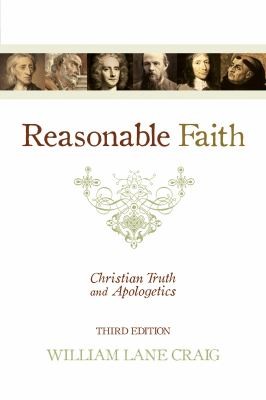
William Lane Craig: Reasonable Faith

 William Lane Craig, Reasonable Faith: Christian Truth and Apologetics, third edition (Wheaton, IL: Crossway, 2008), 416 pages, ISBN 9781433501159.
A third edition of what has become something a classic work in the field of Christian apologetics since its original (1984) and second (1994) versions is well worth the reading (or re-reading). The author insists it has only expansions of content and minor updates rather than any retractions of arguments that didn’t stand up to the test of time. In a word, it still packs quite an intellectual punch. And no wonder. It is the signature book of a very prolific scholar and writer. William Lane Craig is research professor of philosophy at Talbot School of Theology (La Mirada, California) and founder of Reasonable Faith (www.reasonablefaith.org), a web-based apologetics ministry. He has been publically debating with detractors, including the infamous former (subsequently) atheist, Anthony Flew, and defending a Christian worldview against all comers for more than twenty years. He’s especially noted for his unique take on the cosmological argument for God’s existence and also for his philosophy of time and criticisms of the Jesus Seminar movement and postmodernism. He’s authored more than twenty books, about half of which are scholarly in nature with the other half aimed at a more popular audience.
Craig freely admits that Reasonable Faith represents his personal approach to Christian apologetics. Accordingly, he recommends other, supplemental, texts on the history and development of apologetics for readers desiring a well-rounded understanding. Craig understands apologetics (Greek, apologia) to be “that branch of Christian theology which seeks to provide a rational justification for the truth claims of the Christian faith.” Accordingly, apologetics is primarily a theoretical discipline. However, this is not a concession that apologetics is of no practical benefit. Christian apologetics has a major role in shaping culture, strengthening believers, and evangelizing unbelievers. While he distinguishes between offensive or positive and defensive or negative types of apologetics, and affirms the validity of both, he explains that Reasonable Faith is more in the offensive or positive mode. That is, it seeks to present a positive case for Christian truth claims rather than to nullify objections to them.
On another hand, showing Christianity is true gives more priority to rational argumentation and evidence while expecting the Holy Spirit to work in hidden ways as well. Craig is confident that there are good arguments that can demonstrate the intellectual credibility of Christian truth claims to an honest and open-hearted hearer. Yet, it is refreshing in a book on apologetics, carefully defined as “providing rational justification” for the Christian faith, that there is such an energetic emphasis on the effective agency of the Holy Spirit in that process. This is possible in part because at its root unbelief is not only an intellectual but also a spiritual problem. Accordingly, the most effective apologetic is one which trusts in the agency of God’s Spirit even while it builds on rational arguments.
Nonetheless, Reasonable Faith does indeed readily utilize weighty rational argumentation. Arranging the discussion in a classical format, Craig presents positive evidence regarding the Christian faith (De Fide), humanity (De Homine), God’s existence (De Deo), creation or the natural order (De Creatione), and Jesus Christ (De Christo). Then, in a quite pastoral tone, Craig concludes by suggesting that “The Ultimate Apologetic” involves faithfully living out one’s relationship with God and with others in holy love. He is sure that “who you are rather than what you say” has more impact on unbelievers. The ultimate apologetic is the Christian life well-lived.
Most of the usual topics are covered in Reasonable Faith. For example, in its discussion of creation it presents a logical view affirming the possibility and reality of miracles. Miracles are often one of the major objections of the skeptic. Craig argues convincingly that far from being baseless superstition to believe in miracles, it is actually gross arrogance, intellectually speaking, to deny them categorically. It’s surprising that Reasonable Faith doesn’t straightforwardly take on the topic of religious pluralism or the reality of world religions. However, it does here and there address these somewhat as they come up as a matter of course during the ongoing conversation. Accordingly, Craig sometimes briefly discusses the views of, for example, Jews on Jesus Christ and the “Jewish reclamation of Jesus”, especially of his ethics, and their objections to his resurrection. In fact, his kalām cosmological argument is drawn in large part from Islamic theologians, especially al-Ghāzalī, as he responds to Aristotelian challenges. Notably, Craig describes the cosmological argument positively in terms of its roots in ancient Greek thinkers, such as Plato and Aristotle, and its development by Islamic, Jewish, and Christian thinkers through the ages. However, he insists that the centrality and essentiality of the person of Jesus Christ is quite unique to Christianity and completely apart from the perspectives on Moses in Judaism, Buddha in Buddhism, or Mohammed in Islam. And Craig clearly rejoices when a former Muslim who had become something of an atheist converts to Christ after reading Christian apologetics on Jesus’ resurrection. One of the recurring ideas of Reasonable Faith is that apologetics is an aid to evangelism.
In something of a departure from C. S. Lewis’s well-known argument that the repeated occurrence of “a dying and rising god” in ancient pagan myths may have pointed ahead to the truth of the dying and rising again of the Son of God in an actual historical occurrence, Craig denies that ancient religions actually had such a mythical tradition and suggests the examples commonly used of their existence aren’t all that credible. Craig seems to be intent on demonstrating the utter uniqueness of Christ’s resurrection so as to underscore its greater likelihood of not being fabricated while Lewis and others have seen more of a promise-fulfillment/precedent-occurrence pattern as positive evidence of the rationality and validity of Jesus’ bodily resurrection. In any case, one of the better parts of the book is where Reasonable Faith turns the tables on scoffers and skeptics in exposing the weaknesses of their arguments against Jesus’ own self-understanding of his identity and their obviously biased objections to the reality of his resurrection.
Craig is concerned that secularists, in the aftermath of 9/11 terrorist attacks by Muslim jihadists, have become aggressive in denouncing religious belief in general. He never misses a chance to point out the dangers of secularism or to poke fun at the rational inconsistencies of secular skeptics like Richard Dawkins and others on, for example, topics like Intelligent Design. He charges that the well-known atheistic scientist often ridicules but never refutes Christian arguments for theism. Again, Craig almost gleefully exposes the inconsistencies of skepticism’s greatest thinkers, such as Nietzsche and Sartre, who wished to reject moral absolutes and their witness to God even while they spoke and acted as moralists in rejecting, for example, the anti-Semitism which at its root denies human dignity and value. Again and again Reasonable Faith argues that Christianity is consistent with a rational worldview, and that atheism and agnosticism are often embraced under quite irrational terms.
As stated above, Craig freely confesses that he is writing for Christian theism. Nevertheless, the majority of the book’s arguments could be construed simply as a case for theism in general. In other words, much of it would be just as applicable for Judaism or Islam as for Christianity. The most notable exception is the section on Jesus’ self-understanding and resurrection. The chapter on “How do I know Christianity is true?” also stands out as distinctively Christian. This overlap is quite understandable and not at all problematic since these are all theistic, and even monotheistic, faiths which would necessarily share a similar rationale. It is quite natural that theism in its various forms would join forces against atheism in all its forms. However, the book would perhaps have had a bit more of an honest ring to it if the shared intellectual turf had been humbly and openly confessed.
Reasonable Faith covers heavy material but is written in comparably clear language. When the material gets too technical, personal examples help too, as do line drawn figures. Footnotes are kept to a minimum, but Cited or Recommended Readings at each chapter’s end and an Index are helpful aids for researchers. Reasonable Faith should be an eminently useful text for seminarians and perhaps university philosophy students and teachers.
Reviewed by Tony Richie
Preview Reasonable Faith: books.google.com/books?id=DZ8XzHSJpd4C











Tony Richie says: "Glad to see that PR has made my review of this classic text available online–for free! I appreciate the mission of PNEUMA REVIEW. And if you're looking for a book that addresses in depth the hard questions of Christian faith in a secular and pluralistic world, this is it because–well, you can read the review for the 'because'."
Tony Richie says: “Glad to see that PR has made my review of this classic text available online–for free! I appreciate the mission of PNEUMA REVIEW. And if you’re looking for a book that addresses in depth the hard questions of Christian faith in a secular and pluralistic world, this is it because–well, you can read the review for the ‘because’.”