In the updated version of The Third Force in Missions: A Pentecostal Contribution to Contemporary Mission Theology (Hendrickson Publishers, 2016), Paul A. Pomerville offers an amplified reiteration of the major premises of his earlier work (Hendrickson, 1985), namely, that Pentecostalism is enacting a biblical reading which challenges theologies skewed by the claims of dispensationalism on mission theory and praxis, and that indigenous Christianity of the Southern Hemisphere offers viable examples of authentic engagement with the Bible. In fact, that engagement is unhampered by Western assumptions that threaten to contradict inherent Southern sensibilities regarding the existence of the spiritual realm. In regard to the vigor of the contemporary Pentecostal missions phenomenon, Pomerville offers that setting the movement apart as distinctive is in order. Not only does Pentecostalism don well its appellation as “The Third Force” of Christian expression after Roman Catholicism and Protestantism, Pomerville posits the justification of the term “first force” in twenty-first century missions as a possible descriptor pointing to the undisputed vigor of Southern missions today. That “force” manifests an impressive record of strides made within and emanating from that zone out to the world—much of which has been underreported. Its efficacy is also found in its potential to engage sensitively with the growing Islamic population. Pomerville sees the church of the South, rather than the church of the North, as the hope for Islam.
Paul A. Pomerville
In other words, what Pomerville does this second time around is to point to the undeniable vigor of the Pentecostal phenomenon in the Southern Hemisphere, and coming out of the South these past 30 years, where the movement is producing a contagious and enduring transcultural spirituality. Also, this time Pomerville reflects not just on the dangers of dispensational theology in terms of major blind spots counterproductive to sound hermeneutics (i.e., a hollow eschatology and an anemic ontology of the kingdom of God). As well, his concern targets the dangers to the ongoing mission of the Christian church that lay couched in an abiding silence on the role of the Holy Spirit and a suspicion of the concept of revelation as a dynamic activity.
Pentecostalism is undoubtedly at the forefront of the Christian global landscape.
Pomerville laments that Pentecostals have sought to accommodate incompatible elements of evangelicalism. One of the keys to correcting Western distortions is the realization that the Christ is the sign of triumph in ways that supersede the nationalism of Zionist dispensationalism, pointing rather to an eschatological fulfillment explicated in the faith and praxis of the disciples of the early church. Dispensationalist inclinations have made insidious inroads, impacting evangelicals and Pentecostals of the North, Pomerville offers, and the remedy is a robust Trinitarian use of missio Dei, an unapologetic appreciation for the agency of the Spirit in the New Testament church, and a biblical theology which can replace dispensational theology with an alternative that is moored to the “Christ-event” as the “mid-point” of the biblical meta-narrative. Herein is mission strategy also retrieved for honest engagement with all of the implications of Pentecostal life and expression; “theologizing” is freed from the ill-fitting yoke of scholasticism.
“Before Douglas Petersen, Allan Anderson, Veli-Matti Karkkainen, Andy Lord, Julie Ma, et. al., Paul Pomerville was charting the contours of a distinctively Pentecostal missiology. This revised edition of the The Third Force in Missions is not only prophetic with a three-decade hindsight in terms of the relevance of Pentecostal-charismatic Christianity for global mission in the third millennium, but it may even be understated in the sense that the other two ‘forces’ intimated in the title may well be riding on the coattails of their Spirit-filled and empowered upstarts. Whether the reader is coming again or is new to this book, Pomerville is a sure guide for the task of Christian mission theology in the present context.”
—Amos Yong, Professor of Theology & Mission, Fuller Theological Seminary
Pomerville’s text leaves us with at least one correction and a challenge. In answer to the issue of the gaps in the reporting on Pentecostalism in the South, he supplies data to reflect a truer portrayal in numbers of the movement’s actual scope today. Pentecostalism is undoubtedly at the forefront of the Christian global landscape. As well, Pomerville is sending out a fresh challenge to Pentecostal scholarship, and if I am gauging the terrain accurately, “the water has been stirred” and the academy is experiencing an upsurge of voices saying the same thing, that Pentecostal-Charismatic spirituality is poised for the presentation of articulate constructs which more adequately explain Pentecostal engagement with the Spirit, the Word, and the world.
Anna M. Droll, M. Div. (Fuller Theological Seminary), is ordained with the Assemblies of God and is a district-appointed missionary, having founded Kairos Global Missions in 2012 with her husband Raymond. Her ministry is focused in Africa where she also served as Communications Coordinator for Global Teen Challenge Africa. She is adjunct professor of Evangelism and Missions at Southeastern University and adjunct professor of Old Testament at Northwest University. She is finishing her PhD work with advisor, Amos Yong, exploring dreams and visions in African Pentecostal spirituality. A forthcoming publication will be articles to be presented in the Encyclopedia of Christianity in the Global South on Christianity in the West African countries of Togo and Benin. Facebook
Thomas C. Oden, Turning around the Mainline: How Renewal Movements are Changing the Church (Grand Rapids: Baker, 2006), 270 pages. This latest book by Thomas C. Oden gathers together for the first time the prevailing themes and documents of the confessing and renewal movements within mainline denominations. It also includes a case study concerning the…
Douglas S. Bursch, The Community of God: A Theology of the Church from a Reluctant Pastor (Seattle, WA: Fairly Spiritual, 2017), 240 pages, ISBN 9780692868386. As the last word of the title of this book indicates Douglas Bursch is a pastor; he is affiliated with the Foursquare Church. In addition to pastoring he serves on…
Martin Robinson & Dwight Smith, Invading Secular Space: Strategies for Tomorrow’s Church (Grand Rapids: Monarch Books, 2003), 221 pages, ISBN 9780825460500. This book assesses the crisis of the Western church and proposes strategies for recovering the missional character of the church. According to Robinson and Smith, the mission of the church in the apostolic period…
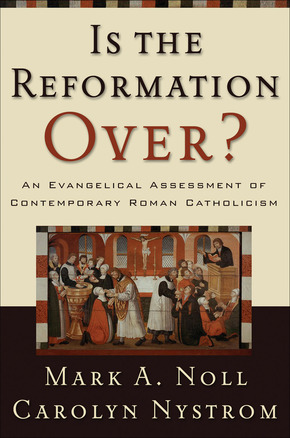
Mark A. Noll and Carolyn Nystrom, Is the Reformation Over?: An Evangelical Assessment of Contemporary Roman Catholicism (Baker Academic, 2005), 272 pages, ISBN 0801027977. “Is the Reformation Over?” This is the question raised in a recent book by Mark Noll and Carolyn Nystrom. In this work, the authors do not attempt a “final” or…
Andrew D. Clarke, Serve the Community of the Church: Christians as Leaders and Ministers (Grand Rapids: Eerdmans, 2000), 305 pages. Clarke’s interest lies in discerning the attitude towards leadership in the early church, in New Testament times. Rejecting the traditional, protestant position that the early church was essentially a charismatic community which, through time,…
A report from the 2014 Anglican Diocese of the South Intercessory Prayer conference by William De Arteaga. The conference was convened at Holy Cross Anglican Church in Loganville, Georgia, from August 27 – 28, 2014. I had the privilege of speaking and participating in the intercessory prayer conference sponsored by the Anglican Diocese…
To provide the best experiences, we use technologies like cookies to store and/or access device information. Consenting to these technologies will allow us to process data such as browsing behavior or unique IDs on this site. Not consenting or withdrawing consent, may adversely affect certain features and functions.
Functional
Always active
The technical storage or access is strictly necessary for the legitimate purpose of enabling the use of a specific service explicitly requested by the subscriber or user, or for the sole purpose of carrying out the transmission of a communication over an electronic communications network.
Preferences
The technical storage or access is necessary for the legitimate purpose of storing preferences that are not requested by the subscriber or user.
Statistics
The technical storage or access that is used exclusively for statistical purposes.The technical storage or access that is used exclusively for anonymous statistical purposes. Without a subpoena, voluntary compliance on the part of your Internet Service Provider, or additional records from a third party, information stored or retrieved for this purpose alone cannot usually be used to identify you.
Marketing
The technical storage or access is required to create user profiles to send advertising, or to track the user on a website or across several websites for similar marketing purposes.


 Paul A. Pomerville, The Third Force in Missions: A Pentecostal Contribution to Contemporary Mission Theology (Hendrickson Publishers, 2016), 276 pages, ISBN 9781619707689.