
Aida Besancon Spencer: The Exegetical Process
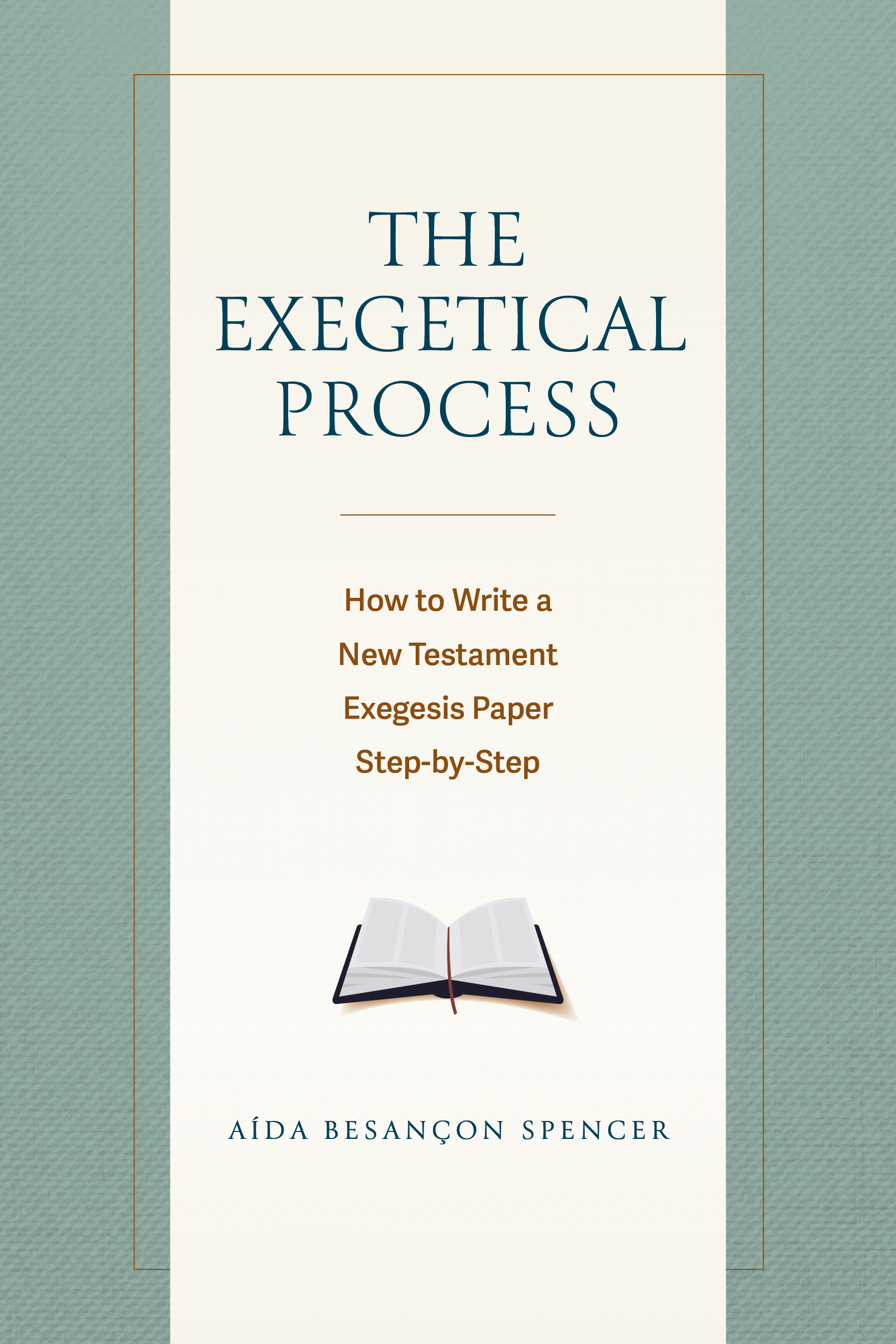 Aída Besançon Spencer, The Exegetical Process: How to Write a New Testament Exegesis Paper Step-by-Step (Kregel Academic, 2025), 274 pages, ISBN 9780825449161.
Aída Besançon Spencer’s The Exegetical Process offers a comprehensive, step-by-step guide to New Testament exegesis designed primarily for seminary students and undergraduate biblical studies programs. The work systematically addresses each stage of the exegetical task—from initial text selection and translation through historical-cultural analysis, grammatical-syntactical investigation, literary context, theological synthesis, and contemporary application. What distinguishes Spencer’s handbook from others in the field is its granular level of procedural detail, complete with assessment rubrics for each exegetical component, and an extensive collection of reference charts, tables, and resource lists designed to support students through every phase of research and writing.
The Exegetical Process enters a well-established field of exegetical handbooks, positioning itself alongside Gordon Fee’s now-classic New Testament Exegesis and other methodological guides that have served generations of students. Spencer, an experienced New Testament scholar and professor emerita at Gordon-Conwell Theological Seminary, brings considerable pedagogical expertise to this task. The result is a highly structured, mechanically precise guide that will prove valuable for certain learning contexts while simultaneously raising questions about its broader applicability.
The volume’s most distinctive contribution lies precisely where Spencer intends it: in its relentlessly systematic, step-by-step approach. Unlike many exegetical handbooks that describe the interpretive process in more general terms, Spencer provides exhaustive detail at each stage, breaking down complex exegetical tasks into discrete, manageable components. For instructors seeking to demystify biblical exegesis for beginning students—particularly those lacking strong backgrounds in hermeneutics or biblical languages—this granular approach offers genuine advantages.
Most notably, Spencer includes detailed grading rubrics for each component of the exegetical process. This feature distinguishes The Exegetical Process from its competitors and addresses a genuine pedagogical need. Seminary and Bible college instructors often struggle to communicate assessment expectations clearly, and students frequently complain about the opacity of grading criteria for exegesis papers. Spencer’s rubrics provide concrete standards, specifying what constitutes exemplary, adequate, or deficient work at each stage. This transparency serves both fairness and learning outcomes, helping students understand not merely what to do but how well they should do it.
Spencer provides scaffolding that can help students internalize good exegetical habits.
Additionally, Spencer enriches the volume with numerous reference charts, graphs, and tables that function as practical tools throughout the exegetical process. These include terminological glossaries, taxonomies of grammatical and syntactical categories, lists of ancient sources (including extrabiblical Jewish and Greco-Roman literature), curated bibliographies of contemporary scholarly resources organized by exegetical topic, and visual aids for discourse analysis and semantic mapping. These reference materials transform the handbook from mere procedural guide into a portable research companion. For students unfamiliar with the landscape of New Testament scholarship or uncertain about which lexicons, commentaries, or databases to consult, these lists provide invaluable orientation. The charts on rhetorical devices, figures of speech, and argumentative structures offer quick-reference tools that students can apply directly to their textual analysis. This apparatus represents a significant practical contribution that extends the book’s utility beyond its methodological instruction.
However, the volume’s strengths paradoxically generate its most significant limitations. Spencer’s approach is markedly idiosyncratic, reflecting her particular pedagogical preferences and methodological commitments in ways that may not translate well across different institutional contexts or learning environments. While the exegetical terrain she covers substantially overlaps with Fee’s New Testament Exegesis—textual criticism, translation, historical-cultural background, lexical-syntactical analysis, theological interpretation, and contemporary application—her specific procedures and emphases often diverge in ways that seem arbitrary rather than methodologically motivated.
The step-by-step format, while initially appealing, risks fostering a mechanical, almost formulaic approach to biblical interpretation. Exegesis is fundamentally an art as much as a science, requiring interpretive judgment, synthetic thinking, and the ability to recognize which questions matter most for a given text. Spencer’s highly structured methodology may inadvertently obscure this reality, training students to follow prescribed steps rather than develop interpretive discernment. The danger is producing students who can execute exegetical procedures competently but struggle to think like exegetes—to recognize when standard approaches require modification, when certain steps deserve more or less attention, or how the various analytical stages integrate into a coherent interpretive argument.
Moreover, Spencer’s idiosyncratic details sometimes seem to reflect personal preference rather than exegetical necessity. Experienced instructors who have developed their own effective approaches may find Spencer’s specific requirements constraining rather than helpful. The risk is that the volume’s utility becomes tied too closely to adopting Spencer’s entire system rather than serving as a flexible resource that instructors can adapt to their particular contexts and emphases.
Gordon Fee’s New Testament Exegesis remains, in this reviewer’s judgment, the more helpful resource for most contexts. Now in its third edition, Fee’s handbook has proven its staying power precisely because it avoids Spencer’s level of prescriptive detail. Fee provides a clear, comprehensive overview of the exegetical task while maintaining sufficient flexibility for instructors to adapt his approach to their particular pedagogical goals and institutional contexts. His discussion is more discursive, offering methodological rationale alongside practical guidance, helping students understand not merely how to do exegesis but why particular procedures matter.
Fee also demonstrates greater sensitivity to the diversity of New Testament genres, providing genre-specific guidance that recognizes how exegetical priorities shift when moving from gospel narrative to Pauline argumentation to apocalyptic literature. Spencer’s more uniform approach, while simpler to follow, may not adequately prepare students for the genre-sensitivity that mature exegesis requires.
Furthermore, Fee’s integration of exegetical method with broader hermeneutical reflection provides students with a more robust theological framework for their interpretive work. Spencer’s focus on procedure, while pedagogically valuable, offers less guidance on the theological and hermeneutical questions that ultimately shape how one approaches the biblical text.
This is not to suggest that The Exegetical Process lacks value. For specific contexts—particularly undergraduate Bible programs, introductory seminary courses, or institutions where students arrive with minimal interpretive training—Spencer’s detailed scaffolding and explicit assessment rubrics may prove extremely beneficial. The volume could serve effectively as a supplementary text alongside Fee or other handbooks, with instructors selectively utilizing Spencer’s rubrics and detailed guidance for particular exegetical components while drawing on other resources for broader methodological perspective.
Spencer has produced a conscientious, pedagogically motivated handbook that reflects deep teaching experience and genuine concern for student learning. Her commitment to assessment clarity addresses a real need in biblical studies education. However, the volume’s idiosyncratic character and methodologically prescriptive approach limit its broader utility. Instructors should carefully evaluate whether Spencer’s specific system aligns with their pedagogical goals and institutional context before adopting it wholesale.
For most seminary and graduate programs seeking a comprehensive, methodologically sound, and pedagogically flexible exegetical handbook, Gordon Fee’s New Testament Exegesis remains the superior choice. Spencer’s The Exegetical Process offers a valuable alternative for specific teaching contexts but seems unlikely to displace Fee as the standard reference in the field.
Reviewed by Rick Wadholm Jr
Publisher’s page: https://www.kregel.com/biblical-studies/the-exegetical-process/

Category: Biblical Studies, Fall 2025

 Followers
 Fans
Fans