
John MacArthur’s Strange Fire, A Brief Biblical Response by Jon Ruthven
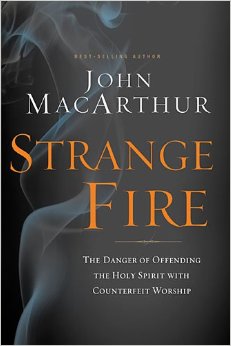 John MacArthur, Strange Fire: The Danger of Offending the Holy Spirit with Counterfeit Worship (Nashville, TN: Nelson Books, 2013), 333 pages, ISBN 9781400206414.
As we shall see, John MacArthur’s abhorrence of “further revelation” via prophecy and related spiritual gifts derives, not from scripture, but from the frustration of Calvinists under Oliver Cromwell (1599-1658) of watching so many of their members defect to the Quakers, the crazy charismatics of the time. People were falling down, making a lot of noise and encountering Jesus in visions, prophecies, and healings. Sound familiar? Calvinist scholastics responded to this outrage with the Westminster Confession of Faith (WCF)—often now regarded as the gold standard of Calvinist theology.
Despite the charismatic experiences of even some of the authors of the WCF, and especially their founder, John Knox, whose charismatic experiences were abundant and powerful, the dogmatists managed to ram through this narrow, unpopular paragraph in 1646, which, was to be imposed by threat of death on the British Isles—including Catholic Ireland. This curious history is thoroughly documented in a revised PhD dissertation by Garnet H Milne, The Westminster Confession of Faith and the Cessation of Special Revelation (Milton Keynes, UK: Paternoster, 2007). See review in Pneuma 31:2 (2009), 318.
1. … It pleased the Lord, at sundry times, and in divers manners, to reveal Himself, and to declare that His will unto His Church [Heb 1:1] and afterwards for the better preserving and propagating of the truth, and for the more sure establishment and comfort of the Church against the corruption of the flesh, and the malice of Satan and of the world, to commit the same wholly unto writing [Prov22:19-21; Lk1:3; Rom15:4; Mt 4:4]; which makes the Holy Scripture to be most necessary [2Tm 3:15; 2Pt 1:19]; those former ways of God’s revealing His will unto His people [miracles, prophecy] being now ceased [Heb1:1-2]. [Emphasis mine]
When the WCF was presented to Parliament for approval, the suspicious representatives bounced the document back, quite reasonably fearful that this document was asserting itself as a substitute for scripture itself. They demanded that the writers support every claim in the Confession with a clear grounding in the Bible. The writers grudgingly complied, though their exegetical skills fell far short of supporting their elaborate theologizing. If you can make sense of how these scripture verses they added [in brackets] support the dogmatic claims in this paragraph, then you are a far more insightful exegete than I.
Yet, this paragraph 1 of the WCF is the principal grounds for John MacArthur’s rejection of continuing revelation—except as it appears in “non-propositional” expression in the revealing scriptures and in the Calvinist ordo salutis (Latin, “order of salvation”) : Predestination, Election, Calling, Regeneration, Faith, Repentance, Justification, Sanctification, Perseverance, Glorification (MacArthur, Strange Fire, 179-230). Despite the concession that “revelation” occurs normatively today in these Calvinist stages of salvation, MacArthur insists the gifts of “continuing revelation” such as prophecy and words of knowledge have ceased.
It is against MacArthur’s amazing claim that I produced What’s Wrong with Protestant Theology: Traditions vs. Biblical Emphasis (Tulsa: Word & Spirit, 2013). In this book, I argue on a transparent “hermeneutic of emphasis.” Such a hermeneutic is not about what the Bible says—you can make it “say” anything—but about what it emphasizes. What I found was that the Bible not only does not teach cessation of prophecy, but that the revealed, prophetic word is the central, normative experience of the Bible.
Proof of this is:
- Denial of the direct, immediate voice of God is the central temptation for mankind. In Genesis 3 this is Eve and Adam—mankind; in Exodus 20 the Israelites; in Matthew 4 and Luke 4, Jesus; and in Hebrews 12 all the rest of us. We are commanded, “Do not refuse the One who speaks [present tense]” (Heb 12:25). Hebrews emphasizes: “Today, if you hear his voice” (Ps 97:5; Heb 3:7; 3:15; 4:7).
- The central plot line of all of God’s role models—Adam, Noah, Abraham, Isaac-Jacob, Joseph, Moses, Joshua, the Judges, the prophets, Jesus, and the apostles—is that they hear the voice of God and obey it under great resistance. This is, likewise, to be the normative pattern for the reader.
- The goal of the Bible is the New Covenant. What’s Wrong shows that the essence of this New Covenant is the Spirit of prophecy and revelation. The punch line of the Pentecost sermon is to cite a totally neglected (for dogmatic reasons) programmatic prophecy, Isaiah 59:21 (See Appendix IV in the second edition of Jon Ruthven, On the Cessation of the Charismata: The Protestant Polemic on Miracles [Tulsa: Word & Spirit Press, 2011]). This parallels the more often quoted New Covenant passage about the revealed Law “in the heart” (compare Jer 31:33 to 2 Cor 3 and Heb 8-12).
- The mission of Jesus was not simply to “die on the cross for our sins”—this focus is based on the Reformation need to answer the great question of that time: “How much does it cost to go to heaven?” Romanist priests were charging money for indulgences to get sprung from Purgatory (Read What’s Wrong for a more complete explanation). However, the biblical mission of Jesus is explicit: “He will baptize you in the Holy Spirit” and this meant to receive the New Covenant Spirit of revelation and utterance. Jesus’ death on the cross was not the New Covenant itself: it crucially ratified and mediated the New Covenant, which is the Spirit (Heb 8-10). No cross, no New Covenant Spirit.
- The content of Jesus’ teaching to his disciples must not be ignored (as Protestants do). What did Jesus teach his disciples to do? What is the content of the “mid-term exams” in Matthew 10; Mark 6; Luke 9&10, repeated in Matthew 28:19-20 and Acts 1:8? It’s all about expressing the Spirit in power. Traditional Protestants dismiss these early commissions as only for the “apostles,” showing that they understand NT apostles as 16th century popes, not as role models for the reader. However, Paul says, “Imitate me as I imitate Christ” (1Cor 11:1; cf. Heb 6:12).
- The Eucharist of 1 Corinthians 11 must be tied to its context, 1 Corinthians 12. “Discerning the body” means to discern the “New Covenant in my blood,” which is the “body” of charismatic believers whom the Corinthian elitists were rejecting. By breaking Jesus’ covenant of the Spirit and gifts, “many of you are weak, sick, and have fallen asleep”—a situation that could have been avoided had they allowed these members of Jesus’ body to function in healing, prophecy, etc.
- Countless verses of scripture teach the continuing gift of prophecy and other charismata. For example, “the charismata and calling of God are not withdrawn” (Rom 11:29). God ideally “energizes all of the gifts in everyone” (1Cor12:5). “In the last days I will pour out my Spirit on all flesh” (Acts 2:17, quoting Joel 2:28. To see we are in the last days, refer to 2 Tm 3:1; Heb 1:1-2; 2 Pt 3:3). For more on this, see On the Cessation of the Charismata, especially the fourth chapter for a summary.
Here is the bottom line. Contrary to the far away Protestant tradition that denies the New Covenant Spirit of prophecy and power, the Bible itself makes the reality of the prophetic Spirit of Jesus the central experience of the Christian message.
I realize that all this seems radical and extreme. But I urge you to examine for yourself the supporting biblical arguments for all this—as opposed to the fiat dogmatics of scholastic Protestantism.
PR








Jon Ruthven, this is your signature topic. You always add so much to the discussion. You should keep writing about this and introduce others to your excellent work on the charismata.
This is a wonderful response from the professor of my Doctor of Ministry program @United, Dr. Jon Ruthven, author of "What's Wrong with Protestant Theology?"
Thanks for posting this Mike; I've read all of the other articles you listed as well.
Poor John MacArthur. We can hope he is mostly preaching to the choir.
Thank you for the link! I had heard about Dr. Ruthven once before but didn't know he moved to United Theo. Seminary. I would love to read this when I get a chance this week.
I've heard that this is a good book, maybe some furlough. Too bad we just had one.
I hear about Dr. Ruthven frequently in my household…never met the man but from what I hear from my wife…I highly honor and respect him.
Great response from Dr. Jon Ruthven.
This is a great response from my Doctor of Ministry Professor Dr. Jon Ruthven!
Tell us what you think: What place does experience or history have in the debate about the contemporary ministry of the Holy Spirit?
Invitation to readers: develop a TL;DR summary of this review.
Dr. Ruthven, again I thank the Lord for your ministry and for your example of being a true defender of Gospel truth. Your latest book is a must read for all called to the ministry. As Paul said, "For the Kingdom of God does not consist in words, but in power".
Great response from Dr. Jon Ruthven.
Jon Ruthven, this is your signature topic. You always add so much to the discussion. You should keep writing about this and introduce others to your excellent work on the charismata.
This is a wonderful response from the professor of my Doctor of Ministry program @United, Dr. Jon Ruthven, author of “What’s Wrong with Protestant Theology?”
This is a great response from my Doctor of Ministry Professor Dr. Jon Ruthven!
Invitation to readers: develop a TL;DR summary of this review.
Tell us what you think: What place does experience or history have in the debate about the contemporary ministry of the Holy Spirit?
Dr. Ruthven, again I thank the Lord for your ministry and for your example of being a true defender of Gospel truth. Your latest book is a must read for all called to the ministry. As Paul said, “For the Kingdom of God does not consist in words, but in power”.