The Speaking in Tongues Controversy: Reader Responses

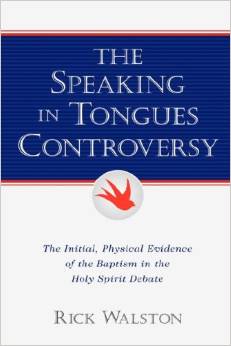
Thank you for joining us to discuss Rick Walston’s book The Speaking in Tongues Controversy: The Initial, Physical Evidence of the Baptism in the Holy Spirit.

Rick Walston, The Speaking in Tongues Controversy: The Initial, Physical Evidence of the Baptism in the Holy Spirit (Fairfax, VA: Xulon Press, 2003), 235 pages.
Part 1 of A Narrative-Critical Response
Part 2 of A Narrative-Critical Response
I would like to thank readers for sending us their comments, especially Pastor Bernal who is founder of New Life Consulting Ministries and a student at Columbia Evangelical Seminary.
Dear Editor, Raul Mock:
I am a little taken back that Dr. Rick Walston was asked to submit a rebuttal of the critique that Dr. Graves gave him within two issues of Pneuma Review, and then his rebuttal is not going to be published.
This is not academic nor is it responsible journalism. It is unfair and dishonoring to allow a critique of a person’s work, and then not give him a chance to respond to the critique.
I have known Dr. Walston for over ten years now, and he is not only academic in his writings, but a sincere and true Pentecostal.
I was very impressed with his book, The Speaking in Tongues Controversy and after reading it I remember saying, “Finally, someone who has the ability and intelligence to bring to light the issues that surround the controversy.” I also did not feel that he watered down, Pentecostal theology, or made steps backwards but rather, “blazed” a path forward to give pentecostals a clearer understanding of the presence and evidence of the Holy Spirit in their lives.
Sincerely,
Adrian A. Bernal
Response from the Editor
Greetings from the Pneuma Foundation.
Thank you for writing, Pastor Bernal, about the conversation the Pneuma Review has started about Dr. Walston’s book The Speaking in Tongues Controversy.
The editorial committee shares your disappointment about not hearing from Dr. Walston in the Pneuma Review regarding his book and the topic of initial evidence and separability/subsequence. Dr. Walston did submit a response to Robert Graves’ critique of his book, but we were unable to publish it as submitted. Dr. Walston has informed us that due to time constraints he will not be able to revise his response in the near future.
Readers, such as yourself, are invited to respond to Robert Graves and further this discussion about glossolalia as initial evidence of the baptism in the Holy Spirit, and the separability and subsequence of that experience. There are many Pentecostal/charismatic leaders that disagree with Robert Graves’ conclusions. It would be helpful to hear from others why they disagree—even as they share core beliefs and the contemporary ministry of the Spirit.
Thank you again for writing.
In the love of the Father,
Raul Mock
Executive Editor, Pneuma Review
I was very disappointed in the critical response which Dr. Graves submitted to the Pneuma Review. I have personally read Dr. Walston’s work, The Speaking in Tongues Controversy and believe that Dr. Walston’s approach to the subject was thorough and cognitive.
Dr. Graves appears to approach the author, Rick Walston, with a personal attack rather than a scholarly one. He states in his conclusion in Winter 2006, “…[f]urthermore, all of these issues are pervaded by a sense of staleness and amateurism due to Walston’s omission of current scholarship” (p. 11). In addition he states that Walston, “…uncritically accepts Fee’s unwarranted and, now, outdated conclusions concerning authorial intent…”
First, I didn’t realize Dr. Walston’s scholarship was in question. This approach to criticism is ancient and a worthless one at that. “If one can discredit the author, then anything the author states is therefore wrong.” I personally know Dr. Walston, and I can attest to his integrity regarding his academic and scholarly pursuits. Not to mention that he is very Pentecostal. He even says so in the work that is in question.
Secondly, Dr. Graves discredits the usage of outdated work by Gordon Fee, yet Dr. Graves uses the same method in critiquing Walston’s work. Throughout the entire critique he uses the arguments that have been used as stepping stones to the initial, physical evidence of the baptism in the Holy Spirit and quotes from scholars of pentecostal persuasions.
Thirdly, I do agree that Dr. Walston does not take a more scholarly approach to his argument, but I can say that his book is able to be read by the scholar and common person alike. I tend to believe that most individuals appreciate Rick’s approach to using the popular level rather than the scholarly level.
In conclusion I would like to add that the common mistake Classical Pentecostals continue to make is the exclusion of brothers and sisters in the Lord, that are very spirit-filled yet do not speak in tongues. Even Paul had “desired” that all “would” speak in tongues, yet he does not say that they all “DID.”
Finally, the disrespect that Dr. Graves gives to Rick Walston in saying that, “You left too early. But you’re welcome to return,” is largely an arrogant approach to scholarship because it falsely assumes that somehow, Dr. Walston, “left” Pentecostalism, simply because he appears to be heading backwards in the progression of the Spirit over the last hundred years.
WOW! Very disappointing.
– Adrian A. Bernal
Tongues as initial evidence certainly is a controversy!
I own Walston’s book and I was looking forward to a discussion on initial evidence that would address some of the good points being made by non-classical Pentecostals (and third-wavers too). Though I am not yet convinced that scripture teaches this, there is something attractive about believing that God completed everything about our salvation (including our empowerment for service) at our salvation experience.
Something that bothered me about Graves’ critique: he himself acknowledges that Walston’s book is written to a popular audience but then expects it to have been written for an academic one. That seems sloppy to me, I think Graves should have been more gracious. To say that no “serious” scholars will disagree with classical Pentecostalism’s interpretation of Luke in a few decades smacks of ludicrous triumphalism. I don’t think younger generations that grew up in a postmodern society are going to accept classical Pentecostalism’s systematized theology about separability and subsequence so readily. Can you imagine a parishioner asking, “Why do I need to know if someone has been Spirit-filled? If they are doing what God has called them to do, isn’t that what is important?”
– RTE