Steven Studebaker: From Pentecost to the Triune God

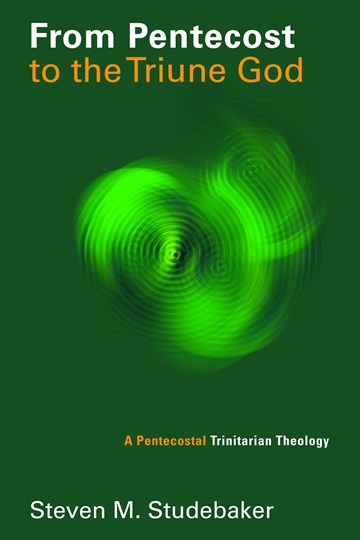
 Steven M. Studebaker, From Pentecost to the Triune God: A Pentecostal Trinitarian Theology, Pentecostal Manifestos series (Grand Rapids, MI: William B. Eerdmans, 2012), 270 pages.
In his monograph From Pentecost to the Triune God, Steven M. Studebaker argues that theological reflection upon “fundamental pneumatology” and Trinitarian theology has not played a significant role in Pentecostal thought. Consequently, he presents two goals for his text. The first is to show the importance of experience in theology. The second goal is to examine scripture for teachings on the trinity, especially its focus upon pneumatology. Methodologically, Studebaker advocates that theology should begin with experiences of the Spirit, move to an analysis on scripture, and end with reflection upon the trinity. He justifies this method on two grounds. First, since the Spirit is “indispensable” to the trinity and theology, it is logical for Pentecostals to move in this manner without subordinating Christ. Second, he ascribes to Rahner’s maxim that the immanent trinity reveals the economic trinity. The Spirit contributes to the identity of the Father and the Son, so anything that is learned about the Spirit reveals something about the trinity.
Studebaker begins his book by emphasizing the importance of experience within theology. He states that the writers of scripture draw upon experience, and experience, as it is conveyed in narrative, serves to teach. Furthermore, personal encounters with the Spirit can illuminate scripture because the text is also the result of the Spirit’s work. This does not mean that experience should be on the same level as scripture, but he suggests that what was once experience is now tradition. Studebaker proposes that, for Pentecostals, Spirit-baptism is a unique practice that should inform Trinitarian theology.
Studebaker continues by arguing for the priority of scripture, including what it reveals concerning the many facets of the Spirit. For example, it conveys that the Spirit is involved in both the creation and redemption of the world, including the incarnation and eschatology – which is evidenced within the resurrection. Furthermore, Pentecost, according to Studebaker, reveals that the Spirit is not merely an addendum but an essential dynamic of God’s activity within the world.
In chapter three, Studebaker discusses Eastern and Western trinitarian theology. He argues that explications of the processions are helpful but, generally, inadequate because they tend to subordinate the Spirit. Within the trinity “each person mutually conditions the others’ personal identities” (138). So, for Studebaker, the Spirit shapes the identity of the first and second articles as much as they shape the Spirit’s. The Trinitarian relations are “mutually contingent” (146).
In the subsequent two chapters Studebaker, discusses trintiarian theology within American Evangelicalism and the Charismatic movement. First, he predominantly focuses upon the work of Jonathan Edwards, pointing out shortcomings in Evangelicalism that can also be found in traditional Western theology. Specifically, Studebaker proposes that the Spirit’s work in redemption is not fully appreciated in this camp. Next, he examines the development of Trinitarian thought through several Pentecostal/Charismatic theologians. Although, among PC’s there is a general desire and an attempt to emphasize the role of the Spirit, Studebaker argues that they are only preliminary. PC theologians tend to remain within traditional frameworks and do not fully implement the role of experience in constructing a Trinitarian theology.
Studebaker, in the final section of the book, addresses Pentecostal theologies of religions and a theology of creation. In the penultimate chapter, he argues that the Spirit operates in the lives of people, regardless of their religion. It is not the religion that saves; rather, they are ways in which people respond to the Spirit. Studebaker suggests that from Pentecostal there is a universal outpouring of the Spirit and that Christian missions are acts of participation within the mission of the Spirit. In the final chapter Sudebaker explores how a theology of creation, which is guided by pneumatology and Trinitarian concerns, can impact Christian ecological concerns. The Spirit does not work from outside but within human-situatedness. The Spirit actualizes the inner communion of the trinity within creation.
Studebaker does not present radically novel ideas, but throughout his book he clearly elucidates many themes that preoccupy contemporary Pentecostal thought. One value of Studebaker’s argument is his ability to weave these concerns together to show their interrelatedness. Additionally, he offers notable insight to see the implications of these concerns for a robust trinitarian theology. Readers who tend to follow a Barthian approach to theology, however, may find his pneuma-centric method troubling. Nevertheless, it offers a challenge, which is deserving of consideration, to the Barthian school, who emphasize beginning with Christology.
My only significant critique is that some parts of Studebaker’s book could benefit from further clarification and elaboration. For example, when addressing Evangelical theology, he doesn’t provide a thorough rationale why he mainly focuses upon Edwards’ theology. A more thorough justification of this, particularly if it provided the foundation for contemporary Evangelical thought, would have been helpful. Moreover, in chapter six and seven Studebaker does not flesh-out how these ideas help us to understand the Spirit in relation to the trinity. He advocates a method that he does not fully advance. But, ultimately, Studebaker’s book presents a provocative proposal, and many readers will find this to be a valuable window into the current state, and possibly the future, of Pentecostal theology.
Reviewed by David Bradnick
Preview: https://books.google.com/books/about/From_Pentecost_to_the_Triune_God.html?id=TdWprZS46GUC
Publisher’s page: http://www.eerdmans.com/Products/6530/from-pentecost-to-the-triune-god.aspx