Grant Wacker: Heaven Below

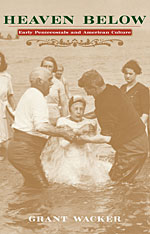
 Grant Wacker, Heaven Below: Early Pentecostals and American Culture (Cambridge, Massachusetts: Harvard University Press, 2001), 377 pages.
Readers of this journal tend to be inhabitants of the Pentecostal/charismatic movement, and are thus to some degree familiar with the theological terrain of the early Pentecostal movement. Pentecostals have not been, at least in the past, the best keepers of their own history. They have preferred to concentrate on evangelism and propagation in light of the “soon coming return of the King” (as I so often heard it expressed in my home church as a child) rather than wasting time on worldly things like records and oral histories. They did, however, leave a historical record in their printed justifications of their doctrine and doctrinal experiences. In recent years there have been a number of histories, pioneered by Edith Blumhofer and William Menzies among others, attempting to give an account of how Pentecostalism came to be. These accounts have tended to focus on the discovery of the theological distinctive of Spirit Baptism and how that distinctive survived and thrived.
Early Pentecostals defined themselves and were known to the outside world as those who “tarried” in the “upper room” until they had “prayed through” to the “baptism in the Holy Ghost and power.” But what were those believers like outside of the “upper room”? How did they manage to maintain the reality of their experience within the pressures of “real life”? It is this which has motivated Grant Wacker to crawl through the recycling bins of used bookstores and the shelves of archives and Bible colleges to retrieve this lost story. Wacker painstakingly excavates the world of these first Pentecostals because the “ideas, practices, and institutions they set in motion persisted long after their deaths and, to a great extent, continued to define Pentecostal patterns in America at the end of the twentieth century. From them later adherents learned what questions to ask of life and, perhaps more important, what questions not to ask.” (p.8) Wacker sifts through an enormous amount of evidence to allow us, eighty years later, to listen in on and observe the dynamic of the Pentecostal experience in the lives of these believers across the whole realm of human experience, from the upper room to the bedroom.
Heaven Below details the worldview and experience of life among early Pentecostals and the implications of Pentecostal belief in all areas of life, including some areas not previously focused on in standard Pentecostal histories: temperament, authority, rhetoric, customs, boundaries, nation and war, to name a few. All are examined in pursuit of establishing Wacker’s key premise for the book:
The genius of the pentecostal movement lay in its ability to hold two seemingly incompatible impulses in productive tension. I call the two impulses the primitive and the pragmatic…idealism versus realism, or principle versus practicality…Pentecostals’ distinctive understanding of the human encounter with the divine, which included both primitivist and pragmatic dimensions, enabled them to capture lightening in a bottle and, more important, to keep it there, decade after decade, without stilling the fire or cracking the vessel (p.10, author’s emphasis in italics).
The primitivist leaning of Pentecostalism is well documented; early Pentecostals (and many of their present day descendents within the Pentecostal and Charismatic tents) believed that by means of their baptism in the Holy Ghost they had bridged 18 centuries of institutional and experiential obstruction to direct contact with God, as had been experienced by the first believers in Christ on the day of Pentecost and after. But less known and, Wacker argues, less acknowledged has been Pentecostal pragmatism, the success that shows, “that at the end of the day pentecostals proved remarkably willing to work within the social and cultural expectations of the age. Again and again we see them holding their proverbial finger to the wind, calculating where they were, where they wanted to go and, above all, how to get there. That last instinct, the ability to figure the odds and react appropriately, made them pragmatists to the bone.” (p.13-14) Some may take this quote to mean that Wacker is accusing Pentecostals of being mere opportunists, who have naturally followed what works rather than what is right. In truth, some Pentecostals have been anointed more by the spirit of pragmatism than the Spirit of God—in larger truth, all believers in all ages have faced that temptation. But Wacker is not convicting Pentecostals of this; rather, he is pointing out that those first Pentecostals were adaptable and willing to change the way they delivered the message while keeping the content the same. This is perhaps the key lesson to take away from Wacker’s tome; if we are to honor our predecessors in the faith, we would do well to face our own culture with similar flexibility.
There is one curiosity about this otherwise excellent book; one senses at times that Wacker, given his background as an ex-Pentecostal who yet feels kinship with Pentecostals (ix-x), runs away from evaluation of and interaction with the cardinal doctrine that defined early Pentecostalism. Wacker insists that this is because his is a cultural history, and not a doctrinal history, listening “less to formal theological debates and more to the conversations that took place around the kitchen table.” (p.9) Granted, such an approach opens the door to examining life as it was lived, which helps to understand why Pentecostalism survived when other radical Evangelical movements (like John Alexander Dowie’s Zion Illinois community) did not. But without the theological background, the effect is at times like sitting in a car, marveling at it’s ability to move while studiously never engaging the engine and doing so.
However, let the reader be indulgent, the reward for doing so is great. As Pentecostalism enters its second century, perhaps the best way to celebrate the past is to read this book and be encouraged. The church faces change with each generation. For with each change the Spirit whispers the words of Christ, “Be not afraid little flock; it is the Father’s good pleasure to give you the kingdom.” We have an example set down in print in Heaven Below; let’s get to it.
Reviewed by Steven J. Brooks
Publisher’s page: http://www.hup.harvard.edu/catalog.php?isbn=9780674011281
Preview Heaven Below: http://books.google.com/books/about/Heaven_Below.html?id=BtWSkPO4y48C