Edward Irving’s Incarnational Christology, Part 3

Edward Irving’s Incarnational Christology: A Theological Examination of Irving’s Notion of Christ’s Sinful Flesh as it relates to the Fullness of the Incarnation
Edward Irving’s Incarnational Christology, Part 1
Edward Irving’s Incarnational Christology, Part 2
 This is the third of a three-part series by Trevor Martindale. He gives us an in-depth look at how Edward Irving, one of the 19th Century’s most important church leaders, understood the meaning of God coming in the flesh. What does that controversy have to teach us today?
Part Three: Assessing Irving’s Orthodoxy
“In my humble opinion, if the common interpretation of the Bible is to be followed, our friend [Edward Irving] is perfectly right, nay indubitably and palpably so: at all events, the gainsayers are utterly, hopelessly, and stone-blindly wrong.”[1] ~ Thomas Carlyle
Now that the framework of Irving’s theological views upholding his notion of Christ’s sinful flesh has been presented, this chapter evaluates his views in light of a wider perspective; by considering his historical position within the development of contemporary theology. The viability of his views will be assessed on this basis.
3.1. Questioning Irving’s Heterodoxy
The initial obstacle to the task of assessing Irving’s orthodoxy regards the question of how the notion of ‘heresy’ is to be approached. In Irving’s day, heresy was certainly thought of as “teaching that is regarded as [being] contrary to the basic confession of the church in some central point or points, such that the confession is endangered by it.”[2] A heretic was, therefore, a Christian whose divergent stance with regard to the faith involuntarily bars him from the path of salvation.[3] Yet such treatment of this issue has recently attracted stern criticism.
Post-modernity has produced increasingly anti-authoritarian attitudes towards the established church. This has resulted in orthodoxy being understood as a dogma that is imposed on people by a coercive authority while a heretic is understood to be a victim of suppression by an intolerant church.[4] Walter Bauer’s thesis on Orthodoxy and Heresy in Earliest Christianity argues that there were many prevalent orthodox forms of belief within the universal Christian community.[5] Consequently, these widespread and varied views were regarded as heterodox while simultaneously being upheld as authentic Christian expressions. Christianity could exist in a variety of forms and the lines between orthodoxy and heresy were indeterminate. Certainly, the valuing of diversity of opinion within post-modernity makes it possible for contemporary theologians to suggest that the category of ‘heresy’ is no longer applicable in the church today.[6] Excommunication for heresy is, therefore, no longer a viable possibility, especially when today’s heresy may become tomorrow’s orthodoxy.[7] The general sway of conclusions over recent years about Irving’s views (i.e. from being heretical to orthodox) bears witness to this phenomenon.
To be sure, Bauer’s thesis is in line with the post-modern criticism that categories of orthodoxy and heterodoxy are notions used by the establishment of the church to impose a controlling influence upon others. This criticism could well be applied to Irving’s situation, as his eventual deposition and official condemnation as a ‘heretic’ was a direct result of the elders of his own church disagreeing with his decision to allow the manifestation and operation of the gifts of the Holy Spirit within the church worship services. The ousting of Irving from the Church of Scotland could legitimately be viewed as a manipulation of religious politics that superseded the task of honest doctrinal inquiry. One could conclude, then, that any continuing debate over whether Irving was a heretic or not should be rendered obsolete, especially given that the Church of Scotland has since recanted from its incrimination of him.
However, the hasty rejection of notions of orthodoxy and heterodoxy, simply due to a critical attitude towards church government, carries with it the danger of a biased perspective. Exhibiting a willingness to entertain heresy based on the possibility of it becoming orthodoxy in future would be misguided, as there have been a number of heretical teachings that have consistently been opposed by the universal church in every generation.[8] H.E.W. Turner rejects Bauer’s overly critical thesis by arguing that the early church universally did, in fact, hold to a number of fixed elements of orthodoxy.[9] Howard Marshall emphasizes the presence of theological diversity among apostolic writers as well as a clear distinction between heretical and orthodox issues in the New Testament church.[10] Also, most evangelical authorities today agree that evidence within early church history and theology shows that boundaries for orthodoxy were present earlier and more widespread than Bauer had allowed.[11] Still, Turner agrees with Bauer’s call for the church to recognise the presence of theological diversity in the second century church, as well as the need for the recognition of doctrinal diversity within Christian teaching today.
Concerning Irving’s historical debate then, proponents and opponents alike have suffered from a tendency to assume an attitude that their conclusions are supported unequivocally throughout the whole of church history. Yet it is imperative for each generation that evaluates Irving’s views to recognise that the limits of their conclusions are no less derived from their own theological perceptions than it was from the original generation who condemned Irving. It is, therefore, prudent to state that the evaluation and conclusions that follow are influenced by a postmodern theological hermeneutic – in the sense that we do not intend to determine whether Irving was a heretic or not, but rather to recognise Irving’s place within the diverse and complex historical development of Incarnational Christology. We present this as an appropriate attitude for determining the viability of Irving’s views; in that while they might have been deemed heterodox from the established church at the time, it does not necessarily follow that he be guilty of heresy.
3.2. An Assessment in Contextual Theology: Federalist Foundations vs. Romantic Inclinations
The previous chapter illustrated the polemical nature of the debate over Irving’s orthodoxy. However, a simple exploration of the parameters of debate without conducting a detailed investigation of Irving’s perspective would result in the formation of biased conclusions based upon one’s own presuppositions, as has so often been the case in tempestuous theological debate. In order to avoid such pitfalls, this dissertation has not followed the conventional method of arguing for or against. Instead we seek to explore Irving’s place within the historical context of his theological tradition. Arguably, there is no theological viewpoint that can be fully understood without investigating the context within which it was formed.[12] Therefore, it is essential to identify two relevant contextual factors affecting Irving’s theology.
David Dorries has recently examined a significant contextual influence on Irving’s thought, calling attention to his possible attitude towards the Federal theological tradition.[13] Derived from the Latin ‘foedus’, meaning ‘covenant’, Federal theology came to be regarded as the most influential development of Reformed thought in the post-Reformation period.[14] The movement exhibited a highly scholastic approach to theological method,[15] which valued the systematic organisation of theological issues and relied heavily on Aristotelian philosophy, resulting in an increasing emphasis toward metaphysical and speculative theological questions.[16]
Considering the historical issue at hand, David Dorries attributes Irving’s views as being ‘orthodox’ primarily due to his position of stern opposition to his inherited theological tradition. Dorries bases his argument on the contribution of James B. Torrance, who claimed that Federalist confusion between the concepts of ‘covenant’ and ‘contract’ led to the portrayal of God as a contract-God rather than a covenant-God.[17] However, Peter Golding refutes this claim: “To assert, as Torrance does, that the federalists placed law before grace betrays not only a deep-seated theological bias, but a complete failure to understand the mindset of such men.”[18] Despite the fact that Federal theology has been susceptible to sharp criticism for the presence of an unhealthy emphasis on legal terminology due to syncretism within fiduciary culture, especially due to the ‘golden age’ of its seventeenth century developments,[19] we suggest Dorries’ conclusions to be unnecessarily extreme. Even if Dorries’ critique may correctly highlight an underlying theological weakness present within the tradition, his argument falls short of grasping the foundational issue that distinguished Irving’s theological views from his opponents. Instead, the mistaken impression is given that Irving was adamantly opposed to major foundational tenets held within Reformed theology. Yet there is much evidence to suggest that Irving saw his teachings as being wholly within his theological tradition.[20] Graham McFarlane comments: “He is no radical thinker in the sense that he proposes ideas that undermine traditionally accepted formulae. Quite the reverse: Irving may be understood as unfolding what has been in the tradition from its very genesis.”[21] Setting aside the issue of whether he was right or not, McFarlane shows a clearer grasp of where Irving saw himself in his standing with his theological tradition. Therefore, the possibility that Irving entirely opposed his theological heritage remains unsubstantiated. Furthermore, this leads to a conjunctive influence that has to be considered.
Hence we direct attention to the earlier contribution of Arnold Dallimore, who devoted a large portion of his investigation of Edward Irving’s life to his affinity with a movement known as Romanticism – a cultural movement influencing literary, artistic, political, religious and philosophical aspects of culture within the late eighteenth and nineteenth centuries.[22] Although, while Dallimore describes Irving’s modern dress sense and illustrates how his early interest in the romantic poets may have led to his particularly flamboyant style of preaching, he neglects to present any proper evidence for how this cultural movement directly influenced Irving’s theology.[23] Instead, Dallimore seems content enough to attribute the root of Irving’s unorthodoxy to his affiliation with Samuel Coleridge.[24] His justification for this is simply to allege that the contentious nature of Coleridge’s theology confused Irving’s Christology, leading him away from orthodox belief and into Unitarianism.[25] Upon this shoddy reasoning, he unilaterally concludes that “nothing whatsoever in Coleridge’s actions or writings qualified him to be addressed as an orthodox Christian, and to those who were truly orthodox Irving’s statements seemed utterly ridiculous.”[26]
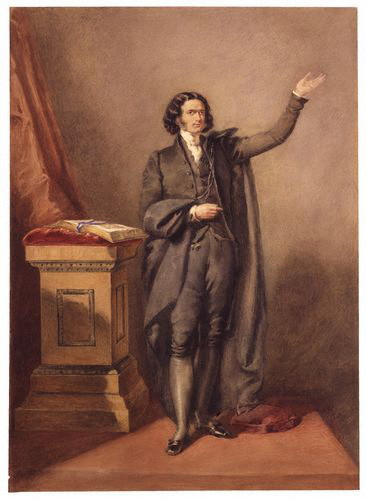
Image: Wikimedia Commons
Yet Dallimore’s claims are highly disputable. Graham McFarlane refutes the allegation that Irving’s views were Unitarian: “For it was in [the Hatton Garden] congregation that [Irving] began to defend his doctrine of God against the increasingly Unitarian interpretation of God which late eighteenth- and early nineteenth-century Deism spawned.”[27] McFarlane adds that the contemporary influence of Romanticism upon Irving caused him to refute the Unitarian heresy “in a manner that engaged with the issues rather than simply mouthing old formulae.”[28] Likewise, Claude Welch explains, “The work of Kant marked the end of a theological era…beginning a definite movement away from rationalism’s view of religion toward new ways of understanding theology that would be distinct from those of both orthodoxy and rationalism. This tendency was accelerated and carried farther by the new intellectual and spiritual climate of romanticism.”[29] This highlights the strength inherent within theological romanticism in that it rejected any rationalistic formulae, formulated within scholasticism, which had increasingly been regarded as resulting in the hindrance to the spiritual growth of Christian believers.[30] Conceivably, such evidence suggests that Dallimore was wholly mistaken about the result of Romanticism’s influence on Irving, as well as its wider influence on religious thought.
Irving was so characteristically linked to this movement that he occupies centre stage in the historian, David Bebbington’s examination of how Romanticism profoundly influenced many evangelical leaders within the nineteenth century.[31] Regarding Irving’s possible influence from Coleridge; it has been well documented that Coleridge’s intellectual views reflect an affinity with the core ethos of theological romanticism.[32]
The theological significance of Coleridge’s philosophy lies in its appreciation of the essential subjectivity of religious and moral convictions…of God, the freedom of the will, the authority of conscience and the immortality of the soul derive their origin from man’s moral consciousness and any reception of them as objectively true is determined by a practical interest only. Its basis, like that of the rest of our beliefs, is experience.[33]
It is quite possible that these core ideals were passed on to Irving. If so, this would explain why he was so determined to emphasize the practical relevance of the Incarnation for the experience of the believer, and so adamant that this was an aspect in which the doctrinal formulations of his theological tradition had so abysmally failed. It should, therefore, be acknowledged that the influence of Romanticism on Irving’s thought does not automatically condemn him for heresy, as Dallimore suggests.[34]
The opinions presented by Dorries and Dallimore have correctly identified the presence of two separate influences upon Irving’s theology. Yet while each scholar has determined to argue wholly for Irving’s orthodoxy or non-orthodoxy, neither has considered the possibility of the other’s influence upon Irving’s thought. Their approaches, therefore, hinder the achievement of a fuller understanding of his views. Any understanding of Irving’s theology should therefore take into consideration the convergent nature of his standing within the Federal theological tradition as well as his tendency towards the ideals of Romanticism.[35]
3.3. The ‘Substance’ of Christ’s Union with Humanity in Reformed Theology
We continue our assessment by demonstrating how Irving’s notion of Christ’s sinful flesh adhered to foundational elements of Reformed Christology while simultaneously challenging the federal scholasticism that had grown to obscure it.
In doing so, we look to the figure of John Calvin as a discussion partner. Calvin is not consulted here because we believe him to be the originator of Reformed theology (which is more commonly known as ‘Calvinism’). Indeed, it would be entirely inappropriate to identify Calvin as Federal theology’s sole benefactor, as the Reformed tradition is far more diverse in its origin and development.[36] Rather, Calvin serves as an appropriate companion because his theology helps to bridge the gap of history, enabling us to compare fundamental Christological tenets within early Reformed theology with their subsequent developments in Federal theology.
Calvin’s Christology insists upon an organic or ontological union of God with mankind in the Incarnation, in such a way that it necessitates that Christ assumed full humanity in its fallen state.[37] This was possible because Calvin distinguished between the person of Jesus Christ from the human nature that he assumed.[38] As a result, it was perfectly reasonable to believe that God had assumed a fallen human nature because the intention of his person was to redeem that which he assumed. “Christ is worthy of our faith…because he is God. Only thus does he exhibit God’s power to save. But that power is exhibited to us and available for our faith insofar as he is with us – insofar as he has accommodated himself to our lowly condition and become human.”[39]
Furthermore, Calvin makes clear that the Atonement and the way in which the benefits of salvation are transferred to the believer are fundamentally dependent on this organic union with mankind. “First, we must understand that as long as Christ remains outside of us, and we are separated from him, all that he has suffered and done for the salvation of the human race remains useless and of no value for us.”[40]
…the foundation of all that Christ does through his humanity is who he is in his humanity – he is our brother. His activity has meaning only as he is our brother, and it is only in this brotherhood that Christ in his divinity can reunite us to God. This fellowship of nature, the brotherhood, that Christ establishes through his incarnation is in many ways the pivot on which Calvin’s Christology turns. It is through this fellowship that God is revealed…in [this] sense, Calvin’s Christology is a Christology of the brotherhood of Christ.[41]
For Calvin, the notion that God had assumed sinful flesh in the Incarnation of Jesus Christ did not automatically mean that He was a sinful being. This can be clearly seen in his institutes where he strongly opposes those were who propagating the belief that Christ’s humanity was divinely pure and separate from sinners; the same reasoning that was to be held by Irving’s antagonists centuries later. Such discussion can be found concerning Calvin’s understanding of the reality that Christ was ‘Truly man – yet sinless’: “The absurdities with which they wish to weigh us down are stuffed with childish calumnies. They consider it shameful and dishonourable to Christ if he were to derive his origin from men, for he could not be exempted from the common rule, which includes under sin all of Adam’s offspring without exception.”[42]
As we move beyond the early Reformation to the context of Irving’s time, we find that Reformed theology underwent a considerable amount of development, which can also be seen in Britain.[43] Although the thought notion of Christ’s union with humanity was still present within the federal theological tradition, its perspective had undergone a major shift. Torrance acknowledges a distinct presence in the early Scottish Reformation of the emphasis of an ontological link between the humanity of Christ and its application with the salvation theory.[44] However, he notes that this position is contrasted by a complete reverse of thinking within the later Scottish federal tradition: “It is however right here that we are faced with the deepest scandalon, that by His human nature Christ exerts saving influence on us. This was the very point in Calvin’s teaching so strenuously rejected by some of the greatest champions of the Westminster Theology, such as William Cunningham.”[45]
Federal theology had come to rely increasingly upon Aristotelian metaphysics of nature.[46] This resulted in the mainstream acceptance that the nature of a substance totally equates to the whole being of what it represents. The particular use of the term ‘sinful flesh’ in Federal theology was to express the condition of humanity under the bondage of sin in a way that made an individual legally guilty of sin simply for being human. The only logical way around this was to assert that Christ had assumed a human nature that was inherently pure, innocent and free from sin, as was the human nature that was originally possessed by Adam.
Hendry argues that the strength of Patristic theology’s understanding of the relationship between Christology and Soteriology, i.e. Incarnation and Atonement theory lay in the concept of Christ’s ‘consubstantiability’ with mankind. Yet the significance of such a concept had not been given enough assent within the development of the western church, especially within the dogmatic formulations of reformed scholasticism in the shape of federal theology.[47] “The federal theologians did usually try to leave some significance to consubstantiability, but in effect it was swallowed up in confederation; for the distinctive thing about this theology is not that it employed the covenant idea, which is soundly Biblical, but that it projected the idea back into the eternal order and grounded the salvation of mankind in the covenant made between the father and the Son before the foundation of the world. Confederation was thus made more ultimate than consubstantiability.”[48]
The federal theology, a characteristic product of a legally minded age, maintained its appeal so long as the minds of men were responsive to the legal concepts and categories with which it operated. Its appeal began to decline toward the closing years of the eighteenth century. The rationalistic and romantic movements of that period were evidences of a revolution in men’s ways of thinking that had a profound influence in theology and that demanded restatement of the gospel [with a new set] of concepts and categories[49]
Moving further along in history, there has been a growing need for modern theology to recapture the heart of the Incarnation as being an organic ‘consubstantial’, in the fullest possible sense, union of God with mankind in the God-Man, Jesus Christ – a concept which had been so prevalent within the theology of the early church but had been neglected within the mainstream of Irving’s tradition.
The era of post-Reformation scholasticism spurred on the rise of eighteenth-century classical liberal Protestant theology, among which its most influential theologians must include Friedrich Schleiermacher (1768-1834) and Albrecht Ritschl (1822-1889).[50] At the turn of the twentieth-century, Wilhelm Herrmann exposed a growing tension in modern western theology, especially found within evangelical Protestantism.[51] On the one hand, there is a great acceptance among Protestants that a foundation of the Christian life relied on a personal communion with the living God through a relationship with Jesus Christ.[52] Yet on the other hand, the danger of Christian piety is that it tends to give little or no place to the relationship of the Christian to the incarnate life of Christ.[53] In response, Herrmann sustained a vehement repudiation of the overly used forensic categories of salvation theory within Protestant Orthodoxy as well as a rejection of the over-emphasizing of a metaphysical two-natures Christology at the expense of more, what he calls, ‘personalistic’ categories when speaking of humanity’s union with God in the Incarnation.[54] The influence of liberal Protestantism should not be underestimated, as it challenged many to reformulate their conception of Christ’s union with humanity in more personal and ethical terms and to at least question their understanding of the notion of ‘substance’ and the theological meaning assigned to it within Christology.[55]
A revitalisation of Trinitarian thought in modern Christian theology,[56] and more specifically renewed attention to the role of the Holy Spirit in the Incarnation, has gone a long way to exonerate Irving’s views.[57] This focus has been the thrust of recent theological enquiry into Irving’s theology. We acknowledge that, while this is an essential component for many in determining the viability of Irving’s views, we have limited our enquiry specifically to the fundamental question of whether the fullness of the Incarnation necessitates the assumption of sinful flesh. Yet full appreciation for Irving’s theology should acknowledge that his particular perspective is found at a time when liberal Protestantism found cause for inception over the very issues that he had sought to engage. Edward Irving’s motivation in emphasizing the notion of Christ’s sinful flesh represented an attempt to return to a theological emphasis upon Christ’s ontological and personal solidarity with humanity within the Reformed tradition in a period of history where the understanding of this, and related, theological issue/s had been hindered by the neglect of such a notion. His perspective reflects certain aspects of Herrmann’s perspective. While his theology displayed a strong adherence to metaphysical categories in speaking of the human ‘nature’ of Christ and its ontological union with the rest of mankind (therefore retaining foundational tenets of belief within the Patristic and early-Reformed periods), he nonetheless guarded against the scholastic reductionist tendency to equate substantial ‘nature’ with actual ‘being’ by also adhering to an emphasis of Christ’s ‘person’ and his personal solidarity with the human race. His perspective, therefore, shows some similarity with liberalism’s critique of the scholastic orthodoxy. Yet rather than being led to completely disregard his theological tradition he sought to overcome the conceptual difficulties at issue by trying to uphold it.[58] Arguably then, Irving is strategically placed in a period of theological transition and may indeed be a valuable example of how the development of major trends within modern western thinking can influence particular theological responses within a particular historical context.
Furthermore, the life and work of Thomas F. Torrance is perhaps the most recognised recent example of how a Reformed theologian can legitimately hold to a view that Christ assumed a fallen humanity in the Incarnation as a fundamental element of a coherent Christology that also informs related areas of systematic doctrinal engagement.[59] The popularity and relevance of his views upon the contemporary theological stage still continues to increase even after his recent death.[60] Ironically, Torrance stands as the more fortunate counterpart to Edward Irving, as he enjoyed an academic theological career spanning 27 years as Professor of Christian Dogmatics at New College, Edinburgh, and even held the esteemed position of Moderator of the Church of Scotland General Assembly 1976-77 (a position of influence within the same church denomination that would no doubt have, in Irving’s day less than 150 years before, condemned him for heresy). Therefore, it would seem that whichever direction theological discussion takes in future regarding this highly controversial debate over Christ’s human nature, it should not be allowed to make the mistakes of past generations of neglecting or belittling the significance of Irving’s contribution to these, and related, Christological issues when trying to discern what the Incarnation means for the twenty-first century.
3.4. Theologizing Beyond the Philosophical Restrictions within Western Theology
While the contemporary debate over whether Christ took a fallen human nature (i.e. sinful flesh)[61] continues, there are those who have attempted to reassess the parameters of debate in order to navigate through the theological impasse.[62] Kelly Kapic, in support of such an undertaking, has issued a sincere call for the whole theological community to seek some clarity upon which to build further, more productive theological enquiry.[63] A strong reason for this, Kapic claims, is that both sides of debate actually agree on more than they recognise. Trevor Hart mimics such a position by suggesting a way forward via the amalgamation of doctrinal assertions from both sides in order to eradicate controversy.[64]

Yet while adopting Hart’s suggestion of simplifying doctrinal decisions may aid in alleviating controversy, this may be too simplistic a solution in the long term as it disregards the underlying proclamation beyond the theological formulae invoked. Ivor Davidson argues that many systematic theologies falter because contemporary theologians fail to see ‘what is at issue’ when speaking about the human Jesus. He helpfully invokes Karl Barth’s warning regarding this matter: “There are more modern ways that are perhaps more accessible and easier to tread, but they cannot serve us as we need because, to put it mildly, they rest upon a much less profound and serious knowledge of the matter.”[65] Finding the significance of Irving’s theology rests not so much on the particular formulae in use, but rather on venturing beyond the mere conceptual categories in order to understand the underlying proclamation.
Kapic suspects that the divergent positions are a result of problems that arise from preconceptions and continuing misunderstandings. Concerning Irving, he comments:
While historians may agree that Irving’s adversaries misunderstood his position, they did so for a reason. The Presbyterian tradition was one steeped in the language and categories of the Reformation, and so they had tremendous difficulty making the conceptual leap required by Irving’s fluid language and ideas. He was able to speak of Christ as ‘fallen’ with ‘sinful flesh’ and yet also maintain that he was ‘without sin’. Much to his dismay his opposition could not so easily separate the two, especially in the midst of inflated rhetoric and church politics.[66]
Kapic argues that genuine dialogue must go beyond the simple affirmation, or denial, of whether Christ assumed a ‘fallen’ or ‘unfallen’ human nature. The reason being that although both sides hold much in common, disagreement arises over the interpretation of theological terms that lack clarity and, therefore, theological substance.[67] Irving himself expressed misgivings about using the term “sinful” in relation to Christ’s flesh, as the danger was the inference that he was proclaiming Christ as a sinner, yet it was the only terminology available for him to work with.[68] This demonstrates how theology in any context is limited to the constraints of the language used. While Kapic correctly identifies many topical issues that result in divergent understandings within the debate, what he neglects to mention is the fact that the doctrinal formulations needing review are heavily shaped by philosophical influences.[69] Discussions of such influences, including the restrictions thereof, are all too often completely absent from the assessment of Irving’s views. It only stands to reason then that theologians must consider the conceptual difficulties contained within the philosophical theology of Western Christianity if they are to proceed in more productive enquiry in future.
One aspect of enquiry should, no doubt, revisit evident conceptual difficulties when ascribing philosophical and theological meaning to the notions of ‘flesh’ and ‘nature’ and what place they have in Christology. According to McGrath, the Enlightenment raised three major Christological problems. Firstly, the ‘two-natures’ doctrine of the ancient church was questioned as absurd and illogical. Secondly, it became increasingly difficult to maintain the uniqueness of Jesus Christ without recourse to the supernatural. Lastly, as the historical reliability of the gospel records were more and more questioned, there was an increasing skepticism concerning knowledge of the historical Jesus.[70] Certainly, one of the main difficulties with Irving’s theology is that it is susceptible to contemporary criticisms concerning ‘two-natures Christology.[71] While this perspective alone represents a wide and complex debate in itself,[72] what is apparent throughout the whole history of theological discussion over the divine and human natures in Christ is the fact that controversy arises whenever one is emphasized more than the other, especially when such an emphasis claims to rectify a perceived over-emphasis towards one or the other.[73] Such a contention has been evident ever since the separate patristic schools of Antioch and Alexandria tended to begin Christological discussion from different perspectives.[74]
George S. Hendry comments on the occurrence of a “general fragmentation of Christian tradition”[75] due to the presence of different conceptions of the gospel of the Incarnation: “The estrangement of churches owes much to the partial perspectives, because, when attention is concentrated unduly on one limited aspect of the gospel, that aspect, not being viewed in the context of the whole gospel, is usually distorted and made to bear a disproportionate weight of significance.”[76] While Hendry cites a number of aspects that display such a fragmentation,[77] he claims that this fragmentation is at its deepest within the division between Eastern and Western theological traditions.[78]
The theology of the Eastern Church has always been characterised by a dominant interest in the Incarnation from a perspective that is particularly different to the Western alternative: While the Western church has predominantly been concerned with sin as a matter of the will by which man incurs guilt, leading to a general understanding of the purpose of salvation is primarily to remove the guilt of sin. Whereas the Eastern perspective is concerned to understand how salvation provides restitution for the whole of the human being and not merely the forgiveness of guilt. “It is this concern which underlies the preoccupation of the ancient church with the doctrine of the Incarnation in the traditional sense of the term; the Incarnation, the assumption of our nature by the eternal Word, was to them the means of effecting a transmutation or ‘transubstantiation’ of the corrupted nature of man.”[79]
Peter De Rosa examines the inter-relations between Christ and sin using the doctrines the incarnation and original sin in Western thought.[80] De Rosa argues that it is Christ who should illuminate original sin and that the latter cannot be understood except in relation to him, who came to take upon himself the sin of the world.[81] This argument counters practical unbelief in Christ’s humanity, not in the sense that anyone would deny that Jesus is a man, but rather in the sense that theological formulations regarding sin and humanity unnecessarily result in a general reluctance to accept the full reality of Jesus’ manhood within much of Western theology.[82]
It is fair comment to say that dogmatic theologians have usually been inclined to minimize, as far as possible, the effects upon Christ himself of living and moving in a sinful world. The danger is that by the time they have set down everything they consider to be entailed by Christ’s divinity his humanity may almost dissolve in a blaze of glory.[83]
De Rosa’s contribution stands as a powerful corrective for a theological system that gives priority to the doctrine of original sin, allowing it to dictate subsequent thought concerning the humanity of Christ – Such is the Federal view of original sin in that it leads to the need for a ‘perfect’ humanity of Christ and results in a restricted understanding of the Incarnation.
From a different perspective of Eastern theology, however, we may find cause for greater appreciation of Irving’s views.[84] Due to Eastern Orthodoxy’s emphasis on the Incarnation as playing a major ontological role in the redemption of mankind, i.e. requiring the union of perfect deity with sinful humanity in order to reconstitute and redeem it,[85] its perspective has the conceptual ability to see that Irving builds on a distinction between the levels of nature and person. “The human nature that Christ took at the incarnation was subject, like our own, to the effects of original sin; but on the level of personhood, in his freely-willed acts of personal choice, Christ was utterly and entirely sinless, his whole life being one continual victory over sin.’”[86] Whereas, as we have seen, the main issue of contention for western thinkers remains to be the presumption that Christ’s assumption of a human nature that is affected by sin automatically corrupts his person. It is conceivable, then, that a careful enquiry as to how the Eastern theological tradition may alleviate the conceptual pressures and difficulties inherent within the Western tradition regarding this issue may indeed shed further light and perhaps pave the way for further discussion and appreciation of Irving’s theology in future.[87]
We acknowledge that significant continuing conceptual difficulties are attached to the notions of sinful or fallen, and conversely, sinless or unfallen, regarding the Christological debate. Yet despite the problems inherent within the conceptual understandings of ‘sinful flesh’ within modern Western theology, a strength of Irving’s notion of Christ’s sinful flesh is that his views where a result of searching beyond the doctrinal formulations of his context to shed at least some light on the theological understanding of what it meant for Christ to become man.
From thinking about the truth of doctrine, we need to consider the more fundamental living truth of Christ himself. That truth comes before all the dogmas, scriptures, creeds, classical theological formulations and so on. These are attempts to put into words the truth of Christ, and of necessity they are imperfect attempts, for no form of words can fully express the living personal truth of Christ. But we cannot do without words and language. To the extent that the records, doctrines, creeds, and the like point us to Christ and bring him before us – and some of them do this more adequately, some less so – they share in his truth. Without the words of scripture and doctrine, his truth could not be appropriated or communicated by us. We never fully attain to that truth and in its fullness it always escapes our verbal formulations. But we do claim to have glimpsed the fullness of the truth in Jesus Christ, and to the extent that our words can express that truth, we affirm their truth. Thus we confess him true man at the same time true God in human form.[88]
PR
Notes
[1] Thomas Carlyle to John A. Carlyle, 1 May 1830, The Carlyle Letters Online, 5:95-99, DOI: 10.1215/lt-18300501-TC-JAC-01, [cited 22 May 2009]. Online: http://www.carlyleletters.org.
[2] I. Howard Marshall, “Orthodoxy and Heresy in Earlier Christianity” in Themelios (1976) 2.1:14
[3] W. Bauer, Orthodoxy and Heresy in Earliest Christianity, London: SCM Press, 1972:234
[4] A.E. McGrath, Christian Theology: An Introduction (3rd edition) Oxford: Blackwell Publishers, 2001:151
[5] W. Bauer, Orthodoxy and Heresy in Earliest Christianity, London: SCM Press, 1972 (First published in 1934)
[6] J. Macquarrie, Thinking about God, London: SCM Press, 1975:44-5
[7] Ibid.
[8] For a discussion on the four fundamental heretical notions consistently found to preserve the appearance of Christianity yet contradicts its essence, see: F.D.E. Schleiermacher, The Christian Faith, Edinburgh: T&T Clark, 1960
[9] H.E.W. Turner, The Pattern of Christian Truth: A Study in the relations between Orthodoxy and Heresy in the Early Christian Church, London: Mowbray, 1954
[10] I. Howard Marshall, “Orthodoxy and Heresy in Earlier Christianity” in Themelios (1976) 2.1:5-14
[11] B. Demarest, “Heresy” in S.B. Ferguson & D.F. Wright (eds), New Dictionary of Theology, Leicester: IVP, 1994:292-3
[12] D.L. Migliore, Faith Seeking Understanding: An Introduction to Christian Theology (2nd Ed), Grand Rapids, M.I./Cambridge, UK: Wm. B. Eerdmans Publishing Co., 2004:4, 197-222
[13] Dorries, Edward Irving’s Incarnational Christology, 261-95.
[14] W. Klempa, “The Concept of the Covenant in Sixteenth- and Seventeenth-Century Continental and British Reformed Theology”, in D.K. McKim, Major Themes in the Reformed Tradition, Grand Rapids: Eerdmans, 1992:94-107; D.D. Wallace Jr., “Federal Theology” in D.K. McKim and D.F. Wright (eds), Encyclopedia of the Reformed Faith, Edinburgh: St. Andrew Press, 1992:136-7
[15] For an extensive summary of the formation of Reformed Scholasticism as a term denoting the technical/academic process of the institutionalisation of Protestant doctrine, see: R.A. Miller, Post-Reformation Reformed Dogmatics, 4 Volumes, 2nd Ed. Grand Rapids: Baker, 2003
[16] A.E. McGrath, Historical Theology: An Introduction to the History of Christian Thought, Oxford: Blackwell Publishing, 1998:169-72
[17] J.B. Torrance, “The Covenant Concept in Scottish Theology and Politics” in D.J. Elazar & J. Kincaid (eds), The Covenant Connection: From Federal Theology to Modern Federalism, Lanham; Oxford: Lexington Books, 2000:143-62.
[18] P. Golding, Covenant Theology: The Key of Theology in Reformed Thought and Tradition, Ross-shire, Christian Focus Publications, 2004:57.
[19] P.A. Lillback, “Covenant” in S.B. Ferguson & D.F. Wright (eds), New Dictionary of Theology, Leicester: IVP, 1994:176. Also see: D.A. Weir, The Origins of the Federal Theology in Sixteenth Century Reformation Thought, Oxford: Clarendon Press, 1990
[20] Federal formulations of the covenants of works and grace received creedal status in the Westminster Confession and Catechisms (1643-49). Irving appeals to the Westminster Confession for validation of his teachings. For a short appeal, see E. Irving, The Orthodox and Catholic Doctrine of Our Lord’s Human Nature, London: Baldwin & Cradock, 1830:52-4; However, Irving unpacks the validation of his views by the Westminster Confession in E. Irving, Opinions Circulating Concerning Our Lord’s Human Nature, Tried by the Westminster Confession of Faith, Edinburgh: John Lindsay, 1830
[21] McFarlane, Christ and the Spirit, 5.
[22] J.H. Elias, “Romanticism”, in S.B. Ferguson & D.F. Wright (eds), New Dictionary of Theology, Leicester: IVP, 1994:598-9
Literary and artistic figures of influence include William Wordsworth, S.M. Coleridge, G.G. Byron, Robert Burns, Percy, B. Shelly, John Keats, Sir Walter Scott, William Blake, Ralph W. Emerson, Henry D. Thoreau, Beethoven, Franz Schubert, Felix Mendelssohn, Richard Strauss among many others. See: D. Wu (ed), Romanticism: An Anthology, Oxford: Blackwell Publishing, 2006; H. Honour, Romanticism, NY: Westview Press, 1979; R.M. Longyear, Nineteenth Century Romanticism in Music, NJ: Prentice Hall, 1969
Philosophical and theological figures of influence include J.G. Hamann, G.E. Lessing, J.G. Herder, Immanuel Kant, Friedrich Schiller, J.G. Fichte, Friedrich Schlegel, Johann Wolfgang von Goethe and Friedrich Schleiermacher. See: I. Berlin, The Roots of Romanticism, Princeton, NJ: Princeton University Press, 1999
[23] Dallimore, The Life of Edward Irving, 5-6, 10-11, 12, 16-17, 18, 23-25, 35-36, 39-41, 45-49
[24] The esteemed views that each man held for one another can be observed in their writings:
Coleridge wrote, “I hold that Edward Irving possesses more of the spirit and purpose of the first Reformers, that he has more of the Head and Heart, the Life, the Unction, and the genial power of Martin Luther, than any man now alive. See, J. Colmer (ed), The Collected Works of S.T. Coleridge, Vol. 10, London: Routledge, 1976:143.
Similarly, Irving wrote in appreciation of Coleridge’s influence; “…you have been more profitable to my faith in orthodox doctrine, to my spiritual understanding of the Word of God, and to my right conception of the Christian Church, than any or all the men with whom I have entertained friendship.” See, Oliphant, The Life of Edward Irving, 98; Also cited in Dallimore, The Life of Edward Irving, 4
[25] Dallimore, The Life of Edward Irving, 46
[26] Ibid., 49
[27] G. McFarlane, “Irving, Edward (1792-1834)” in T.A. Hart (ed), Dictionary of Historical Theology, Grand Rapids, MI: Wm. B. Eerdmans, 2000:275-6.[Italics mine] To further address the question of Unitarianism would be to digress away from the main issues surrounding this thesis. However, if the reader is interested, Irving’s arguments against the Unitarian heresy can easily be viewed in C.W. IV.
[28] Ibid.
[29] C. Welch, Protestant Thought in the Nineteenth Century Volume 1 (1799-1870), New Haven & London: Yale University Press, 1972:52
[30] A.E. McGrath, Historical Theology: An Introduction to the History of Christian Thought, Oxford: Blackwell Publishing, 1998:227-9; R. Hille, “Transition from Modernity to Post-Modernity: A Theological Evaluation” in Evangelical Review of Theology (2001) 25:116-19
[31] D.W. Bebbington, Evangelicalism in Modern Britain: A History from the 1730’s to the 1980’s, London: Unwin Hyman, 1989:75-104
[32] B.M.G. Reardon, Religious Thought in the Nineteenth Century, Cambridge: Cambridge University Press, 1966:239-53; See also, C. Welch, Protestant Thought in the Nineteenth Century Volume 1 (1799-1870), New Haven & London: Yale University Press, 1972:108-26
[33] Reardon, Religious Thought in the Nineteenth Century, 242
[34] If this condemnation were upheld on this basis, then figures such as John Wesley and Jonathan Edwards, among many others, would suffer the same charge for heresy based on their influences from romanticism. See: C. Welch, Protestant Thought in the Nineteenth Century Volume 1 (1799-1870), New Haven & London: Yale University Press, 1972:52-5
[35] An awareness of the tension between these two movements in Irving’s historical context is essential, not only with regards to our immediate enquiry but is also due to their increasing relevance in contemporary theology within a postmodern context. The reaction of Romanticism against the rationalism of Reformed Scholasticism is representative of the wider reaction of post-modernity against the Enlightenment. For an examination of Romanticism as the precursor of the Nihilistic epoch of the Postmodern age, see: M.A. Gillespie, Nihilism before Nietzsche, Chicago: University of Chicago Press, 1995:101-34; I. Berlin, The Roots of Romanticism, Princeton, NJ: Princeton University Press, 1999.
The enormous challenges that face any Christian tradition that seeks to uphold its heritage within orthodoxy while simultaneously learning from the criticisms of post-modernity provides the backdrop of an emerging theological movement known as “Radical Orthodoxy”. See: J.K.A. Smith, Introducing Radical Orthodoxy: Mapping a Post-secular Theology, Grand Rapids, MI: Baker Academic & Carlisle: Paternoster Press, 2004. Illustrations of this can be seen in various theological attempts to address the problems of modernism’s influence in aspects of the Christian life, each of which display provocative themes and language that are distinct to Romanticism, can be seen as follows: Dave Tomlinson acknowledges the disenchantment with approaches to faith experienced by many contemporary evangelicals. Many, locked into interpretations of Christianity that they can no longer accept, have given up on the Church altogether. See: D. Tomlinson, The Post Evangelical, London: SPCK, 1995. But in his follow-up work, Tomlinson asks whether re-enchantment is possible in the post-modern, post-Christian age. He explores how Christianity, once deconstructed, can become credible again. This involves looking at key components of Christian belief – God, sin, the Bible, resurrection, the Church, mission, prayer and more – and asking how they can be understood in deeper, more meaningful ways. See: D. Tomlinson, Re-Enchanting Christianity: Faith in an Emerging Culture, Norwich: Canterbury Press, 2008. Another such example can be seen in Richard Harries’ work examining the practice of decision-making in the Christian life. He is critical of traditional Christian approaches based on the idea of obedience, in light of the problems of temptation and sin, which has lost resonance in the modern world, and leaves Christian ethics open to the charge of reinforcing immaturity. See: R. Harries, The Re-Enchantment of Morality: Wisdom for a Troubled World, London: SPCK, 2008
[36] R.A. Muller, “John Calvin and later Calvinism: the identity of the Reformed tradition” in D. Bagchi & D.C. Steinmetz, The Cambridge Companion to Reformation Theology, Cambridge, UK: Cambridge University Press, 2004:130-149
[37] S. Edmondson, Calvin’s Christology, Cambridge: Cambridge University Press, 2004; J. Calvin, J.T. McNeill (ed) (ET by F.L. Battles), Institutes of the Christian Religion, Westminster: John Knox Press, 1960:474-81
[38] S. Edmondson, Calvin’s Christology, Cambridge: Cambridge University Press, 2004:186-96
[39] S. Edmondson, Calvin’s Christology, Cambridge: Cambridge University Press, 2004:183
[40] Calvin, Institutes, III.I.I
[41] S. Edmondson, Calvin’s Christology, Cambridge: Cambridge University Press, 2004:210
[42] Calvin, Institutes, II, XIII, 4
[43] For a general overview of how closely the Scottish Reformation was influenced by Calvinist Theology, see: J. Kirk, Patterns on Reform: Continuity and Change in the Reformation Kirk, Edinburgh: T&T Clark, 1989:70-95; M.C. Bell, Calvin and Scottish Theology: The Doctrine of Assurance, Edinburgh: Handsel Press, 1985
Some English Federal theologians include Thomas Cartwright (1535-1603), William Whitaker (1548-95) and William Perkins (1558-1602), whereas Scotland had equally produced some well known Federalists; namely Scottish Federal Theologians: Robert Rollock (1555-99), Robert Howie (1565-1645), John Sharp (1572-1648) and John Cameron (1579-1625). See: R.A. Muller, “John Calvin and later Calvinism: the identity of the Reformed tradition” in D. Bagchi & D.C. Steinmetz, The Cambridge Companion to Reformation Theology, Cambridge: Cambridge University Press, 2004:138
[44] T.F. Torrance, Theology in Reconstruction, Grand Rapids: Eerdmans, 1965:151
[45] T.F. Torrance, School of Faith: The Catechisms of the Reformed Church, London: James Clark, 1959:lxxxii, cited in W.B. Evans, Imputation and Impartation: Union with Christ in American Reformed Theology, Milton Keynes: Paternoster, 2008:247
[46] K. Knight, Aristotelian Philosophy: Ethics and Politics from Aristotle to MacIntyre, Cambridge: Polity, 2007; D.M. MacKinnon, “’Substance’ in Christology – A Cross-bench View” in S.W. Sykes & J.P. Clayton (eds) Christ, Faith and History: Cambridge Studies in Christology, Cambridge: Cambridge University Press, 1972:281-83
[47] G.S. Hendry, The Gospel of the Incarnation, London: SCM Press, 1959:63-72
[48] Ibid., 71
[49] Ibid., 72
[50] R.E. Olson and C.A. Hall, The Trinity, Cambridge: William B. Eerdmans Publishing, 2002:67-95
[51] W. Herrmann, Communion of the Christian with God, London: Williams & Norgate, 1906; cited in G.S. Hendry, The Gospel of the Incarnation, London: SCM Press, 1959:15-16. [For a more thorough discussion of Herrmann’s significant critique of modern theology, see: G.W. Bromiley, Historical Theology: An Introduction, Edinburgh: T&T Clark, 1978:397-404; H.R. MacKintosh, “Books that have influenced our epoch: Herrmann’s ‘Communion with God’,” in The Expository Times, (1929) 40.7: 311-315]
[52] Herrmann, Communion of the Christian with God, 289
[53] Ibid., 291
[54] W.B. Evans, Imputation and Impartation: Union with Christ in American Reformed Theology, Milton Keynes: Paternoster, 2008:241-3
[55] H.R. Mackintosh, “The Unio Mystica as a Theological Conception” in The Expositor 1909 7:138-55. For a defence of the legitimacy of holding to the notion of ‘substance’ in theological reflection regarding the Incarnation, and therefore resisting a completely liberal hermeneutic, see: D.M. MacKinnon, “’Substance’ in Christology – A Cross-bench View” in S.W. Sykes & J.P. Clayton (eds) Christ, Faith and History: Cambridge Studies in Christology, Cambridge: Cambridge University Press, 1972:279-300
[56] R.E. Olson and C.A. Hall, The Trinity, Cambridge: William B. Eerdmans Publishing, 2002:95-115
[57] T.A. Smail, Reflected Glory: The Spirit in Christ and Christians, London: Hodder & Stoughton, 1975; M. Habets, “Spirit Christology: Seeing in Stereo” in Journal of Pentecostal Theology (2003) 11:199-234
[58] Perhaps Graham McFarlane ingeniously recognises this underlying perspective in Irving by comparing his theology with that of Schleiermacher’s. See, McFarlane, Christ and the Spirit, 131-8
[59] For an introduction to Torrance’s views on the significance of Christ’s assumption of human nature in its ‘fallen’ state, see: G.S. Dawson, “Far as the Curse is Found: The Significance of Christ’s Assuming a Fallen Human Nature in the Torrance Theology” in G.S. Dawson, An Introduction to Torrance Theology: Discovering the Incarnate Saviour, Edinburgh: T&T Clark, 2007:55-74; For further illustration of how Torrance viewed the ontological implications of Christ assuming sinful flesh upon a vicarious view of the Atonement, see: E.M. Colyer, “The Incarnate Saviour: T.F. Torrance on the Atonement” in G.S. Dawson, An Introduction to Torrance Theology: Discovering the Incarnate Saviour, Edinburgh: T&T Clark, 2007:33-54. For further explanation as to how Torrance responds to the critiques of liberal Protestantism, see: W.B. Evans, Imputation and Impartation: Union with Christ in American Reformed Theology, Milton Keynes: Paternoster, 2008:246-9
[60] Torrance’s treatment of the doctrines of Incarnation and Atonement are presently being popularised for a wider church audience beyond the purely academic context. See: T.F. Torrance, R.T. Walker (ed), Incarnation: The Person and Life and Christ, Carlisle: Paternoster, 2008; T.F. Torrance, R.T. Walker (ed), Atonement: The Person and Work of Christ, Carlisle: Paternoster, Forthcoming…
[61] For a helpful argument for Christ assuming a fallen nature, see: K. Gage, “What Human Nature did Jesus take?: Fallen”, p.1-9. [cited 22 May 2009]. Online: http://biblicalresearch.gc.adventist.org/documents/humanatureChristfallen.pdf
Conversely, works opposing an assumption of fallen nature include, P.E. Hughes, The True Image: The Origin and Destiny of Man in Christ, Grand Rapids: Eerdmans, 1989:125-35; O.D. Crisp, “Did Christ have a Fallen Human Nature?” in International Journal of Systematic Theology (2004) 6.3:270-88; O.D. Crisp, Divinity and Humanity, Cambridge: Cambridge University Press, 2007:90-117
[62] I. Davidson, “Theologizing the Human Jesus: An Ancient (and Modern) Approach to Christology Reassessed”, in International Journal of Systematic Theology (2001) 3.2:129-53
[63] K.M. Kapic, “The Son’s Assumption of a Human Nature: A Call for Clarity”, in International Journal of Systematic Theology (2001) 3.2:154-66
[64] T.A. Hart, “Sinlessness and Moral Responsibility: A Problem in Christology”, in Scottish Journal of Theology (1995) 48:37-54
[65] Cited in I. Davidson, “Theologizing the Human Jesus: An Ancient (and Modern) Approach to Christology Reassessed”, in International Journal of Systematic Theology (2001) 3.2:153
[66] K.M. Kapic, “The Son’s Assumption of a Human Nature: A Call for Clarity”, in International Journal of Systematic Theology (2001) 3.2:163
[67] Ibid., 164-6
[68] E. Irving, Christ’s Holiness in Flesh, 37
[69] C. Partee, Calvin and Classical Philosophy, Leiden: E.I. Brill, 1977; B. Magee, The Great Philosophers: An Introduction to Western Philosophy, Oxford: Oxford University Press, 1987
[70] A.E. McGrath, The Making of Modern German Christology, Oxford: Basil Blackwell Ltd., 1986:17-18; also cited in McFarlane, Christ and Spirit, 131
[71] Gunton, Two Dogmas Revisited, 371ff
[72] S.W. Sykes & J.P. Clayton (eds) Christ, Faith and History: Cambridge Studies in Christology, Cambridge: Cambridge University Press, 1972:39-52
[73] R.G. Crawford, “The Two-Nature Doctrine of Christ” in The Expository Times 1967) 79:4-8
[74] For an explanation of the direct affect of this upon the understanding of Irving’s views, see: Gunton, Two Dogmas Revisited, 359-65
[75] G.S. Hendry, The Gospel of the Incarnation, London: SCM Press, 1959
[76] Ibid., 14
[77] Ibid., 13-24
[78] Ibid., 24-31
[79] Ibid., 25
[80] Kapic suggests that terminology regarding original sin is one of the major aspects of theological enquiry that needs to be readdressed. See: K.M. Kapic, “The Son’s Assumption of a Human Nature: A Call for Clarity”, in International Journal of Systematic Theology (2001) 3.2:164-6
[81] P. De Rosa, Christ and Original Sin, London: Geoffrey Chapman, 1967:14
[82] Ibid., 27-8
[83] P. De Rosa, Christ and Original Sin, 42
[84] K. Ware, “A Note on Theology in the Christian East: The Eighteenth to Twentieth Centuries” in H. Cunliffe-Jones (ed), A History of Christian Doctrine (Scholars’ Editions in Theology), London: Continuum, 2006:453-7.
[85] D. Fairbairn, Eastern Orthodoxy Through Western Eyes, London: Westminster John Knox Press, 2002:79-95; J. Meyendorff, Christ in Eastern Christian Thought, Crestwood: St. Vladimir’s Seminary Press, 1987:69-89
[86] Bishop Kallistos of Diocletia, “The Humanity of Christ: The Fourth Constantinople Lecture” at the Anglican and Eastern Churches Association, 1985, cited in Gunton, Two Dogmas Revisited, 369
[87] This hermeneutic can be adopted from D. Fairbairn, Eastern Orthodoxy Through Western Eyes, London: Westminster John Knox Press, 2002
[88] J. Macquarrie, The Humility of God: Christian Meditations, London: SCM Press, 1978:31-2