With the rise in obesity among adults and children globally, it is not surprising, perhaps, that American Christians struggle with obesity and its resulting health problems. This culture of allowing oneself to go and ignoring one’s vitality is deeply embedded in the church; however, the premise of this book is that healthy habits are part of the moral life, and by practicing these habits, Christians can live a more faithful life with God. Health isn’t just a concern for the overweight, however. Humans also suffer from chronic illnesses unrelated to nutritional deficits. Dobson’s work acknowledges that chronically ill persons still desire to live healthful lives and flourish in their spirituality to every degree possible. This book explores ways in which Christians can achieve holistic flourishing through practicing health as a habit. The author explores and interprets what Thomas Aquinas has to say on the topic of health as a habit in his Summa Theologiae.
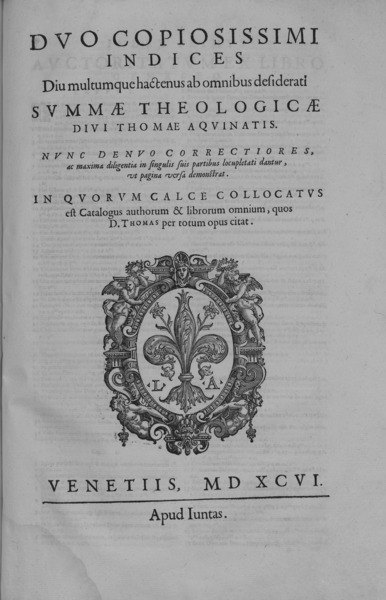
Title page from a 1596 edition of Summa Theologiae. Image: Wikimedia Commons
The book is divided into two parts. The first part (chapters one to eight) is the theoretical framework laying out health as a virtuous habit to be pursued. Relying on Aquinas’s writing on the virtues and health and his appropriation of Aristotle’s teaching on the virtues, Dobson shows how we can view health as a virtuous pursuit with the end (telos) in God. Chapter seven, in particular, zeroes in on the practical application of healthy habits that lead to a flourishing (eudaimonia) of individuals in their relationship to self, others, and God. Chapter eight considers why believers should cultivate habits of health. The goal of healthy living isn’t for the sake of health itself but, more importantly, for the sake of God. In other words, “the love of God becomes the end (telos) of health practices.” Health as habit is defined as the ethical intention and effort to live lives that lead us deeper into love with God and neighbor. Dobson asserts that Aquinas believes Christians have a responsibility to practice healthy habits.
By focusing on holistic health that includes exercise, eating well nutritionally, and spiritual practices, pastors and missionaries reported a greater flourishing in their interactions with others.
The second part (chapters nine to 11) covers two case studies conducted with pastors and missionaries, examining these individuals’ pursuit of a more holistic, and thereby virtuous, lifestyle that includes a focus on healthy habits. The pastors interviewed by the author reported the challenges they faced in their congregations not only with the expectations placed on them by themselves and parishioners to sacrifice self for the good of the community but also the unspoken, but palpable, opposition they faced from congregations as they sought to improve their wellbeing through exercise, healthy eating, and preserving personal time. Pastors also reported feeling unsupported by their denomination due to the institutional structures that move ministers frequently and place often less-experienced ministers in isolated communities. Dobson shows how these individuals were able not only to improve their health, in most cases, but also to improve (i.e., strengthen) their ministries. By focusing on holistic health that includes exercise, eating well nutritionally, and spiritual practices, pastors and missionaries reported a greater flourishing in their interactions with others.
The question at issue is how we care for our bodies and our health as part of faithful Christian living. Habits of health do not mean yo-yo dieting or extreme fitness programs. Rather, they have a lasting quality and are formed by repetitive action.
God is very much involved in the habit-forming process through his grace because the focus of the pursuit of health is flourishing with God.
Nevertheless, sustaining habits of health doesn’t depend solely on the individual who pursues health; rather God is very much involved in the habit-forming process through his grace because the focus of the pursuit of health is flourishing with God. Soul health and physical health are interdependent. Furthermore, emotional health is also included in the notion of the virtuous life. Indeed, for humans to be holistically well all aspects must be tended to. Dobson’s work brings to light the real struggle that individuals face who are not living a fully healthy life. The author demonstrates how the pursuit of healthy living is a godly pursuit that can lead individuals to a more resilient ministry and life of flourishing, where they live as healthfully as they can, sometimes in spite of their circumstances, and find grace to keep working toward the virtuous life.
Michelle Vondey, Ph.D. (Regent University) and M.Div. (Church of God Theological Seminary), has more than twenty years’ experience working in non-profit organizations. Her interests are focused mainly on developing followers in their roles in organizations. She teaches courses in leadership, critical reasoning, and Christian discipleship. 2012 dissertationLinkedIn
Easter is the centerpiece of the Christian Faith. It is the annual celebration of the resurrection of Jesus Christ, the Son of God. The proclamation of “He is risen” and its response “He is risen indeed” will keynote Easter services all over the world. The only reason I write these words is that resurrection. The…
John Bevere, Breaking Intimidation (Creation House, 1995), 205 pages, ISBN 9781591858812. Like their worldly counterparts, Christian bookstores today seem to be laden with self-help or, if you will, “spiritual” pop psychology books. Breaking Intimidation is no such book. Author John Bevere confronts head on a spiritual problem most of us encounter at one time or…
Scott T. Kelso, Theological Violence in the 21st Century: The Eclipse of Ethics and Morality in Today’s World (New York: Boss Media, 2021), 184 pages, ISBN 9781633375079. In the Old Testament, we are shown how God sent prophets again and again to warn Israel of its impending destruction if it did not repent of its…
What would you do if you learned you had leprosy? Pastor John Lathrop interviews pastor and missionary Dan Izzett about his ministry and advocacy for those afflicted with the ancient, debilitating disease. John Lathrop: Please tell us where you come from and how you began your walk with Jesus. Dan Izzett: When I was…
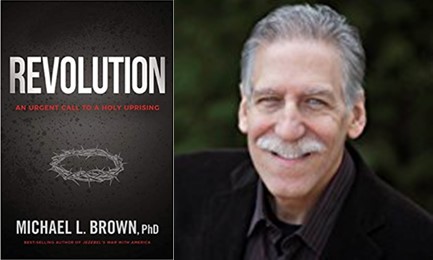
Pneuma Review speaks with Dr. Michael Brown about his 2020 book Revolution. PneumaReview.com: Revolution and revival are subjects that you have addressed in a number of your books. What experiences in your life birthed your passion for these things? Dr. Michael Brown: Although I had been preaching the message of repentance since my first…
A posting from the Rev. Dr. William De Arteaga on ways of engaging in effective long-distance healing prayer. Like much of his work, this has the potential to be both edifying and controversial. I call a certain form of intercessory prayer “spirit to spirit prayer.” It is generally long distance intercessory prayer of a special…
To provide the best experiences, we use technologies like cookies to store and/or access device information. Consenting to these technologies will allow us to process data such as browsing behavior or unique IDs on this site. Not consenting or withdrawing consent, may adversely affect certain features and functions.
Functional
Always active
The technical storage or access is strictly necessary for the legitimate purpose of enabling the use of a specific service explicitly requested by the subscriber or user, or for the sole purpose of carrying out the transmission of a communication over an electronic communications network.
Preferences
The technical storage or access is necessary for the legitimate purpose of storing preferences that are not requested by the subscriber or user.
Statistics
The technical storage or access that is used exclusively for statistical purposes.The technical storage or access that is used exclusively for anonymous statistical purposes. Without a subpoena, voluntary compliance on the part of your Internet Service Provider, or additional records from a third party, information stored or retrieved for this purpose alone cannot usually be used to identify you.
Marketing
The technical storage or access is required to create user profiles to send advertising, or to track the user on a website or across several websites for similar marketing purposes.
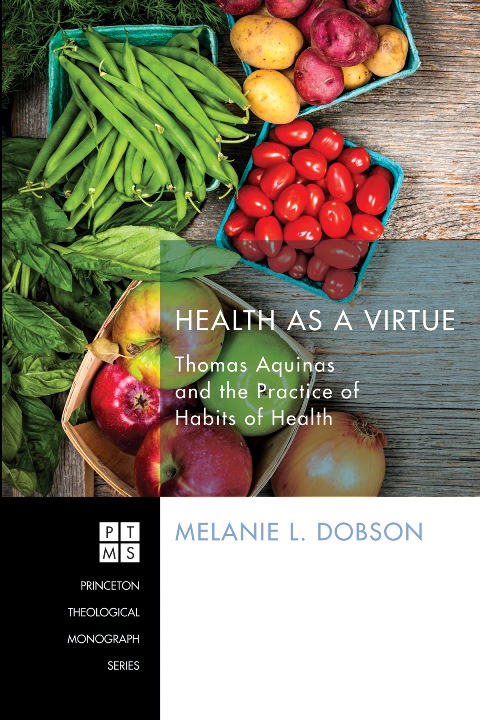

 Melanie L. Dobson, Health as a Virtue: Thomas Aquinas and the Practice of Habits of Health, Princeton Theological Monograph Series (Eugene, OR: Pickwick Publications, 2014), xiv + 146 pages, ISBN 9781620325612.