
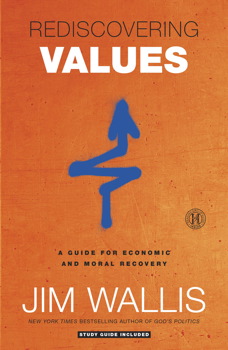
Jim Wallis: Rediscovering Values


Jim Wallis, Rediscovering Values On Wall Street, Main Street, and Your Street: A Moral Compass for the New Economy (New York, NY: Howard Books, 2010), ix + 255 pages, ISBN 9781439183120.
Rahm Emanuel, President Obama’s former chief of staff, was quoted as saying, “You don’t ever want to let a crisis go to waste; it’s an opportunity to do important things that you would otherwise avoid.” Jim Wallis is founder and CEO of Sojourners as well as editor-in-chief of Sojourners magazine; evangelical ministries promoting social justice. In his recent book, Rediscovering Values On Wall Street, Main Street, and Your Street: A Moral Compass for the New Economy he writes that the current economic crisis is a “transformative moment in history,” one where all Americans have an unprecedented opportunity to make fundamental and, hopefully, long-lasting changes that are not just economic and political, but moral as well. It appears that Wallis is as pragmatic as Emanuel.
Jim Wallis is also the author of recent bestsellers, including The Great Awakening: Reviving Faith and Politics in a Post-Religious Right America (2008) and God’s Politics: Why the Right Gets It Wrong and the Left Doesn’t Get It (2006). Along with other writers such as David P. Gushee, author of The Future of Faith in American Politics: Witness of the Evangelical Center (2008), and sociologist James Davison Hunter in his recent book To Change the World (Oxford University Press, 2010), Wallis touches the ideological nerve center of the majority of American people and Christians. To one degree or another, they all advocate the reformation of the large ideological, political, and even spiritual center, moving away from the polarization between Left and Right.
For Wallis, the current economic crisis is the point where the social and spiritual combine to set the stage for combating not only the economic ills brought about by the crisis, but also to offer an opportunity to resurrect the human spirit: a spirit of compassion, creativity, community development and empowerment, and plain old neighbors helping neighbors. It is here at this crux that Wallis sees an opportunity for the wheels of political action, spiritual unity, and social justice to roll into high gear. He examines all three in Rediscovering Values.
Wallis contends that the more important question revolves around our moral compass, a compass that registers the direction of our moral deficit and shows the way toward our moral recovery. But this moral recovery is impossible if clergy, politicians, media and others continually ask the wrong question. “If we start with the wrong question, it doesn’t matter how good our answer is, we’ll always end up in the wrong place. If we only ask how to get back to the place we were before this crisis began, we will miss the opportunity to stop walking in circles and start moving forward” (6). For Wallis, then, the real question—“How will this crisis change us?”—goes to the moral and spiritual heart of social justice; a concept that the evangelical Left touts as its theological and ideological mantra.
Do not be deceived, however. Wallis’ intention is to both attack and argue for changes to the current capitalistic market system (although he is limited in providing specifics). The system that began with Adam Smith’s “invisible hand” is a system that Wallis believes has gone unchecked for far too long and now requires the very visible hand of the federal government to institute even tighter regulatory mechanisms. He is not opposed to capitalism or the free market system. However, the market system that resulted in the crash of the housing market, the bailout of Lehman Brothers and the government takeover of AIG and General Motors, is an institution that knows no self-regulation. The market system, like the golden calf in the Old Testament (39), is being served rather than doing the serving. Thus, he contends that additional governmental regulation is the answer.
Greed is worshiped, laments Wallis. Like Gordon Gekko, the unscrupulous financial broker in the movie Wall Street, many people today, especially the “very rich,” apparently believe that “Greed…is good. Greed is right. Greed works. Greed clarifies, cuts through, and captures the essence of the evolutionary spirit…” (45). It is greed, spawned by the manipulation of Wall Street financial gimmicks, that created the great chasm between CEOs, like Richard Fairbank at Capital One who received nearly $250 million, and the average bank or financial institution employee, who makes in the low five figures (85). Greed also produced this unbelievable statistic: 400 people hold more wealth than half of the United States combined. This is a disparity, he adds, that “we should all despair” (89). Obviously, something must be done; something must happen to lessen this gap.
What are the questions Christians, Jews, and Muslims should be asking? What should people of faith be thinking, saying, and doing? What does the Bible say about all the issues now being raised? What can economists, some of whom are also people of faith, tell us about economic philosophy, the role of the market, the role of government, the place of social regulation, the spiritual consequences of economic disparities, the moral health of an economy, and the criteria of the common good? What does this book say that is relevant to me as a pastor, teacher, minister, missionary, or interested layman? These and many more (10) are the questions that Wallis believes need to be asked regarding the greatest economic crisis since the Great Depression of the 1930s.
If greed, self-deception, and an immoral and socially unjust market system are the culprit, what is the answer? It is a spiritual one that is imbued with the power of social justice and validated by the doctrine of Scripture. Wallis is clear: “the logic of a consumer society is fundamentally at odds with the teaching of Jesus” (111). We live in a marketing-infused and inflated world, where toys and trinkets and sex sell with equally rapidity, while those of us who claim Christianity as our code of faith, and who follow the words of Jesus and the Old Testament prophets, know all too well that conspicuously consuming wealth is at odds with giving it away. Wallis believes one key to resolving this is redistribute the wealth of the rich.
Wallis says that Jesus the Son of God many times spoke about and demonstrated the art of giving—the hope found in redistributing the wealth of a few to retard the poverty of many. In fact, the Bible is replete, he argues, with examples of “redistribution of wealth,” such as the spiritually and financially enriching practice of Jubilee (Leviticus 25). Further, it was the early Church fathers—such as Clement of Alexandria, Augustine, and John Chrysostom the Patriarch of Constantinople (115, 116)—who challenged the early Christians to reconsider the possession of their wealth, and to advance economic communitarianism (Acts 4:32-37).
Wallis’ ideal society is one predicated on the belief that social parity trumps individual opportunity; where the avarices of the market economy must be subdued by the regulatory arm of the state. Although he gives lip service to re-establishing “self-governance” (3), meaning that people must reassert self-regulation and prioritization of their needs from wants; it is clear throughout the text that of the three institutions—public, meaning government, private, and non-profit—that frame and contain the problems and solutions of society, it is government, and specifically the federal government, that must play a sizable role in creating a better balance between the other two institutions (225), a balance that will ward off further crises, economic or otherwise, that might one day plague our nation.
He believes that a “social transformation” is necessary, one that is rooted in spiritual and political values, values that according to Wallis are found in the social justice gospel of the evangelical Left. He concludes with a clarion call saying, “Change begins when some people make different choices. Change grows when people make different choices together. And when the critical mass of those who are making different choices gets big enough, change becomes a social movement. It is those movements that change history…” (228).
Wallis is correct, but only partly. A transformation is necessary, but he only gets to the first of two necessary questions. Wallis answers, “How will this crisis change us?” with the social justice gospel. This theology promotes the gross misunderstanding that Jesus was more concerned about society and its institutions than He was about the individual. This “gospel” argues for the intervention of social, economic, and political regulations imposed and enforced by government. It is a gospel that wrenches the heart and soul of man toward belief in redistributing wealth as a means of assuaging one’s conscience, especially when the imbalance of wealth is too great. This is a gospel that Jim Wallis believes is the salvation of society.
But Wallis is politically savvy, if not worldly spiritual. He understands that this economic crisis is not one that will easily be dismissed, or one that will be solved solely by the political and economic regulations. It will require a response from the every person in every town across America. It will require civic and economic sacrifice. It will require families, neighborhoods, faith-based organizations, and communities working with each other and with local and state governing bodies.
There is a second question that Wallis does not ask: “How will this crisis change me?”
Wallis’ gospel is based on human understanding and manipulation of religious values and spiritual involvement, promulgated by progressive government principles and practices. This is at best a pretentious gospel, one that markets more than it can produce. It places faith in government-directed transformational efforts, which although produce incremental and temporary results, fail to correct the fruit of fear and ignorance. Social justice devoid of spiritual transformation and grace is simply a form of legalism.
The real gospel is one that is spiritually transforming. The basis of true social change is “bottom-up” where the church disciples believers and then believers impact their world for Christ.
Reviewed by Stephen M. King
Preview Rediscovering Values online: books.google.com/books?id=8Nc8FhxNF8IC











Wallis preaches a false gospel more akin to Marxism than the gospel of the Kingdom preached by Christ.
He has been a supporter of Marxist ideology for decades and now seeks to deceive Americans with pious calls for sharing, but not voluntarily. His method is confiscatory in nature and done by the heavy hand of the Federal government. Wallis’ false teachings need to be exposed for what they are.
Good review.