Judging the Judges: Searching for Value in these Problematic Characters

The biblical judges are well known for their less than exemplary behavior. In the past, these judges have been appreciated largely as examples of how a charismatic leader should NOT behave. In spite of the judges’ questionable morals, the writer of the book of Hebrews commends four of them (Barak, Gideon, Jephthah, and Samson) for their faith. This paper evaluates these judges in light of their characterizations in the book of Hebrews and in the book of Judges and suggests that our struggle with the judges parallels the contemporary integrity crisis in Christian leadership.
Introduction
‘Time would fail me’, declares the writer of Hebrews, ‘to tell of Gideon, Barak, Samson, Jephthah, of David and Samuel and the prophets—who through faith conquered kingdoms, administered justice, obtained promises, shut the mouths of lions, quenched raging fire, escaped the edge of the sword, won strength out of weakness, became mighty in war, put foreign armies to flight’ (Heb. 11.32-34; NRSV).1 With these words the judges of the Old Testament are forever enshrined as heroes of the faith, and consequently they have served as examples to Christian believers from the First Century until now. Careful readers of the book of Judges, however, might suggest a few changes to Hebrews 11, so that the text would read: ‘Time would fail me to tell of the judges, … who through unbelief tested God, committed murders, pursued pleasure, enabled idolatry, and turned Israel into a land of anarchy’.
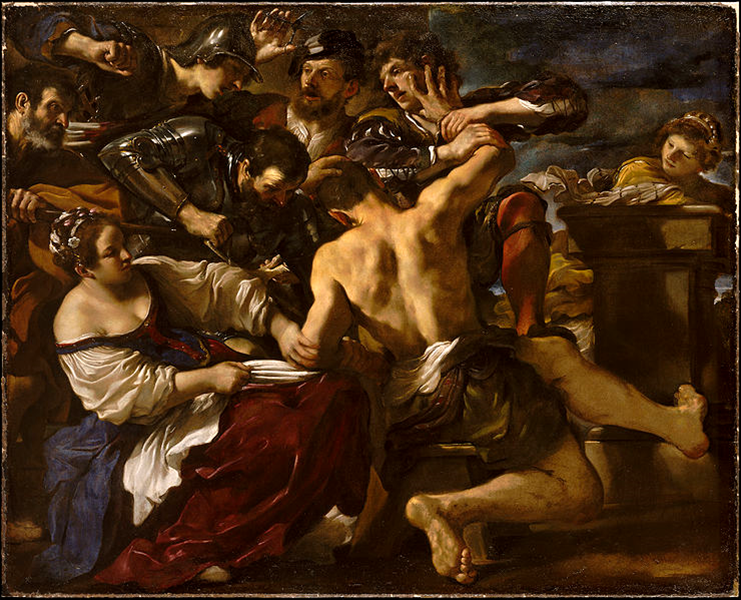
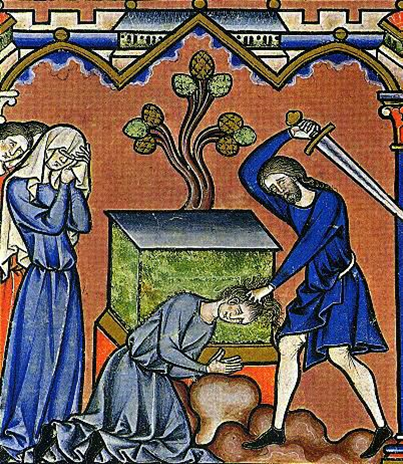
As these hypothetical changes to Hebrews show, we are faced with paradoxical depictions of the judges; for although the book of Hebrews applauds the faith of the judges, the book of Judges records the obvious flaws and failings of those same judges.2 Both Jephthah and Samson are particularly unfit for the designation ‘heroes’, given their apparently immoral character. Jephthah is an outlaw who makes a rash vow that results in the sacrifice of his daughter, and Samson is a divinely chosen nazirite who breaks his sacred vows, marries a forbidden foreigner, sleeps with a prostitute, and loses his God given power while asleep on the lap of Delilah.
The debate over this question has persisted at least since the 18th Century.
This image comes from the Maciejowski Bible (France, c. 1250), via Wikimedia Commons.
In my monograph on the book of Judges, I point out that the human characters of Judges have received the primary attention of biblical scholars while the character of Yahweh has not been sufficiently treated. I argue that considerable theological insight can be mined from Judges by paying attention to the previously unappreciated speeches of God in the book.8 It remains to be seen, however, if anything good can be salvaged when it comes to the actions and attitudes of the judges themselves. Biblical scholarship has doubted that the lives of Barak, Gideon, Jephthah, and Samson can offer any positive theological models for righteousness, holiness, or faithful leadership. Recent interpreters, however, have constructed a theological view of the book of Judges that promises hope for redeeming the judges from the hands of their judges.9
In this paper, I will examine the place of the judges within the argument of the book of Hebrews, and I will evaluate the judges as they are characterized in the narrative of Judges. I will attempt to discover the ways in which the judges may serve as positive figures, and I will suggest connections between the biblical portrait of the judges and our own integrity crisis in contemporary Christian leadership.
The Role of the Judges In Hebrews 11
The book of Hebrews is an elaborately constructed literary masterpiece that speaks to a number of theological, ethical, and social issues that are of concern to its intended audience. Although the complexity of the book continues to defy biblical scholarship’s quest for consensus regarding its purpose, the text suggests, on one level at least, that Hebrews is an encouragement to Christian faithfulness in the face of severe opposition.10 The nature of Hebrews as exhortation is registered in the frequency of hortatory subjunctives: ‘Let us fear … lest anyone fall short’ (4.1); ‘let us strive’ (4.11); ‘let us hold fast to our confession’ (4.14); ‘let us approach with confidence’ (4.16); ‘let us go on toward perfection’ (6.1); ‘let us approach with a true heart’ (10.22); ‘let us hold fast’ (10.23); ‘let us consider one another’ (10.24); ‘let us lay aside every weight … and let us run the race’ (12.1); and so forth. Christian believers are enjoined to hold fast, to run their race patiently, and to encourage each other, because Christianity is the better way. Christ is better than the angels (1.4), better than Moses (3.3), better than Joshua (4.8), and better than the Old Testament priesthood (7.1-28). Christians have a better hope (7.19), based on a better covenant (7.22), with better promises (8.6). They offer better sacrifices (10.1), have a better future (10.34), in a better country (11.16), because God has ‘provided something better for us’ (11.40).
Judges 21:25 (KJV)
The importance of faith to Christian perseverance, a topic introduced in ch. 3, is revisited in ch. 10 in a text which, along with 12.1-3, serves to bracket ch. 11 with calls for steadfastness. Thus, before we are presented with the hero list of ch. 11, we hear, ‘the just shall live by faith, but if he should hesitate my soul takes no pleasure in him. But we are not people of hesitation that leads to destruction, but people of faith11 that leads to the preserving of the soul’ (10.38-39). This faithful endurance is then exemplified in the biblical characters who are presented in Hebrews 11. The kind of faith practiced by these Old Testament believers is more than saving faith;12 it is ‘persevering faith’;13 it is ‘active’ faith.14 By faith they obey God; by faith they overcome insurmountable odds; by faith they continue walking with God when contextual forces stand in opposition to his promises.15 However, even though the heroes of ch. 11 are ‘witnesses’16 to God’s faithfulness and are examples of endurance, the most important example is Jesus himself. Following the list of prominent Old Testament characters, we hear another call to perseverance, ‘Therefore, let us run with endurance the race that is set before us, looking unto Jesus the founder and perfecter of faith; … consider him lest you grow weary and lose heart’ (12.1-3).17
The bracketing of Hebrews 11 with exhortations to steadfastness,18 suggests that the function of ch. 11 is to give hope to those who are struggling,19 by demonstrating the genuine possibility of faithful endurance.20 These Old Testament characters persevered; they ran faithfully ‘on the same field, in the same arena of life, in the name of the same God, as the present readers’.21 Both of the bracketing texts contain the word ‘faith’ (Heb. 10.38, 39; 12.2). Thus, the writer of Hebrews argues that the just shall live by faith, and we are people of faith (10.38-39). This faith is exemplified in the heroes of the Old Testament (11.1-40), but Jesus is the greatest example. In fact, he is more than an example; he is the founder and perfecter of faith (12.2).
Having established that at least one purpose of the hero list of Hebrews 11 is to offer hope and encouragement to the hearers of the epistle, let us now examine the place of the four judges within the list. The hero list begins with Abel and proceeds to name Enoch, Noah, Abraham, Sarah, Isaac, Jacob, Joseph, Moses’ parents, Moses, the Israelites, and Rahab in chronological order. In each case, at least one event from the life of the hero is presented as an example of trust in the promises of God. At verse 32, however, the writer expresses a need to conserve time, and the pattern of reportage changes.22 The faith of the judges, David, and the prophets is described in general terms, without reference to specific events and out of sequence chronologically. Commendation of the judges, David, Samuel, and the prophets is given for the following praiseworthy actions: they ‘conquered kingdoms, administered justice, obtained promises, shut the mouths of lions, quenched raging fire, escaped the edge of the sword, won strength out of weakness, became mighty in war, put foreign armies to flight’ (Heb. 11.33-34; NRSV). For the purposes of this paper, we need not connect each action to a particular Old Testament figure, but we should consider a few general observations:23 1. All of these actions are interpreted by the writer as expressions of faith, even though the word ‘faith’ is not found in the book of Judges;24 2. All of these actions are related closely to strength and victory in warfare, except for the four phrases in the middle of the list (‘administered justice, obtained promises, shut the mouths of lions, quenched raging fire’); 3. The phrase ‘obtained promises’ is a motif that is prominent in Hebrews;25 4. The phrases, ‘shut the mouths of lions’ and ‘quenched raging fire’, suggest escape from dangers that may not be directly related to warfare; 5. The judges are not venerated for moral virtues, except that they ‘administered justice’ (eirgasanto dikaiosunēn), which can mean ‘did what was right’,26 but which, coming after ‘conquered kingdoms’, more likely means that they restored order and justice after vanquishing enemy forces. The administering of justice is lauded by the Old Testament prophets as a quality of godly rule and as a mark of the eschatological kingdom of God.27 As will become evident when we examine the book of Judges, the mention in Hebrews 11 of the administering of justice reveals a point of agreement between the perspectives of Hebrews and Judges.
In spite of their sins, however, the heroes of Hebrews 11 embraced the promises of God and pressed forward beyond their encumbering circumstances and their personal flaws. I contend that the inclusion of the judges in the list of heroes is not a blanket approval of their every act; it does not exonerate them from their crimes.31 The book of Hebrews, by highlighting the positive qualities of Old Testament characters, provides examples of heroic acts that are worthy of appreciation and emulation.32
Although the writer of Hebrews does not choose to point out the failures of the Old Testament characters,33 those failures are not ignored in the Old Testament and they would be well-known by the intended audience of the book of Hebrews. The Old Testament, by showing both the positive and negative qualities of its characters, is able to utilize these characters in complex and realistic events that register a variety of subtle theological messages. The book of Judges, as narrative, is able to paint a picture of the judges that is more holistic than is possible within the confines of an epistle.34 Hebrews, therefore, focuses only on the positive characteristics of the judges that might encourage the early Christians to endure faithfully.
In spite of its commendation of the judges, then, Hebrews 11 does not provide justification to disregard the moral and ethical problems that are reflected in the book of Judges.35 For example, it is not legitimate for us to assume, on the basis of his presence in Hebrews 11, that Jephthah would not have sacrificed his daughter. Nevertheless, the inclusion of the judges among the heroes of faith suggests that our search for something of value in these problematic characters is canonically legitimate.36 We move now to the book of Judges to continue that search.
The Role of the Judges in The Book of Judges
The judges do not appear in a vacuum; rather, they emerge as characters with the narrative of the book of Judges. Consequently, I would argue that the value of the judges must be discerned in light of their place in the narrative and message of the book of Judges. The judges are mentioned first in the prologue of the book (2.6-3.6), which outlines the cyclical framework for the series of stories to come in chs. 3-16. The cycle begins when the Israelites forget Yahweh and engage in idolatry. The behavior of the Israelites provokes Yahweh to anger, and he disciplines them by handing them over to an oppressive enemy. The Israelites then cry out to Yahweh for deliverance, and Yahweh is moved with compassion because of their suffering. Finally, Yahweh raises up a judge who saves the Israelites from their enemy, and the land enjoys a time of peace. Although each appearance of the cycle incorporates a unique combination of elements,37 the cycle can be reduced to two basic movements. First, the Israelites rebel and God punishes them; and second, the Israelites cry to God and he saves them.38 Both of these movements hinge on the responsiveness of Yahweh, who acts out of both judgment (sin/punishment) and mercy (cry/salvation) to preserve his covenant relationship to Israel.
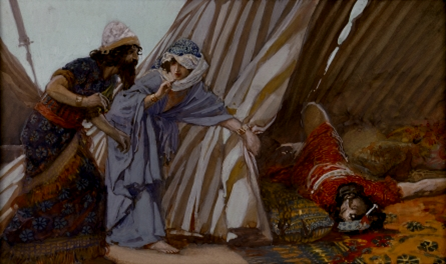
Image: Wikimedia Commons.
Although the actions of the judges relate on the surface to the second movement of the cycle (cry and salvation), at a symbolic level the lives of the judges intersect with the first movement (sin and punishment) as well. That is, the sin of Israel is reflected in the flaws of the judges. This symbolism develops out of the perspective toward Israel’s sin that is conveyed by the book of Judges. The besetting sin of the Israelites is breaking the covenant, forsaking Yahweh, and worshiping foreign gods—in a word: idolatry. Furthermore, the book of Judges presents Yahweh’s relationship to his people in corporate terms. The unfaithfulness of the Israelites, therefore, incurs Yahweh’s punishment of the entire people; and the cries of the Israelites elicit Yahweh’s compassion toward the entire body.39 Finally, the behavior of the Israelites grows worse throughout Judges (2.19); therefore, the repeated pattern represents more than a cyclical repetition; it is a downward spiral.40
This corporate downward spiral into unfettered idolatry is paralleled in the narrative by the problematic behavior of the judges themselves. The increasingly negative characterization of the judges mirrors the increasingly disobedient character of the Israelites and the overall spiritual decline within the book.41 Othniel is the ideal judge, a mighty warrior, who saves Israel from the oppressive king Cushan-rishathaim (3.7-11). The progression from the ideal (Othniel) to the worst of the judges (Samson) begins subtly with the second judge Ehud, who has no major flaws; but his left-handedness makes him less than ideal (3.15). Deborah is also without fault, but her gender may have presented her with distinct challenges in the male-dominated society. Barak is the first judge to show a hint of weakness, when he hesitates to follow the instructions of Deborah (4.6).42 Gideon, the next judge, is a full-fledged coward (6.27), who requires repeated assurances from God and who unwittingly leads Israel back into idolatry (8.27).43 Jephthah, the son of a prostitute, is an outcast from society who is chosen not by God, but by the elders of Gilead. Jephthah foolishly vows to offer up as a whole burnt offering the first person (or thing) who comes out to greet him on his safe return from battle (11.30-31). Jephthah saves the Israelites from only one of the two nations who threaten the Israelites (10.7), thus being the first judge who fails to bring complete deliverance. Finally, Samson does not save Israel at all; he only ‘begin[s] to save’ them from the Philistines (13.5) through the limited impact of his brief skirmishes.44 Samson is the only judge who is does not raise an army of Israelites and inspire a rebellion against their oppressor. Samson is the only judge who is captured by the enemy. The story of Samson, however, ends with a ray of hope, as he cries out to Yahweh who restores his strength, enabling him to destroy the temple of Dagon, thus striking at the very heart of the enemy’s god.45 In spite of Samson’s final individual effort, however, the downward spiral is complete, as the Israelites are content to live under the domination of the Philistines (15.11). Samson serves as a paradigmatic figure, whose feeble response to divine gifting represents the inability of all Israel to remain loyal to the covenant.46 At the end of Judges anarchy and immorality reign supreme, and the Israelites do as they please because there is no king—neither human nor divine—in Israel (17.6; 18.1; 19.1; 21.25).
The foregoing sketch of Judges suggests that the flaws of Barak, Gideon, Jephthah, and Samson are essential to the theological message of the book of Judges and carry a significant spiritual warning. The increasingly problematic character of the judges parallels the increasingly disobedient character of the Israelites. If the writer of Judges had chosen to downplay the failures of these final judges, the narrative impact of the book would have been greatly diminished. The sin of the judges, in conjunction with the sin of Israel, registers a valuable spiritual message, though a negative one.
The suffering of the oppressed Israelites is portrayed vividly in the accounts of Judges. King Jabin of Hazor, the enemy in the Barak story, ‘mightily oppressed’ the Israelites for twenty years (Judg. 4.3). The Philistines and the Ammonites, the foes of Jephthah, ‘vexed and oppressed the Israelites eighteen years’ and the Israelites were ‘sore distressed’ (10.8-9). It is said that the Philistines, against whom Samson struggled, ruled over the Israelites forty years (13.1). The most extensive description of Israel’s suffering is found in ch. 6, where the violence of the Midianites is described:
The hand of Midian prevailed over Israel; and because of Midian the Israelites provided for themselves hiding places in the mountains, caves and strongholds. For whenever the Israelites put in seed, the Midianites and the Amalekites and the people of the east would come up against them. They would encamp against them and destroy the produce of the land, as far as the neighborhood of Gaza, and leave no sustenance in Israel, and no sheep or ox or donkey. For they and their livestock would come up, and they would even bring their tents, as thick as locusts; neither they nor their camels could be counted; so they wasted the land as they came in. Thus Israel was greatly impoverished because of Midian; and the Israelites cried out to the LORD for help (Judg. 6.2-5; NRSV).
Once in bondage to these oppressive forces, the Israelites ‘cannot evade the superior power, and their powers of resistance are inadequate. The force that is oppressing or threatening the people, the attacking enemy, is simply stronger’.48 Jabin, for example, has iron chariots (4.3), and the Midianites have a vast army riding on camels (6.5).
When Yahweh decides to move on behalf of Israel, he ‘raises up’ (2.16; 3.9; 3.15; etc.) judges who will mobilize the people and lead them to freedom from bondage. Yahweh recruits human partners who serve in an active role of leadership, human partners who ‘succeed in restoring loyalty, solidarity, and the capacity for communal action among the people’.50 In spite of their weaknesses, even the most troubling of the judges are able to accomplish amazing and inspiring deeds as they pursue salvation and justice for their communities. The judges, therefore, are more than a reflection of the spiraling decline of Israel’s relationship to Yahweh; they are active participants in God’s work of salvation. As human agents who are raised up by Yahweh to bring deliverance to the Israelites, the judges register Yahweh’s response to the Israelites’ cries for help and his intervention on their behalf.51
Image: Wikimedia Commons.
The ministry of the judges, therefore, witnesses to the ‘important role of human agency in partnership with the redeeming activity of God.’52 In this role the judges are called ‘saviors’ (3.9; 3.15), who ‘save’ Israel (2.16; 3.9; 3.31; 6.14; 10.1; and 13.5). These saviors, however, do not act alone; they are Spirit-empowered leaders who challenge the community to action. At the behest of Deborah, Barak gathers a fighting force of 10,000 men. The Spirit of Yahweh clothes Gideon who subsequently sounds the trumpet and assembles an army (6.34). The Spirit of Yahweh comes upon Jephthah who travels throughout the region, calling the people together for battle. The judges are able to create a ‘renewal of the people’s unanimity and capacity for action, a renewal of the people’s power of resistance in the midst of universal despair’.53 What is commendable in the judges is their willingness to surrender themselves to God and to his saving mission, even when striving against overwhelming opposition. The judges respond in obedience to God’s call; and with God’s promise as their only assurance, they place themselves at risk in the battle to deliver Israel.
Theologically, the battle of the judges against the Canaanites represents resistance to oppression and life-negating forces of evil. The judges encourage us to pursue God’s continuing mission of liberation, equality, justice, and peace (cf. Isa. 11). The stories of the judges compel us to participate enthusiastically and sacrificially in God’s work of salvation. The mission of the judges is not far from that of Jesus the Messiah, who declared, ‘The Spirit of the Lord is upon me, because he has anointed me to bring good news to the poor. He has sent me to proclaim release to the captives and recovery of sight to the blind, to let the oppressed go free’ (Luke 4.18; NRSV).54
The Judges Are Among Us
I have shown that due to the tension between Hebrews 11 and the book of Judges we have struggled to find an appropriate interpretation of and response to the judges. On the one hand, the judges can be helpful as examples of charismatic leaders who devote themselves to the saving mission of God; on the other hand, their reputations are stained by moral flaws. I would suggest that our struggle with the judges parallels in some ways the contemporary integrity crisis in Christian leadership. The Holiness-Pentecostal movement is mired in a culture that is unable to deal effectively with issues of discipline. We rightly affirm the Wesleyan tradition of Christian perfection, but we have unwittingly created an idealized view of leadership, which tends to follow one of two extremes. Either ministers are not held accountable for their sins because it is believed that the ‘success’ of their ministry is proof that they are in good standing with God; or ministers are forced out of their pastorates because of sins that might demand disciplinary action, but which should not disqualify the person for ministry.58 Either we refuse to require accountability for moral failings (even when the person is convicted for criminal behavior), or we demonize any leader who is suspected of a moral lapse.
Conclusion
The positive representation of the judges in Hebrews 11 must not be seen as a blanket endorsement of their lives and character, but neither should the Old Testament’s portrayal of the negative qualities of the judges cause us to doubt the appropriateness of the judges inclusion in Hebrews 11. Pre-critical interpreters, who come to the text with a predisposed sympathy toward biblical characters, tend to be unable or unwilling to wrestle with difficult texts that expose the spiritual inadequacies of those characters. Thus, pre-critical commentators often minimize the undesirable aspects of Old Testament characters while focusing upon their heroic traits. Critical interpreters, however, with no vested interest in defending the biblical characters, often highlight their shortcomings and flaws. I would argue that neither approach fully appreciates the richly textured portrayals of the biblical characters and neither does justice to the biblical text as narrative theology.
Early holiness and Pentecostal Christians are well known for their devotion to the mission of God in the world; but the contemporary Church, much like Israel, is tempted to accommodate itself to the dominant culture, to be seduced by the idols of the powerful, and to abandon God’s mission of salvation for the poor and oppressed. In many places, the Church itself is in bondage to the Canaanites. Like Israel, the Church has settled down with the Canaanites, intermarried with the Canaanites, and served the gods of the Canaanites (Judg. 3.5-6). Let us cry out to God for deliverance, trusting that he will raise up Spirit-filled leaders who will sound a call that mobilizes the Church to repentance, renewal, and mission.
PR
Notes
1 Unless noted otherwise, Scripture citations are my own translation.
2 Interpreters from a number of traditions have questioned how it is possible for God to use these judges who seem to be morally deficient. E.g., Herbert Wolf, ‘Judges’, in F. E. Gaebelein (ed.), The Expositor’s Bible Commentary (Grand Rapids, MI: Zondervan, 1992), III, p. 381, calls this tension a ‘problem’; and J. Clinton McCann, Judges (Interpretation: A Bible Commentary for Teaching and Preaching; Louisville, KY: John Knox Press, 2002), p. 1, admits that Judges is ‘an embarrassment to most church folk’.
3 On the pre-critical exegesis of Judges, see ch. 2 of Lee Roy Martin, The Unheard Voice of God: A Pentecostal Hearing of the Book of Judges (JPTS, 32; Blandford Forum, UK: Deo Publishing, 2008). Most interpreters prior to the reformation resorted to allegory and typology as the way to make sense of the judges; see David M. Gunn, Judges (Blackwell Bible Commentaries; Malden, MA: Blackwell Publishing, 2005), who traces the reception history of the entire book of Judges.
4 John Wesley and G. Roger Schoenhals, Wesley’s Notes on the Bible (Grand Rapids, MI: Francis Asbury Press, 1987), p. 171. One stream of the Jewish tradition asserts that God’s choosing of the judges is evidence of their spiritual qualifications. Cf., e.g., Nosson Scherman, The Prophets: Joshua/Judges. The Early Prophets with a Commentary Anthologized from the Rabbinic Writings (Artscroll; Brooklyn, NY: Mesorah Publications, 1st Rubin edn, 2000), p. xiv, who writes, ‘The judges were chosen by God as individuals of outstanding merit’.
5 One of my former teachers, Jerome Boone, suggested that the brevity of the stories of the judges makes their flaws more conspicuous than those of David, whose failures are a small part of a longer story.
6 Neither the Scripture index nor the subject index in John Wesley, The Works of John Wesley (14 vols.; Grand Rapids, MI: Zondervan, 1958), XIV, pp. 367-532, contains any reference to the book of Judges.
7 C. F. Burney, The Book of Judges, with Introduction and Notes (London: Rivingtons, 1918), p. cxxi. While pre-critical writers and holiness interpreters have struggled primarily with the personal immorality of the judges, it is the violence in Judges that offends many contemporary interpreters.
8 See ch. 1 of Martin, The Unheard Voice of God.
9 E.g., Walter Brueggemann, ‘Social Criticism and Social Vision in the Deuteronomic Formula of the Judges’, in Patrick D. Miller (ed.), A Social Reading of the Old Testament: Prophetic Approaches to Israel’s Communal Life (Minneapolis, MN: Fortress Press, 1981), p. 73-90; McCann, Judges, pp. 14-20; and Bruce C. Birch et al., A Theological Introduction to the Old Testament (Nashville: Abingdon Press, 1999), pp. 181-89.
10 Kimberly F. Baker, ‘Hebrews 11—The Promise of Faith’, Review & Expositor 94, no. 3 (1997), p. 439, writes that the purpose of Hebrews is ‘to call believers to remain steadfast and to take courage’. Cf. David A. Renwick, ‘Hebrews 11:29-12:2’, Interpretation 57, no. 3 (2003), p. 300-301. See also Harold W. Attridge, ‘Paraenesis in a Homily (λόγος παρακλήσεως): The Possible Location of, and Socialization in, the “Epistle to the Hebrews”’, Semeia no. 50 (1990), p. 217; William L. Lane, Hebrews: A Call to Commitment (Peabody, MA: Hendrickson Publishers, 1988), pp. 472-75; and Paul Ellingworth, The Epistle to the Hebrews: A Commentary on the Greek Text (Grand Rapids, MI: W.B. Eerdmans, 1993), p. 58.
11 Although the genitives υποστολης and πιστεως are often translated as if they were plural participles (e.g. ‘we are not of those who shrink back . . . but of those who believe’ [NIV]), they are in fact singular nouns, translated literally, ‘we are not of hesitation . . . but of faith’. As genitives of relationship, their function is to describe the subject and could be paraphrased, ‘we are not characterized by hesitation . . . but by faith’ (Cf. BDF, §162).
12 Baker, ‘Hebrews 11—The Promise of Faith’, p. 440.
13 Steven M. Baugh, ‘The Cloud of Witnesses in Hebrews 11’, Westminster Theological Journal 68, no. 1 (2006), p. 119.
14 Baker, ‘Hebrews 11—The Promise of Faith’, p. 440. Discussions regarding the Christian content of faith within the epistle are not directly germane to my argument; nevertheless, cf. Michael R. Cosby, The Rhetorical Composition and Function of Hebrews 11: In Light of Example Lists in Antiquity (Macon, GA: Mercer, 1988), pp. 34-40; and Pamela Michelle Eisenbaum, The Jewish Heroes of Christian History: Hebrews 11 in Literary Context (Atlanta, GA: Scholars Press, 1997), p. 144, note 43 for a list of works that address πίστις in Hebrews. Eisenbaum agrees (as do I) with the leading view that ‘Hebrews is continuous with the Jewish understanding of faith as fidelity, firmness, and trust in God’ (p. 144), a view that in my mind does not exclude Jesus as the object of saving faith for NT believers. So also, Victor Rhee, ‘Christology and the Concept of Faith in Hebrews 5:11-6:20’, Journal of the Evangelical Theological Society 43, no. 1 (2000), p. 93.
15 On the rhetorical significance of the anaphoric use of ‘by faith’, see Michael R. Cosby, ‘The Rhetorical Composition of Hebrews 11’, Journal of Biblical Literature 107, no. 2 (1988), pp. 258-61; and idem, Rhetorical Composition and Function of Hebrews 11, pp. 41-55.
16 Baugh, ‘The Cloud of Witnesses in Hebrews 11’, pp. 118-21. Regarding the function of Hebrews 11, Baugh argues that the heroes are not so much examples whose faith ‘we are to emulate’ as they are ‘recipients of divine testimony to the coming eschatological realities, and thence by faith they became participants in and witnesses to the world to come’ (p. 113). Although I am unconvinced of Baugh’s primary thesis, he offers a number of helpful observations. E.g., he argues for the cruciality of the repeated motif of seeing the unseen (pp. 121-22), a motif that I also emphasized when I suggested that the faith of Hebrews 11 can ‘See the Invisible’, ‘Obey the Incomprehensible’, ‘Accomplish the Impossible’, and ‘Endure the Intolerable’ (Lee Roy Martin, ‘What Faith Can Do’ (Sermon, Cleveland, TN: Prospect Church of God, 28 Jan. 1996). Baugh’s argument is weakened by the fact that he limits his detailed study to only Abel, Enoch, Noah, and Abraham.
17 For Jesus as an example of endurance, see Victor Rhee, ‘Chiasm and the Concept of Faith in Hebrews 11’, Bibliotheca Sacra 155 (Jul.-Sept.1998), p. 274-75.
18 A contextual factor that is recognized by R. Alan Culpepper, ‘A Superior Faith: Hebrews 10:19-12:2’, Review & Expositor 82, no. 3 (1985), pp. 375-80; and Eisenbaum, Jewish Heroes, p. 137. This bracketing is not appreciated by Robert L. Brawley, ‘Discoursive Structure and the Unseen in Hebrews 2:8 and 11:1 : A Neglected Aspect of the Context’, Catholic Biblical Quarterly 55, no. 1 (1993), pp. 81-98, whose emphasis ironically is on the context of Heb. 11. Cosby, Rhetorical Composition and Function of Hebrews 11, pp. 40, 85-89, notes the introductory function of 10.35-39 but does not observe the concluding function of 12.1-3.
19 Furthermore, in Heb. 11, ‘faith and hope are immediately linked’, declares Baker (‘Hebrews 11—The Promise of Faith’, p. 440). Gerhard Dautzenberg, ‘Der Glaube im Hebräerbrief’, Biblische Zeitschrift, no. 17 (1973), pp. 167-68, goes so far as to assert that in Hebrews, faith and hope are interchangeable.
20 Assurance is desperately needed by the intended hearers, argues Renwick, who writes, ‘Their strength had been so sapped that the community as a whole could not help its members meet their present difficulties with any enthusiasm, let alone with any longing to persevere’ (‘Hebrews 11:29-12:2’, p. 300).
21 Renwick, ‘Hebrews 11:29-12:2’, p. 301. Eisenbaum concludes, ‘Calling on the names of so many great biblical individuals and describing their accomplishments is intended as inspiration as well as argumentation’ (Jewish Heroes, p. 136).
22 The rhetorical features of Heb. 11.32-34 are detailed by Cosby, Rhetorical Composition and Function of Hebrews 11, pp. 57-71.
23 Surprisingly, the Greek phrases in Heb. 11.32-34 have no verbal parallels in the LXX. Words like ‘lion’, ‘righteousness’, ‘fire’, ‘sword’, and ‘armies’ are found in the OT, but not in combination with the verbs used in Heb. 11.
24 On the hermeneutics of the writer of Hebrews, see Luke Timothy Johnson, ‘The Scriptural World of Hebrews’, Interpretation 57, no. 3 (2003), pp. 237-50. See also Eisenbaum, Jewish Heroes, pp. 89-134, who argues that, as a reinterpretation of Jewish history for a Christian audience, Heb. 11 displays these attributes: 1. Heb. 11 removes the nationalism from the OT story; 2. The exploits of the characters in Heb. 11 are diminished so that their fame will not challenge that of Jesus; and 3. Characters in Heb. 11 are praised for actions that differ from the actions for which they are praised in the OT. Eisenbaum’s is a helpful study, but her selective use and misinterpretation of evidence make her conclusions applicable only to a few of the persons named in Heb. 11, while her arguments are unconvincing when applied to the whole list. F. F. Bruce, The Epistle to the Hebrews (New International Commentary on the New Testament, 58; Grand Rapids: W. B. Eerdmans Pub. Co., 1964), pp. 318-21, explicates what he considers to be evidence of faith in Barak, Gideon, Jephthah, and Samson. However, my purpose in this paper is not to show explicit correspondence between Hebrews and Judges.
25 The Greek word επαγγελλία is found 14 times in Hebrews (4:1; 6:12, 15, 17; 7:6; 8:6; 9:15; 10:36; 11:9, 13, 17, 33, 39).
26 Cf. BAGD, s.v. εργάζομαι.
27 Among many texts, cf. 2 Sam. 8.15; 1 Ki. 10.9; Isa. 9.7; and Jer. 23.5. On this point I am indebted to my friend and colleague William Lyons.
28 By no means, however, should this detract from the numerous ethical injunctions in Hebrews, e.g., ‘Pursue peace with everyone, and holiness without which no one will see the Lord’ (12.14).
29 Of all the characters in Heb. 11, only Abel, Enoch, and Moses’ parents are without fault in the OT narrative.
30 However, we might point to Moses, who chooses suffering instead of ‘transitory sinful pleasure’ (11.25).
31 For examples of how interpreters have failed to let stand the tension between Judges and Hebrews 11, see Gunn, Judges, pp. 134, 169, and 171.
32 We could expand the conversation to include famous leaders throughout Christian history. The divisive argument between Barnabus and Paul in Acts 15 does not erase their praiseworthy and sacrificial accomplishments of the previous chapters. The hypocrisy of Peter (Gal. 2.11) does not diminish his role in the inclusion of the Gentile believers (Acts 10-11). Martin Luther’s anti-Semitism does not eliminate his courage and steadfastness in leading the Reformation; and the smoke that arises from the burning of Michael Servetus does not blot out the light that shines from John Calvin’s commentaries.
33 Outside of Hebrews 11, however, OT characters can serve negatively as warnings; cf. the Israelites (Heb. 3.7-19) and Esau (Heb. 12.16).
34 On the suitability of narrative to display subtle theological tensions, see ch. 7 of Martin, The Unheard Voice of God.
35 Gunn, Judges, pp. 106-109, shows how popular character studies have downplayed the flaws of the judges.
36 It might be argued that Hebrews 11 has already identified the value of the judges—their value is in their faith. Such an argument has merit; but as I pointed out above, the writer of Hebrews characterizes the judges in a way that advances the argument of Hebrews. I hope to discern the value of the judges as they are portrayed in the book of Judges. I accept, with some limitations, the contention of Robby Waddell, The Spirit of the Book of Revelation (JPTS, 30; Blandford Forum: Deo Publishing, 2006), p. 78, that the intertextual reading of an interpretive text (Hebrews) will cause us to reconsider and revise our readings of the interpreted text (Judges).
37 The variations are charted in detail by Robert H. O’Connell, The Rhetoric of the Book of Judges (VTSup, 63; Leiden: E.J. Brill, 1996), pp. 22-25.
38 Cf. Walter Beyerlin, ‘Gattung und Herkunft des Rahmens im Richterbuch’, in Ernst Würthwein and Otto Kaiser (eds.), Tradition und Situation: Studien zur alttestamentlichen Prophetie. Artur Weiser zum 70 Geburtstag (Göttingen: Vandenhoeck & Ruprecht, 1963), pp. 1-29; and Brueggemann, ‘Social Criticism’, pp. 73-90. See also, Lee Roy Martin, ‘Yahweh Conflicted: Unresolved Theological Tension in the Cycle of Judges’; Old Testament Essays 22.2 (2009), pp. 356-72.
39 The book of Judges uses the term yisrael or benay yisrael, ‘Israelites’ (154 times) even when only one or two tribes are in view (E.g., Abimelech rules Shechem only, but the narrative says he ‘ruled Israel’ [9.22], and Jephthah leads Gilead alone, but the text says he ‘judged Israel’ [12.7]). Although the judges and their battles may be limited in scope, the narrative (by using ‘Israelites’) invests each episode with national significance, a feature observed as well by Gerhard von Rad, Old Testament Theology (2 vols.; New York: Harper, 1962), I, pp. 331-32; Norman K. Gottwald, The Tribes of Yahweh: A Sociology of the Religion of Liberated Israel, 1250-1050 B.C.E (Maryknoll, NY: Orbis Books, 1979), p. 149; Pietro Alberto Kaswalder, ‘Le Tribù in Gdc 1,1-2,5 e in Gdc 4-5’, Liber annuus 43 (1993), p. 89; John Goldingay, Old Testament Theology: Israel’s Gospel (Downers Grove, IL: InterVarsity Press, 2003), pp. 531-33. Cf. J. Ayodeji Adewuya, Holiness and Community in 2 Cor. 6:14-7:1: Paul’s View of Communal Holiness in the Corinthian Correspondence (New York: Peter Lang, 2001), whose work is an important challenge to the Church’s rampant individualism.
40 J. P. U. Lilley, ‘A Literary Appreciation of the Book of Judges’, Tyndale Bulletin 18 (1967), pp. 98-99.
41 Cf. ch. 4 of Martin, The Unheard Voice of God. Cf. also J. Cheryl Exum, ‘The Centre Cannot Hold: Thematic and Textual Instabilities in Judges’, CBQ 52 (1990), pp. 410-31, who traces the pattern of decline through the book.
42 Cf. David M. Gunn, Judges, pp. 68-69.
43 See my sections on Gideon in Martin, The Unheard Voice of God; and Lee Roy Martin, ‘Tongues of Angels, Words of Prophets: Means of Divine Communication in the Book of Judges’, in Steven J. Land, John Christopher Thomas, and Rickie D. Moore (eds.), Passover, Pentecost & Parousia: Studies in Celebration of the Life and Ministry of R. Hollis Gause (Blandford Forum: Deo Publishing, 2010), pp. 33-53.
44 See my discussion of Samson in Martin, ‘Power to Save!?’: The Role of the Spirit of the Lord in the Book of Judges’, Journal of Pentecostal Theology 16, no. 2 (2008), 21-50.
45 Cf. Barry G. Webb, The Book of the Judges: An Integrated Reading (JSOTSup, 46; Sheffield: Sheffield Academic Press, 1987), p. 167; and Edward L. Greenstein, ‘The Riddle of Samson’, Prf 1/3 (1981), p. 252.
46 That the story of Samson represents the story of Israel is argued convincingly by Greenstein, ‘The Riddle of Samson’, pp. 237-60.
47 McCann, Judges, p. 19.
48 Michael Welker, God the Spirit (trans. John F. Hoffmeyer; Minneapolis, MN: Fortress Press, 1994), p. 52. It must be remembered that God, not the judge, is the hero of the story. Any reading of the Bible that attends to the roles of human characters to the exclusion of the role of God will be theologically deficient.
49 The exodus is mentioned in nine verses of Judges (2.1, 12; 6.8, 9, 13; 10.11; 11.13, 16 and 19.30) and seems to be in the background of Judg. 5.5 and 21. On the importance of these references to the exodus, see Lee Roy Martin, ‘“Where are all his wonders?”: The Exodus Motif in the Book of Judges’ (paper presented to the annual meeting of the Society for Pentecostal Studies, Minneapolis, MN, 4 March 2010).
50 Welker, God the Spirit, p. 53; cf. p. 56.
51 See Lee Roy Martin, ‘Power to Save!?.
52 Birch et al., A Theological Introduction to the Old Testament, p. 122.
53 Welker, God the Spirit, p. 53.
54 It is not that we have lost our will to fight, but that we, like the Israelites at the end of Judges, fight among ourselves rather than fighting against the oppressor. We fight over ecclesiastical politics; we fight over budgets; we fight over recognition; we fight over personal rights; we fight over fine points of theology; we fight over church programs; we fight over denominational pride; we fight over music styles. Our energy is expended by internal strife, so that we have no strength to fight for the weak, the poor, and the disenfranchised. We should be treading on serpents and scorpions, casting out devils, and laying hands on the sick. If the Church serves Baal, who is left to offer hope to the alcoholic, the drug addict, the prostitute, the pornographer, the laid-off factory worker, the abandoned child, the widow, and the single mother?
55 A vast literature has developed around the sociology of charismatic leadership; and while I appreciate the insights of sociology, I would argue that sociological studies do not account for the theological content of the biblical model of charismatic leadership. On charismatic leadership in Judges, see Timothy M. Willis, ‘The Nature of Jephthah’s Authority’, Catholic Biblical Quarterly 59 (1997), pp. 33-44; Abraham Malamat, ‘Charismatic Leadership in the Book of Judges’, Community, Identity, and Ideology (Winona Lake, IN: Eisenbrauns, 1996), pp. 293-310; Peter A. Munch, ‘The “Judges” of Ancient Israel: An Exploration in Charismatic Authority’, in W. Swatos (ed.), Time, Place, and Circumstance: Neo-Weberian Studies in Comparative Religious History (New York: Greenwood Press, 1990), pp. 57-69; Ze eb Weisman, ‘Charismatic Leaders in the Era of the Judges’, Zeitschrift für die Alttestamentliche Wissenschaft 89 (1977), pp. 399-411.
56 King David himself is a charismatic leader, but most of the charismatics in the monarchic period are prophets.
57 On the role of charismatic leadership in the Pentecostal movement, see Margaret M. Poloma, The Assemblies of God at the Crossroads: Charisma and Institutional Dilemmas (Knoxville, TN: Univ of Tennessee Pr, 1989); idem, ‘Charisma, Institutionalization and Social Change’, PNEUMA: The Journal of the Society for Pentecostal Studies 17, no. 2 (1995), pp. 245-52; and idem, ‘The Future of American Pentecostal Identity: The Assemblies of God at a Crossroad’, in Michael Welker (ed.), The Work of the Spirit (Grand Rapids, MI: William B Eerdmans, 2006), pp. 147-68.
58 Assuming, of course, that the person was willing to submit to discipline.
59 Neither Jephthah nor Samson is rebuked directly in the text of Judges, partly because their sins are obvious and partly because God withdraws and does not speak. See Martin, ‘Power to Save!?’.
Bibliography
Adewuya, J. Ayodeji, Holiness and Community in 2 Cor. 6:14-7:1: Paul’s View of Communal Holiness in the Corinthian Correspondence (New York: Peter Lang, 2001).
Attridge, Harold W., ‘Paraenesis in a Homily (λόγος παρακλήσεως): The Possible Location of, and Socialization in, the “Epistle to the Hebrews”’, Semeia no. 50 (1990), pp. 211-26.
Baker, Kimberly F., ‘Hebrews 11—The Promise of Faith’, Review & Expositor 94 no. 3 (1997), pp. 439-445.
Baugh, Steven M., ‘The Cloud of Witnesses in Hebrews 11’, Westminster Theological Journal 68 no. 1 (2006), pp. 113-132.
Birch, Bruce C., et al., A Theological Introduction to the Old Testament (Nashville: Abingdon Press, 1999).
Brawley, Robert L., ‘Discoursive Structure and the Unseen in Hebrews 2:8 and 11:1 : A Neglected Aspect of the Context’, Catholic Biblical Quarterly 55 no. 1 (1993), pp. 81-98.
Bruce, F. F., The Epistle to the Hebrews (New International Commentary on the New Testament, 58; Grand Rapids: W. B. Eerdmans Pub. Co., 1964).
Brueggemann, Walter, ‘Social Criticism and Social Vision in the Deuteronomic Formula of the Judges’, in Patrick D. Miller (ed.) A Social Reading of the Old Testament: Prophetic Approaches to Israel’s Communal Life (Minneapolis, MN: Fortress Press, 1981), pp. 73-90.
Burney, C. F., The Book of Judges, with Introduction and Notes (London: Rivingtons, 1918).
Cosby, Michael R., ‘The Rhetorical Composition of Hebrews 11’, Journal of Biblical Literature 107 no. 2 (1988), pp. 257-273.
_____, The Rhetorical Composition and Function of Hebrews 11: In Light of Example Lists in Antiquity (Macon, GA: Mercer, 1988).
Culpepper, R. Alan, ‘A Superior Faith: Hebrews 10:19-12:2’, Review & Expositor 82 no. 3 (1985), pp. 375-390.
Dautzenberg, Gerhard, ‘Der Glaube im Hebräerbrief’, Biblische Zeitschrift no. 17 (1973), pp. 161-77.
Eisenbaum, Pamela Michelle, The Jewish Heroes of Christian History: Hebrews 11 in Literary Context (Atlanta, GA: Scholars Press, 1997).
Ellingworth, Paul, The Epistle to the Hebrews: A Commentary on the Greek Text (Grand Rapids, MI: W.B. Eerdmans, 1993).
Exum, J Cheryl 1990. The Centre Cannot Hold: Thematic and Textual Instabilities in Judges. Catholic Biblical Quarterly 52, 410-31.
Goldingay, John, Old Testament Theology: Israel’s Gospel (Downers Grove, IL: InterVarsity Press, 2003).
Gottwald, Norman K., The Tribes of Yahweh: A Sociology of the Religion of Liberated Israel, 1250-1050 B.C.E (Maryknoll, NY: Orbis Books, 1979).
Greenstein, Edward L., ‘The Riddle of Samson’, Prooftexts 1/3 (1981), pp. 237-60.
Griffith, Sheila Dugger, ‘The Epistle to the Hebrews in Modern Interpretation’, Review & Expositor 102 no. 2 (2005), pp. 235-54.
Gunn, David M., Judges (Blackwell Bible Commentaries; Malden, MA: Blackwell Publishing, 2005).
Johnson, Luke Timothy, ‘The Scriptural World of Hebrews’, Interpretation 57 no. 3 (2003), pp. 237-50.
Kaswalder, Pietro Alberto, ‘Le Tribù in Gdc 1,1-2,5 e in Gdc 4-5’, Liber annuus 43 (1993), pp. 89-113.
Lane, William L., Hebrews: A Call to Commitment (Peabody, MA: Hendrickson Publishers, 1988).
Lilley, J. P. U., ‘A Literary Appreciation of the Book of Judges’, Tyndale Bulletin 18 (1967), pp. 94-102.
Malamat, Abraham, ‘Charismatic Leadership in the Book of Judges’, in Community, Identity, and Ideology (Sources for Biblical and Theological Study, 6; Winona Lake, IN: Eisenbrauns, 1996), pp. 293-310.
Martin, Lee Roy, The Unheard Voice of God: A Pentecostal Hearing of the Book of Judges (JPTS, 32; Blandford Forum, UK: Deo Publishing, 2008).
_____, ‘“Where are all his wonders?”: The Exodus Motif in the Book of Judges’ (paper presented to the annual meeting of the Society for Pentecostal Studies, Minneapolis, MN, 4 March 2010).
_____, ‘Tongues of Angels, Words of Prophets: Means of Divine Communication in the Book of Judges’, in Steven J. Land, John Christopher Thomas and Rickie D. Moore (eds.), Passover, Pentecost & Parousia: Studies in Celebration of the Life and Ministry of R. Hollis Gause (Blandford Forum: Deo Publishing, 2010), pp. 33-53.
_____, ‘Yahweh Conflicted: Unresolved Theological Tension in the Cycle of Judges’; Old Testament Essays 22.2 (2009), pp. 356-72.
_____, ‘Power to Save!?: The Role of the Spirit of the Lord in the Book of Judges’, Journal of Pentecostal Theology 16 no. 2 (2008), pp. 21-50.
_____, ‘What Faith Can Do’ (Sermon, Cleveland, TN: Prospect Church of God, 28 Jan. 1996).
McCann, J. Clinton, Judges (Interpretation: A Bible Commentary for Teaching and Preaching; Louisville, KY: John Knox Press, 2002).
Munch, Peter A., ‘The “Judges” of Ancient Israel: An Exploration in Charismatic Authority’, in W. Swatos (ed.) Time, Place, and Circumstance: Neo-Weberian Studies in Comparative Religious History (Contributions to the Study of Religion, 24; New York: Greenwood Press, 1990), pp. 57-69.
O’Connell, Robert H 1996. The Rhetoric of the Book of Judges. Leiden: E J Brill (VTSup 63).
Poloma, Margaret M., The Assemblies of God at the Crossroads: Charisma and Institutional Dilemmas (Knoxville, TN: Univ of Tennessee Pr, 1989).
_____, ‘Charisma, Institutionalization and Social Change’, PNEUMA: The Journal of the Society for Pentecostal Studies 17 no. 2 (1995), pp. 245-52.
_____, ‘The Future of American Pentecostal Identity: The Assemblies of God at a Crossroad’, in Michael Welker (ed.) The Work of the Spirit (Grand Rapids, MI: William B Eerdmans, 2006), pp. 147-68.
Polzin, Robert, Moses and the Deuteronomist: A Literary Study of the Deuteronomic History (New York: Seabury Press, 1980).
Rad, Gerhard von, Old Testament Theology (2 vols.; New York: Harper, 1962).
Renwick, David A., ‘Hebrews 11:29-12:2’, Interpretation 57 no. 3 (2003), pp. 300-302.
Rhee, Victor, ‘Chiasm and the Concept of Faith in Hebrews 11’, Bibliotheca Sacra 155 (Jul.-Sept. 1998), pp. 327-345.
_____, ‘Christology and the Concept of Faith in Hebrews 5:11-6:20’, Journal of the Evangelical Theological Society 43 no. 1 (2000), pp. 83-96.
Scherman, Nosson, The Prophets: Joshua/Judges. The Early Prophets with a Commentary Anthologized from the Rabbinic Writings (Artscroll; Brooklyn, NY: Mesorah Publications, 1st Rubin edn, 2000).
Waddell, Robby, The Spirit of the Book of Revelation (JPTS, 30; Blandford Forum: Deo Publishing, 2006).
Webb, Barry G., The Book of the Judges: An Integrated Reading (JSOTSup, 46; Sheffield: Sheffield Academic Press, 1987).
Weisman, Ze’eb, ‘Charismatic Leaders in the Era of the Judges’, Zeitschrift für die Alttestamentliche Wissenschaft 89 (1977), pp. 399-411.
Welker, Michael, God the Spirit (trans. John F. Hoffmeyer; Minneapolis, MN: Fortress Press, 1994).
Wesley, John, and Albert Cook Outler, The Works of John Wesley (25 vols.; Nashville, TN: Abingdon, Bicentennial edn, 1984).
Wesley, John, and G. Roger Schoenhals, Wesley’s Notes on the Bible (Grand Rapids, MI: Francis Asbury Press, 1987).
Willis, Timothy M., ‘The Nature of Jephthah’s Authority’, Catholic Biblical Quarterly 59 (1997), pp. 33-44.
Wolf, Herbert, ‘Judges’, in F. E. Gaebelein (ed.) The Expositor’s Bible Commentary (Grand Rapids, MI: Zondervan, 1992), III, pp. 375-508.