Hans Boersma: Violence, Hospitality, and the Cross

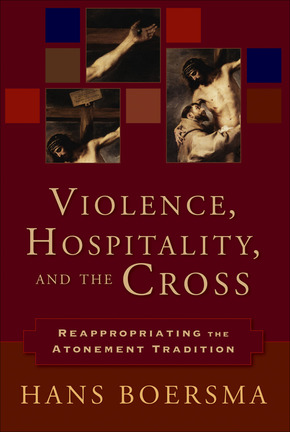
 Hans Boersma, Violence, Hospitality, and the Cross: Reappropriating the Atonement Tradition (Grand Rapids: Baker Academic, 2004), 288 pages.
Hans Boersma takes a serious look at the traditional theories of atonement and investigates the role of violence in Christ’s saving work. To speak of violence in the context of God’s work of salvation is both obvious and bold. It is obvious that the violent execution of Jesus stands at the heart of the atonement. At the same time, it is bold to speak of this violence as an attribute of God’s nature. The cross stands at the heart of this tension between God’s hospitality and the violent nature of salvation history. Violence, Hospitality, and the Cross unfolds on the basis of the paradox that all acts of hospitality in creation require some degree of violence. Boersma challenges the reader to carry this language also into an understanding of God.
Originally trained in the Netherlands, the Reformed theologian Hans Boersma now serves as the J. I. Packer Chair of Theology at Regent College. He takes seriously the challenges of Reformed theology in general, and Calvin’s view on election and predestination, in particular. Nonetheless, Calvin is not the starting point for this book but rather a sounding board that allows Boersma to develop more fully his own theology of the atonement in the terms of hospitality.
The book consists of three parts addressing questions of violence in the context of divine hospitality. Part one sets the tone by introducing the possibility of speaking about God’s hospitality in the face of violence. Part two focuses on the place of the cross in the atonement tradition. Part three draws conclusions from the previous discussion for Christian life and the Church as a community of hospitality. A short epilogue suggests the possibility for the end of all violence in the arrival of God’s unconditional, eschatological hospitality.
The book engages an impressive range of theological, biblical and philosophical sources. The starting point for the discussion is formed by questions of divine hospitality. The late modern debate has framed these questions largely in the context of the necessity and possibility of an unconditional and unlimited hospitality. Boersma suggests that all hospitality is embedded in a context of violence and therefore shaped by the conditions of human existence. Nonetheless, he does not view the boundaries and limitations of creation as negative but suggests, instead, that a positive perspective on violence could redefine our understanding of the atonement and, in turn, of the divine hospitality. Central to this attempt is Boersma’s definition of violence as harm or injury.
Boersma argues that God’s hospitality requires a passionate anger toward anything that violates this relationship of love. The Calvinist emphasis on election tends to emphasize the limited character of God’s hospitality and draws the violence against the non-elect into the heart of God, thereby blurring the possibility of an unconditional and unlimited divine hospitality. In contrast, Boersma speaks of God’s “preferential hospitality” that serves a missiological purpose by embracing potentially all nations. On this basis, the book unfolds the implications of the various atonement theories for an understanding of God’s hospitality.
The heart of the book is formed by a discussion of the moral influence theory, the substitutionary model, and the Christus Victor model. Boersma wishes to preserve the essence of the penal substitution theory but is critical of its scholastic Reformed interpretation that has overemphasized the judicial, non-historical and individual elements of a strict economy of exchange at the cost of obscuring the hospitality of the cross. What makes Boersma’s approach to these theories significant is his insistence on their interpretation and evaluation in light of the concept of divine violence.
No other thinker has influenced the contemporary theological discussion on violence more dramatically than René Girard. The reader unacquainted with this discussion will find Boersma’s work a stimulating and challenging introduction. At the same time, Boersma offers a challenging critique to Girard’s theory that opens up a bold interpretation of the atonement.
Girard’s theory is based on the idea that all violence emerges from an escalation of learned, “mimetic” rivalry. He postulates that human culture derives from the redirection of mutual violence away from the mimetic rivals and toward a third party and surrogate victim: the scapegoat. Girard’s work suggests that the violent execution of Jesus represents a public disclosure of mimetic violence which ultimately renders the mimetic process unworkable by bringing the sacrificial culture to an end. The vision of non-violent relationships thus arises out of the violent context of the death and resurrection of Christ, who submits to and overcomes the mimetic structures of desire and violence and thereby frees humanity from their dominance. Violence is defeated in principle by the death of Christ. However, this consequence of the cross is typically misunderstood and the mechanism of mimetic desire ignored, revealing the radical human incapacity to understand its own violence.
Boersma argues that Girard’s theory exposes the critical function of the cross yet offers no positive role of Christ’s death in revealing God’s hospitality. Instead, he suggests that hospitality can be seen as central metaphor for God’s love that necessarily includes violence in a finite world marked by injustice as long as juridical categories are not neglected.
Boersma locates these categories particularly in the Christus Victor theme cast in an Irenaean framework. The latter takes not the penal aspect of the atonement but the hospitality of God as a starting point. Irenaeus embraces in his thought elements of all three models of the atonement by focusing on the idea of recapitulation rather than the economy of exchange. The result is a greater emphasis on God’s sovereignty despite the affirmation of violence in the life of Christ and of the Christian. Boersma thus trusts the Christus Victor theme as a warrant of God’s eschatological hospitality. In this light, the violence of the cross is seen as a proper instrument in ascertaining the hope that the entire cosmos will one day be embraced by the divine hospitality of the kingdom of God. For Boersma, this paradox forms the heart of redemption.
Violence, Hospitality, and the Cross is a rewarding book that offers both readability and theological substance. The reader might be disappointed that Boersma does not place the atonement tradition in an explicitly Trinitarian context. Neither does he pursue the role of the Holy Spirit in the traditional atonement theories and, as a consequence, in the divine hospitality. On the other hand, the book ends with a strong section on the public face of hospitality that should stimulate discussion on the continuation of the presence of Christ in the Church through the proclamation of the Word, baptismal fellowship, the celebration of the Eucharist, and the Church’s own role in suffering. The application of atonement theories to Christian faith and praxis makes the book an approachable source for any reader who wishes to learn more about the three subject matters indicated in the title.
Reviewed by Wolfgang Vondey
Preview Violence, Hospitality, and the Cross: http://books.google.com/books/about/Violence_Hospitality_and_the_Cross.html?id=i88elF-_L7wC
Publisher’s page: http://www.bakerpublishinggroup.com/books/violence-hospitality-and-the-cross/228221