Stuart Parsons: Ancient Apologetic Exegesis

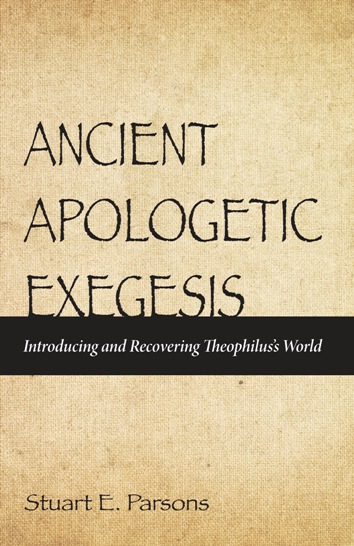
 Stuart E. Parsons, Ancient Apologetic Exegesis: Introducing and Recovering Theophilus’ World (Eugene, OR: Pickwick, 2015), 254 pages, ISBN 9781625648099.
Theophilus of Antioch is one of the so-called Apologists of the second century, and perhaps the most undervalued among them. He is widely regarded as the first Christian actually to refer to the NT writings as inspired in a sense that might approximate what many Christians today mean by “inspiration.” (But there is a difference, in that Theophilus also supposed many non-scriptural writings to be inspired as well.) Theophilus is also known for his influence on Irenaeus, so he is somewhat of a link in a chain of development. Parsons introduces the reader to Theophilus’ exegesis, and tries to make a case for elevating Theophilus’ view of Scripture. He also seeks to uncover Theophilus’ mode of operation when quoting Scripture, arguing that he often quoted from memory rather than from immediate, direct access to a written copy.
It needs to be pointed out that Parsons’s work is marred by a couple of misapprehensions. For one thing, he relies on a psychology experiment conducted by Robert McIver and Marie Carroll to detect when a writer is quoting from memory (pp. 46-48, 50, 63). Unfortunately, he appears to misunderstand their study and what it claims to have proved, as he applies it in a way that makes little sense to the original premise. McIver and Carroll had cited a sixteen-word phrasal agreement as marking the point at which we must deduce direct access to a parallel written writing, and Parsons takes this to mean that quotations of another writing shorter than sixteen words in overall length derive from memory. The problem with this is that the sixteen-word threshold was meant to identify a string of consecutive words in a longer account that parallels another writing, rather than the overall length of a parallel account (verbatim or otherwise). Thus, Parsons does not make his case for Theophilus having quoted from memory (although there is nothing unlikely about that view).
For some, these might be mere quibbles. Aside from them, Parsons’s book is a fine introduction to Theophilus’ exegetical practice. It is mostly nontechnical, and moves through the subject in a way that is reader-friendly. There is no question that more people should be acquainted with Theophilus—we might think of him as bridging the gap between Justin Martyr and Irenaeus—and Parsons does as good a job as any other recent scholar in tracing the main lines of this important figure’s approach to Scripture.
Reviewed by John C. Poirier
Publisher’s page: http://wipfandstock.com/ancient-apologetic-exegesis.html
Preview Ancient Apologetic Exegesis: https://books.google.com/books/about/Ancient_Apologetic_Exegesis.html?id=3FinBgAAQBAJ