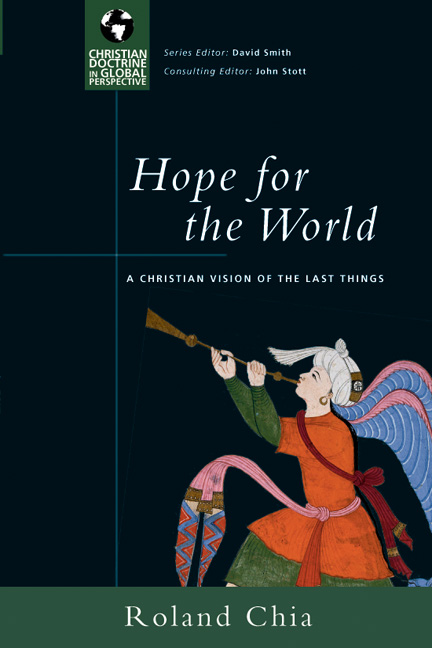
Roland Chia: Hope for the World

 Roland Chia, Hope for the World: A Christian Vision of the Last Things,Christian Doctrine in Global Perspective Series; series editor David Smith, consulting editor John Stott (Downer’s Grove: IVP Academic, 2005), 164 pages.
Roland Chia has written a clear and concise alternative to an all-too-common array of eschatological texts ranging from watered down and weightless to way out and weird. His is neither. The contribution of Chia (Trinity Theological College, Singapore) to the Christian Doctrine in Global Perspective series, edited by acknowledged Evangelical heavies David Smith and John Stott, is stimulating and substantive. Here the series admirably achieves its twin goals of providing texts informed by non-Western Christianity but still applicable for Western Christians. This positive combination is significantly assisted by Chia’s obvious familiarity and intimacy with the Southeast Asian religious context and that of the West as well. The result is exceptional eschatological analysis.
Chia begins by underlining the nature and need of hope in the Asian context. He does not shy away from speaking to issues of terrorism and peace, wealth and poverty, or world religions and worldly ideologies, but sounds a hopeful note bravely based on Christian belief. In fact, he sharply distinguishes secular optimism in cultural or technological progress from Christian hope in Christ. Chia briefly surveys the hope of Israel, accenting the Kingdom of God, the Messiah, and the day of the Lord, but addressing the afterlife too, and of the Church, here accenting Jesus’ teaching on the Kingdom and its timing along with Paul’s vision of the future as “already-not yet” (a partially and provisionally realized eschatology). Then Chia starts tackling specific topics. In successive sections alternating between individual and cosmic eschatology, he discusses death, the intermediate state, and the resurrection, and then the coming of the Lord and the last judgment before exploring the respective fates of the righteous and wicked and the eternal order of the coming new world. The final chapter brings us back to the present, persuasively exhorting us to an eschatological lifestyle characterized as “living in hope”. For Chia the Church is a worshiping community graced by “eschatological moments” ever energizing its hope; faces the fact of evil and suffering in this present age with an inspiring hope; and, expressing hope in Christ openly and personally through commitment to the discipline of discipleship as an identification with and participation in the cross and resurrection of Christ. Chia effectively integrates dimensions of hope often assumed disparate into a present and future dynamic with transforming power for life here and now as well as forever and always. The book concludes with careful endnotes and a Scripture index, but has no person or subject indexes.
As a positive example of Roland Chia’s approach please note his study of death. Rather than merely asking “What happens when we die?” or even “Why do we die?” he goes farther and develops a theology of death deeply probing the purpose and meaning of human existence and life as the gracious gift of our Creator God. Death, therefore, rather than the expected outcome of finite being becomes a contradiction to the character of God. Thus death is an enemy to be overcome—and, in fact, it has been overcome. Believers, who now enjoy eternal life, still presently experience death, but through Christ are assured of resurrection hope. However, Chia does not fail to venture what happens at death and why. In the process he addresses distinctions between physical, temporal death and spiritual, eternal death, and the nature and reality of the intermediate state and the bodily resurrection for holistic existence as unified human beings.
Discerning Pentecostals will discover disturbing trends in Chia’s treatment of cosmic eschatology. Most notably missing is constructive teaching on the rapture and the millennium. Eventually this is explained: Chia confesses advocacy of amillennialism. In short, Chia rejects a literal millennium altogether, spiritualizing it away as a symbol of an age beyond time when the reign of God is finally fully consummated, and relegates the rapture to a mere moment in the movement toward a general resurrection immediately prior to the last judgment. Without outright denial, he downplays eschatological imminence and urgency. Fortunately, throughout the book opposing positions are fairly presented, and this generally includes treatment of distinctions between pre-, post-, and a-millennialism. However, all is not ideal either. While Chia briefly notes “historic premillennialism,” he focuses almost exclusively on “dispensationalist premillennialism.” The former builds on the apocalyptic literature of the Scriptures and the patristic teaching of the early Church, the latter on an ultra-literalist hermeneutic of Scripture shaped by a prefabricated paradigm popularized by J. N. Darby and C. I. Scofield around the turn of the twentieth century. Increasingly, informed classical Pentecostals are identifying irreconcilable differences with such fundamentalist versions of dispensationalism. Dispensationalists are chiefly strong advocates of cessationism (insistence that spiritual gifts have ceased), and often entrenched opponents of Pentecostalism. Understandably, many Pentecostal scholars are dispensing with dispensationalism while retaining belief in the chronology and reality of rapture-great tribulation-millennium (e.g., Hollis Gause, Revelation: God’s Stamp of Sovereignty on History, Pathway, 1983). But Chia fails to note these important distinctions at all, and seems to assume his critique of dispensationalism automatically includes all pre-tribulation millenarians. That is simply inaccurate and unacceptable.
Another cause for concern is the absence of any explicit eschatological pneumatology. With only a few oblique and opaque references from Chia to the Holy Spirit one would never imagine our inspired and authoritative account emphasizes the eschatological Spirit so abundantly (Joel 2:28; Acts 2:17; cf. 2 Co 1:22; 5:5; Eph 1:14). Oddly enough, Chia’s adherence to an “already-not yet” eschatological paradigm provided an excellent but ignored opportunity to explore the Holy Spirit’s role in the present in-breaking of God’s everlasting Kingdom (cf. Gordon Fee, “The Spirit as Eschatological Fulfillment,” God’s Empowering Presence, Hendrickson, 1994). Perhaps here is observed a continuing need for an ongoing critique by contemporary Pentecostalism of Evangelicalism’s tragic tendency to deny or diminish the distinctive significance of the Holy Spirit not only in individual experience but also in the overall intellectual development of Christianity?
The preceding ought not to distract from or diminish the significance of Roland Chia’s accomplishment regarding eschatology. He makes a good case for Christian eschatology as an essentially hopeful enterprise. It need not be a dark undertaking. Throughout the book, occasional comparison-contrasts with non-Christian eschatological schemas helpfully underscore this hopeful accent. We join Professor Chia in affirming “a Christian vision of the last things” as “hope for the world.” Gone is the stereotypical long-haired hippie-like figure on the street corner with a large placard predicting “the end of the world” in doom and gloom; in his place stands a sophisticated global citizen with a bright-eyed vision of the hope-filled future made possible by Jesus Christ (Jer 29:11; Titus 2:13). That does not at all imply imminent judgment is not rushing toward a world of relentlessly unrepentant sinners. But biblical eschatological hope looks beyond the curse to the blessing, and this is surely where our vision should be firmly fixed. As such Roland Chia’s Hope for the World is recommended to pastors and teachers or students and scholars for a refreshing view into Christian eschatology.
Reviewed by Tony Richie
Publisher’s page: www.ivpress.com/cgi-ivpress/book.pl/code=3305










Reader comments and response from reviewer, Dr. Richie in the Summer 2008 issue: http://pneumareview.com/tony-richie-on-dispensationalism/
Reader comments and response from reviewer, Dr. Richie in the Summer 2008 issue: http://pneumareview.com/tony-richie-on-dispensationalism/