
Presence Is a Verb
Presence Is a Verb—a State of Being and an Action
The woman abruptly arose from the Sunday dinner table and accusingly spoke to her husband, “You wouldn’t care if I drowned in the waterhole.” She then turned and walked out the door.
It had been a typical Sunday for the sixteen-year-old girl. The Pentecostal family had dressed in their Sunday best, driven to church, and come home to eat a pot roast that had been cooking in the oven. But the tenor of the day had abruptly changed, and silence now ensued in her mother’s absence. The daughter stared in panic and disbelief while her father paused only momentarily before continuing with his meal. He outwardly appeared unphased by his wife’s startling behavior. Bewildered by his stoic demeanor, her mind whirled, “Why didn’t he say anything? Why didn’t he chase after her?” She learned later that he had not understood his wife’s words. He, too, had been lost amidst the chaos.
The family was aware of the risks of the nearby waterhole. The sudden drop-offs or deep holes underneath the murky water caused it to be potentially perilous. Added to this watery death trap was the reality that her mother could not swim. A brain operation at age twenty had saved the mother’s life but had left her with an inability to walk a straight line on flat terrain, and being in water only exacerbated the unsteadiness. The daughter worried that she had just seen her mother alive for the last time. Like Ebenezer Scrooge facing the Ghost of Christmas Yet to Come, the teenager envisioned a life of darkness and separation brought on by death—her mother’s. At that moment, she desperately longed for her father to protect their family, to keep them safe from the terrors of death.
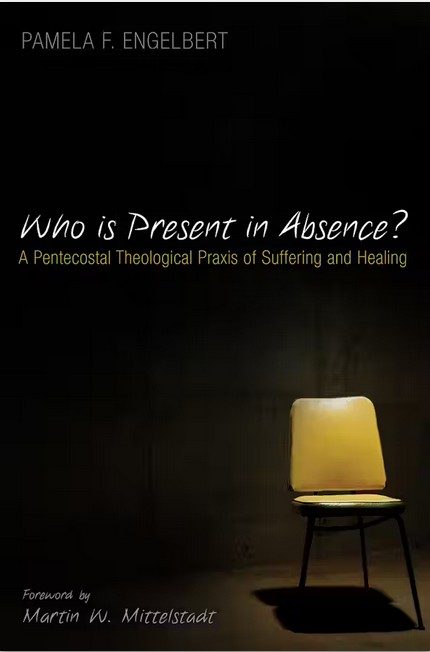
Concepts of this article are taken from Engelbert’s first book, Who is Present in Absence?: A Pentecostal Theological Praxis of Suffering and Healing (Pickwick Publications, 2019). The book is based on interviews with eight Classical Pentecostals, and their experiences are combined with psychology, culture, and Scripture/theology. In this article, Engelbert builds from some of the book’s principles to demonstrate how Pentecostals are uniquely qualified through our emphasis on the Spirit to be empowered to be present when God is apparently absent.
Amidst this chaos, the phone rang. The daughter answered. On the other end, she heard the voice of another 16-year-old girl who lived 180 miles away. The familiar voice said, “God told me to call you. What’s up?” Through this voice, God ministered to the panicked teen in her darkness. God revealed Godself as a minister to a 16-year-old teen through another 16-year-old in a void without safety and protection. God saw the daughter’s distress and invited her friend to participate in God’s ministry to be with the scared teen before her mother returned later that day.
God is revealed as a minister to a teenager, bringing healing presence to an impossible situation. God invites a long-distance friend to unite with God in another friend’s despair through listening and prayer. It conveys that God is a minister who invites humans to participate with God in God’s healing ministry of presence in the world. In what follows, I seek to demonstrate how presence is an act of healing ministry in which Pentecostals are uniquely equipped to participate in the power and the presence of the Spirit. To accomplish this, I draw from Pentecostal experiences, the field of psychology, and Scripture/theology.
Experiencing God’s Presence
The above supernatural incident and others like it are familiar to Pentecostals. We are a people who seek God’s presence. We call on God for revival, an encounter with God in which the Spirit convicts, heals, and renews God’s people. Our worship creates space in a service, which nurtures an expectation of experiencing God’s presence. We emphasize coming forward to the front (the altar) to a place where people may encounter God, be it for salvation, the baptism of the Spirit, healing, or sanctification. We stress the importance of prayer, which includes requests that God would supernaturally intervene. We highlight testimonies that give reports of our experiences of God, such as divine healing. In short, Pentecostals seek, hope, and/or expect to experience God’s presence.
I draw from our emphasis on God’s presence when I teach a course on Pentecostal pastoral care, in which I stress the importance of being present. At first, students push back on this idea. They desire action, such as learning how to use Scripture to solve people’s problems. For them, learning how to be present to others via empathy is not action. Presence does not fix it, so it is equated in their minds with doing nothing. It is devoid of the action necessary to generate transformation (similar to state of being verbs). As one who was born and raised Pentecostal, I relate. We are a pragmatic people who want a theology that works—an action that culminates in a definitive solution. I learned from my junior high English teacher, Mrs. Folkestad, that a noun is a person, place, or thing, and a verb expresses action or state of being; therefore, presence is a thing, not an action. But later in life (my apologies to Mrs. Folkestad), I came to see how presence is also a verb—it is both an action and a state of being.
Consider this question: What transpires when you experience the presence of God? Pentecostals typically respond with phrases like, “I felt love”; “I experienced a tremendous peace”; “I was no longer alone.” Many admit that although their circumstances did not change, they were strengthened through God’s presence. In that moment, they knew God was with them. This gave them courage to walk through their difficult valley, their impossibility. God’s presence transformed them, and it is this transformation that validates their experience as being a genuine act of ministry. When a sixteen-year-old friend participates in God’s ministry in the Spirit’s power by being present to an overwhelmed teenager through a phone call, God’s healing presence is encountered. This presence is an act of ministry. But Pentecostals are not alone in experiencing presence as being powerful for transformation. Psychology also supports that presence changes a person.
Humans Psychologically Need Healing Presence
At the time John Bowlby introduced attachment theory to the discipline of psychology, Western psychological theories tended to mirror our individualistic culture. Psychoanalysis was the dominating theory, focusing on the internal world of the person (think Freud’s ego, id, and superego). But Bowlby’s observations of children with their parents caused him to focus on relationships, not the inner parts of an individual. As such, he developed his theory of attachment. For Bowlby, humans (from infant to senior) instinctively long for the other’s presence to soothe them.

Image: Samuell Morgenstern
Bowlby believed we have an innate attachment behavioral system. When we are threatened, we seek to be close to someone who is stronger and wiser (an attachment figure) for support. Many of us may recall as children being awakened by a loud clap of thunder, and our fears being heightened by the bright, blinding bursts of lightning during a summer storm. As a two- or three-year-old, I was terrified, which meant my attachment behavioral system was activated. I was alone in the dark, feeling unsafe. Like any small child, I voiced my distress by crying loudly, and my mother responded by coming to be with me. Although my parents were unable to make the thunder and lightning cease, I received their support through their presence. As I curled up between them in the comfort of their bed, I felt safe and secure in their presence. Being with them enabled me to relax, and my attachment behavioral system was deactivated, allowing me to sleep. Their presence changed me without transforming the situation. The thunder was still loud and frightening. The lightning was still bright and scary. But their state of being present to me was an act of ministry—it brought healing comfort to my terrified being.
Scripturally/Theologically God Ministers through Presence
Thus far, we have seen how experiencing God’s presence in our worship services changes us. We have also recognized that psychologically we are created to be near others amidst our distress. The presence of those who are wiser and stronger brings about a sense of safety and security. Scripture and theology, too, reveal that God ministers through God’s being to humanity. Throughout human history, God enters into human chaos, or impossibilities, by joining humans in their powerlessness. For instance, when God enters the impossibility of an elderly couple’s childlessness, Abraham and Sarah have a son. God unites with Hagar and Ismael in their despair in the wilderness, delivering them from death (Gen 21). God joins the Hebrew slaves in their impossible situation by calling Moses, an elderly sheep herder, to participate in God’s ministry of deliverance (Ex 3). God repeatedly enters situations in which people experience separation, helplessness, and hopelessness—places of death. I am not speaking only of a physical death, but I am following Andrew Root by expanding death to include impossibilities, limitations, or a deep need that is beyond our reach. Each time that God comes into human impossibilities, God is revealed as minister through God’s being. God ministers by entering into a couple’s childlessness, a mother and son’s abandonment, a people’s oppression, and a sixteen-year-old’s fear of death.

Image: Vitaly Gariev
Such ministry through God’s being is most clearly seen in the person of Jesus Christ. Humanity is in an impossible situation. We are destined for death. As Paul informs us, the wages of our sin are certain death. All our attempts to escape death fall miserably short. Neither our good works, our praying and fasting, nor our offerings enable us to avoid death’s grip and ultimate separation. It is an impossible situation. And it is in this impossibility where God joins humanity.
John 3 reminds us that God’s love for the world initiates God’s act of sending the Son into the world to be with humanity in death. The Son, who is the very being of God, embodies God’s act of ministry to the world by joining with humanity. We may immediately call to mind that Jesus was present to humanity while he walked on this earth. However, I am referring to a ministry that is deeper than this. It is inward, taking place within the being of Jesus Christ. This ministry is seen more clearly through the theological concept called the hypostatic union. The hypostatic union states that Jesus is both fully divine and fully human. Two distinct natures. One divine. One human. Both are in one person without any blending or altering. Since they are in one person, the two natures are united, or in relationship, while remaining distinct in Jesus Christ. The divine is eternally connected with humanity within Jesus. That is, the divine is forever present to humanity in Jesus’s being. Because of the hypostatic union, God is revealed, and humanity is healed (reconciled). Both of these movements are transpiring in the person of Jesus Christ, who is God’s act of ministry.
This ministry that is taking place in Jesus, as seen in the hypostatic union, is both a healing ministry of presence and a healing action. In Jesus, presence becomes a ministry that is both a state of being and an act. The divine nature is present to and in relationship with the human nature in Jesus while healing humanity. In this light, Jesus is the embodiment of God’s ministerial act of healing presence (state of being and action). This is an ongoing healing ministry of the divine ministering healing presence to humanity. Through the power and the presence of the Spirit, we are now caught up in that healing act of presence. We are joined with Jesus’s humanity through the Spirit.
Moreover, we are invited to participate in this ministry of healing presence through the power of the Spirit. When we unite with other persons in the power of the Spirit in their impossibilities through presence, we are joining with God in God’s healing presence to them, which is occurring in the being of Jesus Christ. Therefore, God invites us, such as long-distance friends, to join others, like an overwhelmed sixteen-year-old, in their deaths. Transformation occurs because through the power of the Spirit, we are uniting with God in the ministerial act of God’s presence. This healing presence communicates, “You are not alone. I see you. I am here.” It ministers peace amidst chaos. It brings healing transformation.
A Pentecostal Response
Joining others in their deaths, limitations, or impossibilities calls for us to see God as a minister and to be dependent on the Spirit’s power. Too often we rely on our understanding in response to a hurting individual. We focus on ways to fix the issue or to find reasons why the impossibility exists. These types of responses to hurting people frequently include a form of avoidance, self-agency, or positivity. Avoidance fails to respond to the person who is hurting. Self-agency informs sufferers that their own action or inaction is causing the pain, e.g., You must pray more. Positivity places the onus on the distressed to be optimistic, believing this will change the circumstances, e.g., Trust that God has something for you just around the corner.

Image: Taiki Ishikawa
The emphasis on God being a minister is essential if we are to abstain from unhelpful responses. It expands our perception of God beyond the narrow view of problem solving. When God is perceived as a minister, our perception moves beyond the image of a genie who grants my wishes. It surpasses the restricted depiction of a mechanic who fixes my car or a lifeguard who rescues me from drowning. While the concept of God being a minister may include those aspects in a limited way, it is more. God is a minister who comes close to those experiencing any kind of death. And now God invites us to join God in this healing place.
But more than a change in perception, we need the power of the Spirit to be present to hurting persons and to refrain from avoidance, self-agency, and positivity. We require the Spirit’s power to have courage and strength to sit amidst uncertainty and ambiguity with those in despair rather than fleeing from or fixing them. We need to be empowered by the Spirit so that we are exhibiting the Spirit’s fruit, not blame and shame. We must have the power and presence of the Spirit to be present to those in pain in a similar way that God is present to them. Through our act of ministry of presence, the hurting then may see that God’s healing presence is with them, strengthening and upholding them. And that is ministry, which is both being and action.
Further Reading
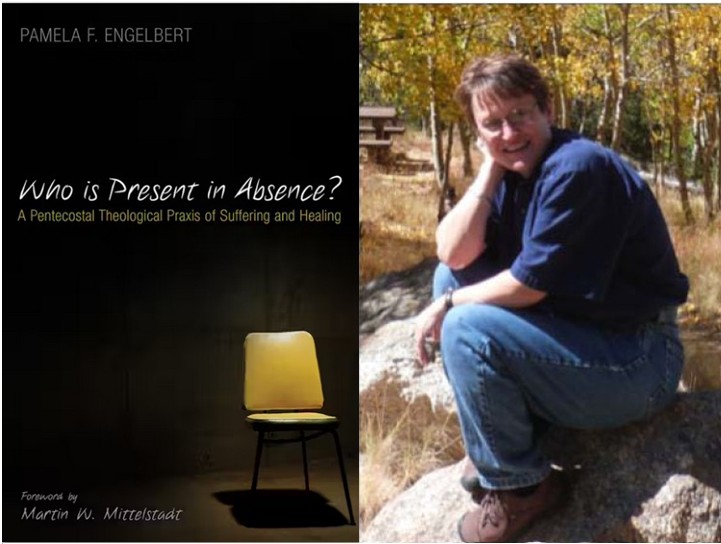 Pentecostal Encounters with Suffering: an interview with Pamela F. Engelbert

Category: Fall 2025, Living the Faith

 Followers
 Fans
Fans