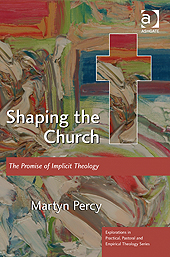
Martyn Percy, Shaping the Church

 Martyn Percy, Shaping the Church: The Promise of Implicit Theology, Explorations in Practical, Pastoral and Empirical Theology Series (Burlington, VT: Ashgate, 2010), 193 pages, ISBN 9780754666004.
Martyn Percy, Principal of Ripon College Cuddesdon and professor at King’s College and Heythrop College London, and the Church of England’s Oxford Ministry Course (for equipping ordinands), adds to his publications on theology and the Anglican Communion. Shaping the Church is presented as a sequel to his interdisciplinary ecclesiological proposal, Engaging with Contemporary Culture (2005). The earlier publication presents ecclesiology in conversation with anthropology, sociology and cultural studies whilst the book currently under review explores ecclesiology in relation to sacramentality, church growth, and ministry/practical pastoral theology particularly when these areas concern church missions, leadership formation and church polity within the Anglican Communion, especially in England. This book makes at least three important contributions to ecclesiology: Percy offers his insights on constructing an ecclesial theology (that listens to culture, theology, pastoral and congregations), on reframing church growth in a culture of consumerism, and on sustaining Anglican unity amidst problems that threatened to divide this global communion.
First, Percy argues for the importance of theologizing from the ground up (what he calls implicit theology) rather than the dominant approach of theologizing from official documents and texts, and with this proposal, he indirectly corrects a common perspective that theology is meaningful only when performed by clerics and/or professional theologians. According to Percy, “implicit theology … is deduced from operant religious practice rather than formal religious propositions” (p.6). Official theological statements often do not determine how churches engage culture. Percy rightly observes that beliefs and practices at the ground are often a result of theology lived in culture (albeit without passing the rigor of theologians’ processes) and as such the churches’ emergent experiences are “natural texts” for theological reflection. Implicit theology opens up vistas for examining the perplexing reality of church life, thereby providing possibilities for reconfiguring ecclesial life and a theology of the church. Simply put, practical theology has much to say to the systematic theological reflection of ecclesiology because culture interfaces with theology and church life more often than has been acknowledged by academic theologians. For instance, Percy traces three different views of baptism and shows that each position reveals a nascent theory of how churches shaped their own identity, which is not written in official documents. Percy also shows how culture influences churches’ views on the theology and practice of confirmation and/or conversion—which becomes crucial as churches think about their role in the process of discipleship.
Second, Percy reframes a theology of church growth against the backdrop of recent alternative church growth practices found in England (known by the name, “Fresh Expressions”). As secularity becomes the dominant character that defines society and as Christian signs and practices lose their grip on society (which is fast becoming secular), declining church attendance is to be expected. But the Principal suggests that the data is no cause for alarm. Even if people do not attend churches, they still relate to the church indirectly. While Grace Davie (1994) describes this ambivalent group as those in the camp of “believing but not belonging” (p.47), Percy calls them those who are “relating and mutating” (p.52). Even if people do not attend churches, they implicitly relate to the church; only very few people would choose to have absolutely no relationship with the church; and so the statistics of declining church attendance barely paints an accurate picture of membership and/or the organic growth of Christianity in these churches. He further demonstrates from the history of English Christianity that the English believe in God but are not active in the church—they support the church from outside and not as pillars of the church (p.60-61). On that note, Percy urges that churches should relax rather than to be uptight about employing aggressive church growth strategies; they should trust the resilience of religion to work itself out. He however reminds the churches that they must respond to society by offering ministry to those in need.
In examining contemporary alternative church models (known under the umbrella of Fresh Expressions), Percy finds these approaches wanting—these churches, notwithstanding their rhetoric of out-reach, and so forth, are mere examples of church in-reaching activities (p.72). For a sustained critique of these alternative approaches, read chapter 4. Also, against some who argue that only conservative churches grow, Percy proposes that the ‘liberal church’ too experiences growth (p.94)! He takes Loren B. Mead’s sociological-theological examination of four paradigms of growth—numeric, spiritual, organic and incarnational—and the ideas of a number of other church growth proponents to strengthen his argument that liberal churches are alive because these communities are open, inclusive and justice-centered. Churches will grow organically as long as churches engage culture in the dual methodology of accommodation to and resistance to culture without becoming impatient, and as long as churches seek to live out a fourfold priestly ministerial function of becoming sacramental-transformational, reciprocal-representative, sacrificial-receptive, and pastoral-prophetic (p.108-109)!
Third, Percy affirms the “mild and yet ardent temperate Anglicanism” (p.172) as the model for resolving the “hurricane of controversy” (p.170) which threatens to divide the Anglican Communion, and for harnessing the conflicts positively towards fulfilling the overall mission of the church. Percy argues that the Anglican via media exhibits the wisdom necessary for reframing conflicts. This is because the method of via media combines robustness and suppleness, reflexivity and directionality, intensity and extensity, and reactivity and proactivity—all of which are qualities needed to deal with “a complex nexus of competing convictions and emotions that cannot be easily resolved” (p.139). Furthermore, Percy urges that ordinands learn the “Anglican genius of ‘directed plurality’” (p.141) which is essentially an openness and vulnerability to the multiple interpretative possibilities within the church: these postures, he suggests, may be learned when leaders exercise courtesy, hospitality, service and deep listening, and when they recognize clarity, precision and resolution takes time to unfold. Those of us who have experienced church conflicts will know that emotions (such as anger) float around in conflicts. Those who loved the church, i.e., those who have strong feelings for the church, will use church polity and pastoral praxis to either protect or move the church forward. Here, Percy encourages his readers to embrace the Anglican posture of “passionate coolness” (p.144). “Passionate coolness” does not mean the avoidance of conflict (which can result in atrophy) or the enabling of strong feelings (p.153). Rather, the goal in ecclesial polity is the management of emotions. He writes, “Extreme feelings, when voiced, can lead to extreme reactions. And extreme reactions, when allowed full-vent, can make situations unstable” (p.144). The recommendation is a “delicate infusion of polarities,” realizable by a communication “characterized by reticence, temperance and openness” (p.144) which is “not driven by anger or react hastily to its outpouring” (p.151). While some may not agree with Percy’s disposition to prefer “heresy over schism”—Percy argues that heresies may be corrected more easily than schism (p.154) and that “fragmentation is to be avoided at all cost” (p.156)—few in the Anglican Church would doubt that the Anglican Communion could maintain its unity without the recovery of biblical and Anglican qualities of “patience, forbearance and catholicity, moderation and a genuine love for the reticulate blend of diversity and unity that forms so much the richness of Anglican life” (p.172).
To the readers of Pneuma Review, I would ask, if Pentecostalism is truly a harbinger of plurality and unity, to what extent would Percy’s proposal for the Anglican Communion be applicable for the churches of the Renewal movement that derive from the Azusa Street Revival? At one level, Renewal Christianity is a living expression of Percy’s first and second thesis for an implicit theology and for an alternative church growth theology: the global Pentecostal and Charismatic movement develops from the grassroots, continues in the convictions and practices of churches on the ground, and remains one of the most expansive outreach movements in the history of Christianity. At another level, leaders of this diverse movement may find it helpful to re-evaluate its church growth dynamics, and how churches in the movement negotiate unity and fragmentation. If Renewal folks claim (though not exclusively) the filling, anointing, and fullness of the Spirit to be operating in discipleship, missions, and in the life of the church, then, in some ways, we may argue that Percy’s third contribution (reviewed above) should resonate with pneumatological sensibilities: and by implication, we have to ask, how may we facilitate diversity and unity among Pentecostals and Charismatics even as the movement seeks an ecumenical role with Christians from other Christian traditions? I am not implying here that renewalists would readily embrace Percy’s proposal. Very likely, renewalists would read Percy’s call as an example of a methodological liberalism. Still, Percy’s sharp observations (on some of intersubjective relational and church growth dynamics within the Anglican Communion) would have resonated with some of the issues facing renewalists in the diverse pneumatological movements. In that sense, Percy offers a parallel lens for renewalists to evaluate their own traditioning. I hope Pneuma Review readers will be open to Percy’s theological reflection.
Reviewed by Timothy Lim Teck Ngern
Preview Shaping the Church: books.google.com/books?id=my4Y4Og4ePkC