Larry Hurtado: Lord Jesus Christ

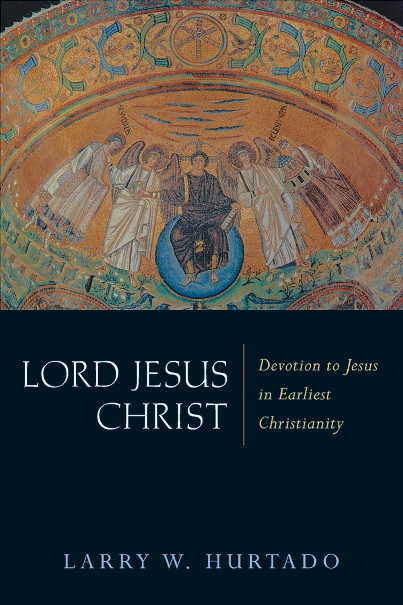
 Larry W. Hurtado, Lord Jesus Christ: Devotion to Jesus in Earliest Christianity (Grand Rapids: Eerdmans, 2005), 746 pages, ISBN 9780802831675.
How is it that early Christians, who were mainly monotheistic Jews, showed such devotion, even worship, to Jesus Christ while still worshipping God in heaven? Larry Hurtado answers that question and more in this book and he does it in intricate, scholarly detail. In fact, Hurtado argues that this attitude towards Jesus stretches back to earliest Christianity in Jerusalem. This doctrine, this concept, he says, did not arise out of much later reflection and theological development, as some would argue.
He begins by setting his study in the context of first century Jewish monotheism, making it clear that generally the Jews of that time believed in one God and one God only. He then shows that from early on Christians, while still demonstrating devotion and worship to God in heaven, also demonstrated devotion and worship to Jesus Christ, a man dead but risen. In other words, these monotheistic Jews engaged in “binitarian” worship.
Hurtado examines Paul’s letters in chapter two, arguing that they are the earliest forms of Christian writing available to us. Hurtado notes that while Jewish critics of Paul’s ministry to the Gentiles complained about his mixing with Gentiles and his attitude to the Law, particularly his apparent rejection of circumcision, none seems to have complained about his using divine terms for this risen Jesus. Whilst arguments from silence can prove little or nothing, sometimes they carry weight, and this one, I believe, does that. The conclusion Hurtado draws is that the reason they did not reject Paul’s teaching on “devotion to Jesus” was because they too were teaching it and that even before Paul did. Indeed, Hurtado wonders whether this could be one of the reasons Paul originally so strongly opposed Christianity.
Even in Paul’s early writings “devotion to Christ is presupposed”. This would date its origins to not later than the 40s A.D. For example, in the first chapter of 1 Thessalonians (probably written in 50 A.D.) Paul speaks of “our Lord [kyrios] Jesus Christ” (v.3) and of God’s “Son from heaven … Jesus, who rescues us from the coming wrath” (vv.9-10). Scholars commonly regard Philippians 2:5-12, which begins “Christ Jesus, ‘Who, being in very nature God …’”, as an early Christian hymn that Paul uses in his letter. That hymn, if such it is, glorifies Christ in unmistakable terms. If that letter was written in about 60 A.D., as is commonly believed, then that hymn must have been composed earlier, perhaps much earlier.
In fact, this belief and its associated practices seem to have become common remarkably early in different Christian groups. Hurtado says, “for such a major cultic innovation to have so quickly become widespread, conventionalized, and uncontroversial among various Christian groups, it must necessarily have originated among one or more sufficiently influential, respected, and very early circle of believers.”
After looking at Paul’s letters Hurtado goes on to examine “Judean Jewish Christianity”, the synoptic Gospels, and then John’s Gospel. After that he looks at early Christian writings that are not part of Scripture, and in the process moves into the second century.
John’s Gospel is generally regarded as the last of the four Gospels to have been written, but it (or most of it, some would argue) was still written in the first century, so soon after the events it speaks of. Yet John’s Gospel has an undeniably high view of Jesus. A striking example of this is John’s frequent recording of “I am” (Gk. egō eimi) on the lips of Jesus, most significantly “before Abraham was born, I am!” (Jn. 8:58). Hurtado says, “this absolute use of ‘I am’ in the Gospels amounts to nothing less than designating Jesus with the same referential formula that is used in the Greek Old Testament for God’s own self-declaration.”
Strikingly, Hurtado also suggests that John’s portrayal of Jesus as the Word (logos) in his first chapter is not really connected with the Old Testament concept of wisdom, as is often suggested. Rather it is more related to “the name of God and the angel of the Lord” found in the Old Testament and later “Jewish traditions”.
When one is brought up in Christian circles it is easy to take Christian traditions for granted, but Hurtado makes one rethink a number of issues. For example, why is Christian baptism “in the name of Jesus Christ” or “into the name of the Lord Jesus” (Acts 2:38; 19:5)? We might answer, “Because the Scriptures say so!” Well, yes, but John the Baptist did not baptise into his name. According to Hurtado, Jewish proselyte baptism was not into the name of Moses or “any ‘divine agent’ figure”. But Christian baptism was from the first baptism into the name of Jesus or baptism “in the name of the Father and of the Son and of the Holy Spirit” (Matt. 28:19). Thus even in this Jesus is given a higher position, a higher status, than Moses, the most revered of Old Testament figures, and, in that last formula, is related to God in a unique way, which is clearly connected to the doctrine of the Trinity.
Hurtado also examines a considerable amount of early non-biblical documents about Jesus to present a fuller picture of the subject, including the so-called Gospel of Thomas and the Shepherd of Hermas. The Gospel of Thomas often departs from a biblical understanding of Christ, with what Hurtado calls an “esoteric” and “revisionist” approach. In fact, Thomas is a collection of sayings rather than a Gospel, and is very different from the canonical Gospels. For example, it does not use such key terms of Jesus as “Christ”, “Lord”, “Word” and “Savior”. Yet Hurtado points out that this document contains Coptic equivalents of the “I am” and “I have come” sayings on the lips of Jesus that are common in the Gospel of John. And, as Hurtado notes, in saying 77, Jesus says that “the All came forth” from Him.
As Hurtado shows, the Shepherd of Hermas has a higher view of Jesus than the Gospel of Thomas. One that is much closer to the biblical view. It says that Jesus is “Lord” and “the Son of God” and it has a strong emphasis on the power of His “name”.
Larry Hurtado’s book is not an easy read. It is very detailed and complex. But it is a most rewarding book to grapple with. It clearly demonstrates that from very early on in the Christian era the followers of Jesus of Nazareth greatly revered, even worshipped, Him, and that they described Him in terms that had previously only been used of the one God.
Towards the end of this book Hurtado sums his subject up briefly but accurately. He says, “We have seen that the ‘binitarian’ pattern of devotion in which both God (the ‘Father’) and Jesus are objects of [worship] goes back to the earliest observable stages of the movement that became Christianity.” Thus the Christian worship of Jesus is not a later add on, it is a fundamental and essential part of the Christian faith. Praise His name!
Reviewed by David Malcolm Bennett
Publisher’s page: http://www.eerdmans.com/Products/3167/lord-jesus-christ.aspx
Preview Lord Jesus Christ: https://books.google.com/books/about/Lord_Jesus_Christ.html?id=k32wZRMxltUC