Jeremiah Campbell: Say What?

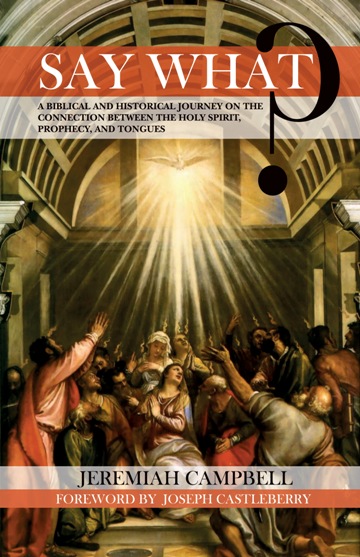
 Jeremiah Campbell, Say What? A Biblical and Historical Journey on the Connection between the Holy Spirit, Prophecy, and Tongues (Wipf & Stock, 2018), x + 122 pages, ISBN 9781532646997.
Jeremiah Campbell (DMin, Talbot School of Theology) has written a very accessible volume in defense of connections between tongues as prophetic speech and the Baptism in the Holy Spirit. He offers what would be deemed a Classic Pentecostal interpretation of tongues as initial physical evidence of the Baptism in the Holy Spirit and presumes this throughout his readings of both Scriptural and historical testimonies. This volume is written to address issues which outsiders might have regarding the connection of tongues to the Baptism and to offer answers to objections regarding such.
Campbell opens with his own brief personal testimony (in good Pentecostal fashion) of the Baptism in the Holy Spirit. He then offers a five part “journey” (essentially an apologetic journey) with brief coverage of: (1) the role of the Holy Spirit in the Trinity, (2) the filling of the Spirit in the Old Testament (he prefers “Covenant”), (3) the filling of the Spirit in the New Testament, (4) the filling of the Spirit in Church history, and (5) the filling of the Spirit and Pentecostal renewal.
The first part presumes that a Trinitarian reading will give appropriate direction to all that follows. It reads a number of Biblical texts as indicating Trinitarian beliefs and confessions. While such might be well received by individuals already in agreement with Trinitarian beliefs the arguments are a-historical in context (with the specific use of “Lord” in the confessions of Paul, on which one might examine the extensive work of Gordon Fee’s Pauline Christology: An Exegetical-Theological Study). Further, it is a curiosity that Campbell does not properly represent the use of YHWH in the English translation he makes use of (NIV1984) which indicates the name as LORD.

In the second part, Campbell offers a brief argument for the connection between prophetic speech and the fullness of the Spirit. The “fullness” is presumed in the texts examined though it may simply be that he has chosen this as the leading metaphor to identify the various terms regarding Spirit endowment/experience. This connection to prophetic speech is likely one of the best offerings in this overall volume (which follows the work of Roger Stronstad’s The Prophethood of All Believers). While Campbell examines many of the texts of the OT which use the Hebrew ruah (“S/spirit”), he selectively offers only those deemed connected to prophetic speech. Thus, for example, he does not address the Spirit upon Joseph (as indicated by Pharaoh) or Bezalel and Oholiab. The former would seem to fit his overall trajectory in this chapter. While there are numerous gaps in his argument regarding the OT (which presuppose a Pentecostal interpretation apart from literary or historical interpretations), he is to be commended in continuing the work of Stronstad regarding prophetic speech in relation to tongues-speech and Spirit baptism. One caveat would be to note that Spirit experiences are not limited to prophetic speech, but include prophetic acts (such as Ezekiel’s mock Jerusalem, tongues of fire, or Paul’s belt).
The third part attempts to reconcile the oft noted differences between the Lucan theology of the Spirit in Luke-Acts and the Pauline. Many may be unsatisfied with his attempt, but it is commendable that he should address such as a hurdle to appreciating the preferential treatments of a given Biblical voice as determining how one might read other voices in the NT. Notable gaps in his reading of the NT would be Spirit endowment in the writings attributed to John which offer yet another distinct voice to the NT witness of the experience/s of the Spirit.
The fourth part (and the longest section) briefly surveys highlights throughout Church history attempting to answer accusations that tongues (and prophetic speech) associated with Spirit filling ceased with the apostolic era. He offers a fine (if overly Classical Pentecostalizing) reading of the testimonies of women and men around the world and throughout history of varying church traditions who experienced tongues and/or prophetic speech in relation to their testimony of experiencing the Spirit. While he makes numerous leaps to read into the historical witnesses as if they themselves connected tongues to Spirit baptism, he does well in identifying the continuation of tongues and prophetic speech as part of the broader historic and global Church (summarizing works like that of Stanley Burgess, Christian Peoples of the Spirit).
The final section is split between the more contemporary experiences of the Spirit associated with tongues and prophetic speech (following from the 19th century revivals, through the Pentecostal outpouring at Azusa in the early twentieth century, and briefly noting the Catholic Charismatic movement). In this section, Campbell describes several of the largest Pentecostal fellowships, but curiously does not mention the Church of God in Christ (entering Pentecostalism in 1907) which predates several he lists and also claims the largest U.S. affiliation of all Pentecostal fellowships (improperly attributed to the Assemblies of God, p. 99). The COGIC reports between 5.5-6.5 million adherents in the U.S. and is the fifth largest Christian denomination in the U.S. (according to the National Council of Church which lists the AG as 9th in 2010 with just under 3 million adherents: http://www.ncccusa.org/news/100204yearbook2010.html). This section closes with a call to seek the fullness of the Spirit and remain open to tongues-speaking. Here, Campbell offers seven barriers to receiving the Classic Pentecostal experience of tongues as initial evidence of Spirit baptism. These show pastoral concern and would certainly offer brief answers to those who might still have something keeping them from such a personal and difficult to describe experience.
As stated previously, Campbell’s work is accessible to the average reader and could be used by a Classic Pentecostal congregation to offer some basic apologetics for the experience of tongues in relation to Spirit baptism. While the arguments would be helpful in such a setting, they would not likely remain unanswered by critics. There are numerous gaps in the Biblical and historical interpretation which begin with the Classic Pentecostal presupposition read back into the text of Scripture and historical writings. Though these are weaknesses specifically, the texts covered still offer insight into prophetic speech and the Spirit as an expectation among many and as normal in the Biblical context. Should any future revisions be made, perhaps some of these comments might be taken into consideration to strengthen the overall argument which still needs further expansion both for the academy and for the church: prophetic speech acts are evidential of Spirit impartation/experience. It is hoped that even the intent of this volume (that others might seek and receive the infilling of the Spirit) would be accomplished through the reading of this volume.
Reviewed by Rick Wadholm Jr.
Publisher’s page: https://wipfandstock.com/say-what.html