Brian Stiller: Jesus and Caesar

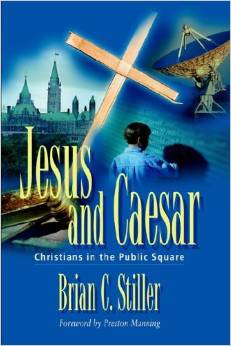
 Brian C. Stiller, Jesus and Caesar: Christians in the Public Square (Oakville, Ontario: Castle Quay Books, 2003), 187 pages, ISBN 9781897213193.
All too often the church vacillates between secularization and sectarianism, between a diminished belief in God in the world and the withdrawal of the church from culture to protect the faithful. Brian Stiller wants to rehabilitate the role of public engagement, Jesus and Caesar argues that Christians need to steer a middle course between secularization and sectarianism if the church is to be a spiritual light to the world.
After investigating the reasons for the decline of Christian witness in the world, Stiller explores the biblical approach to public engagement. In the Old Testament, creation established the principles of shared resources, work, growth and accountability. Since the Fall, however, greed and envy led to the abuse of creation and use of economic resources for personal gain. In the New Testament, Jesus was a political force, a witness to people regardless of political or social location. Although he did not participate in political rule or contest government rulership, Jesus effected social change. He upset the status quo by challenging its “self serving assumptions and values” (p. 62). He inaugurated the kingdom reign by cutting to the center of human self-interest, power and ego. Yet hope for the ultimate fulfillment of the kingdom still lay in the future, pushing the Christian community forward to celebrate life in the midst of turmoil. Christ’s kingdom message sowed the seeds for life-giving transformation. For Stiller, the Christian must embrace the earth (and cosmos) as part of God’s grandeur reality, not to be annihilated but to be transformed into the new heaven and new earth. Thus the state has legitimate status in the order of creation and kingdom expectation, so that Christians have an obligation to influence the state for the gospel.

Four models of church-state engagement are suggested by Stiller. The “Christendom model,” developed under Constantine, combined the church’s message with the state’s concern for exercising power. However, the church’s lack of distance created an inability to critique society. The “Luther model” challenged papal authority and its link to social power to emphasize personal faith. Luther’s two kingdom doctrine severed the spheres of church and state: The former was concerned with spiritual growth, the latter with the restraint and punishment of evildoers. Ironically, Luther ended up calling on the state to fight against the “tyranny of Rome,” Anabaptism and the peasant’s revolt. The “Calvin model” asserted that the state receives its authority directly from God (not the church), but this authority is limited. The church is called to renew creation and exert influence on the whole social order as the gospel makes its way into the world to oppose ungodliness. The “Otherworldly model” argues for Christian separation from the world; the church is the locale of the redeemed, the world under demonic rule. In this model, obedience to the state is conditional and subsequent to obedience to God. For Stiller, the church is called to serve Christ whereas the state is to serve all peoples, faiths and cultures.
Stiller’s most innovative discussion deals with pluralism. Religious pluralism contends that all faiths are legitimate, but this leads to relativism. Cultural pluralism, however, allows people of differing faiths and beliefs to coexist in harmony and recognizes that all faiths have a right to exist. The benefit of cultural pluralism is that it defends against domination and ideological tyranny. Although Christianity no longer has special status, cultural pluralism maintains that all truth claims have a right to be discussed in a public forum. Finally, Stiller insists that Christian participation in the public square must include personal involvement, institutional engagement, a willingness to counter sinful ideology and practice, an “arms-length” (critical) distance from the world and when necessary withdrawal from the world. The tragedy, Stiller notes, is that the church has withdrawn from public engagement and has “stopped singing the song of biblical faith and life in the public square” (p. 170).
Although Stiller is at times too brief in his comments, the value of the work is that it succeeds in its intent—to outline an appropriate approach for Christian involvement in public interchange. The book’s intended audience is Christian pastors and leaders, but it has intellectual credibility. It not only dissects the contemporary church’s tendency toward sectarianism, but it offers a prognosis for Christian participation in the public sphere. Pastors and leaders will find Jesus and Caesar valuable for understanding the public role of the church.
Reviewed by Peter Althouse