
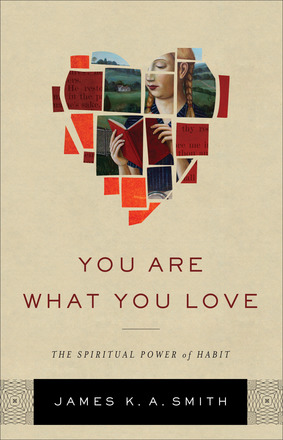
James K. A. Smith: You Are What You Love

 James K. A. Smith, You Are What You Love: The Spiritual Power of Habit (Brazos Press, 2016), 224 pages, ISBN 9781587433801.
James K.A. Smith is a philosophy professor at Calvin College and author of many books and articles. He has designed this book to focus on two distinct aspects of Christian life, the things we love and the habits we have. The book is divided into seven chapters with the first half focusing on the reality of love and the second on habits of worship. He concludes the book with a helpful resource of suggestions for further reading.
Smith opens this book with a distinct re-orientation to view ones’ self as a loving being, rather than a thinking being. He peppers the book with a comic reference to viewing humanity as thinking beings as brains on a stick, rather than beings who are motivated and directed by the things they love. A pointed question drives this: “What if the center and seat of the human person is found not in the heady regions of the intellect but in the gut-level regions of the heart?” (7). He presses the point further: “The center of gravity of the human person is located not in the intellect but in the heart” (9). In this regard, he argues that we are beings that are ultimately oriented by the things we love, and not by the rationality of our thinking. The opening emphasis rests on the repeated phrase and title of the book: you are what you love. Love forms our everyday habits and it forms how we approach making disciples in the church (19). In addition, because of this, love undergirds the interaction of the church with culture. Liturgies, both formal and incidental, unconsciously communicate how we as Christian people view our relationship with God and our relationship with our community, particularly when we are not even aware of having a liturgy (37).
Smith begins to broaden the term and concept of liturgy into multiple aspects of life. There is a liturgy of consumerism (53). There is a liturgy of cultural practice (54-55). As he expands these definitions of liturgy, he will ultimately turn, in the second half of the book, to his concept of liturgy as a methodology for the “rehabituation” or the “re-habit-making” needed in the disciple making work of the Church (61). He argues that re-training the intellect of the disciple does not make new habits of right worship; re-training the heart makes them.
Somewhere in the mid-point of the book, Smith’s thesis seems to take on a different emphasis. It seemed to start out as a work focused on heart habits, but then the book seems to take on an apologetic tone for the liturgical format of worship. The latter chapters of the book seem to labor to demonstrate how “evangelical” or “charismatic” formats of worship miss the mark and how “liturgical” formats of worship hit the bull’s-eye. Wrongly directed, worship can become Pelagianism because the effort is on human effort (73). Later he supports worship as the “arena in which God recalibrates our hearts, reforms our desires, and rehabituates our loves” (77).
One may leave the pages of this book wondering if Smith intentionally placed these two ideas side-by-side between the covers of one book in order to spark a new conversation on the essential postmodern concept of moving the emphasis of discipleship away from the mind and onto the heart. Was he of two minds as he wrote it? Or was he reorienting the reader to think about discipleship in a fresh manner. No, we’ve just been instructed that retraining our thinking is not the path. We must retrain our heart to love the right things.
Reviewed by John Miller
Publisher’s page: http://bakerpublishinggroup.com/books/you-are-what-you-love/377770
Exploring further:
Author website and links: http://jameskasmith.com/
A spirituality for culture-makers
Loving what Jesus loves
You might not love what you think