Jonathan Malesic: Secret Faith in the Public Square

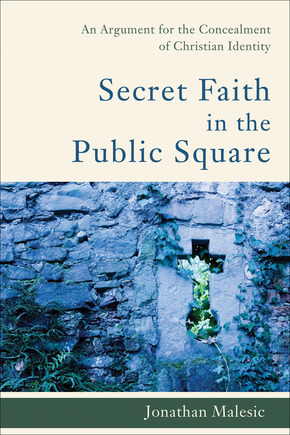
 Jonathan Malesic, Secret Faith in the Public Square: An Argument for the Concealment of Christian Identity (Grand Rapids: Brazos Press, 2009), 248 pages, ISBN 9781587432262.
From outward appearance the author, an assistant professor of Theology at King’s College in Pennsylvania, argues for non-public involvement in public affairs with nothing said of the participants’ Christian faith. His expressed concern is that Christian identity be protected from being exploited as a means for political gain. Malesic, in his introduction, writes that “too often in American public life, the light is used to illumine the Christians themselves, bringing glory to the wrong person”(p. 19). The light, in this sentence, refers to “Christian identity.” By concealing one’s own identity, it is easier to bring the identity of Jesus to bear in public life.
In developing his theme, Malesic first explains that what he does not want to do is to create a privacy of Christian life in opposition to anything public. “Most often ‘public’ is set in opposition to ‘privacy’” (p. 21). It is a false dichotomy. His proposal is to define what individual Christians should do “when non-Christian publics, especially the overarching and competitive public spheres of government, work, and the market pose danger to the integrity of the Christian public” (p.23).
The author’s basic premise is based upon Matthew 6:1,6 where Jesus enjoins those listening to him “Beware of practicing your piety before others in order to be seen by them …” The full quotation is printed on the page facing the table of contents. Malesic sets forth his argument in two parts. The first part sets forth both the biblical and the theological rationale for secrecy of identity in the public square. He not only cites Jesus but also the liturgical secrecy set forth by Cyril of Jerusalem in the late fourth century when the life of the church and the life of the empire appeared to be fusing. After discussing the position of Cyril, he moves on to discuss in two succeeding chapters later the contribution of Soren Kierkegaard’s Works of Love which appeared in the mid-nineteenth century. In chapters five and six Malesic devotes attention to Dietrich Bonhoeffer and his famous work, The Cost of Discipleship. Melasic’s explanation of Bonhoeffer’s view of discipleship is that “Christians confess their Christian identity in secret and conceal that identity in public” (p. 123). The distinctively Christian form of public life is that of “being for others.” While Christians’ works of love should bear visible fruits, the Christian identity of the one who lives for others need not be intentionally made known.
Part two of Secret Faith in the Public Square which comprises chapters seven through nine takes the arguments from Scripture, Cyril, Kierkegaard and Bonhoeffer and takes the idea of concealment of Christian identity as it may work out in contemporary America. Malesic does not rely exclusively on the three men just mentioned. He also relies upon models set forth by Avery Cardinal Dulles, S.J. The church grew and had influence upon its pagan environment by offering an alternative more attractive: “Seeing the mutual love and support of the Christians and the high moral standards they observed, the pagans sought entrance into the Church.”[1] In this recognition, Malesic’s position is not one of withdrawal from the public square but a quiet lifestyle as opposed to a vocal or visible involvement. He also differs from Stanley Hauerwas, who is close to Malesic in sentiment but who challenges Christians “to stand as a visible social and political alternative to the violent ways of the world, bearing witness to the gospel in works of love and mercy” (p. 28). The key word is “visible” as opposed to “secret.” Yet in reading Secret Faith in the Public Square, it appears that what Malesic is advocating is not a secretive Christianity but a Christianity working “behind the scenes” rather “out front” advertising itself.
Malesic is to be commended for the recommendations that he makes in his book. He begins his work on a good biblical base. Historically, he could have pushed for an earlier precedent than that of Cyril of Jerusalem. The earliest Christians were not visibly conspicuous to the pagan public as they did not frequent public forums, theatres, and civic buildings yet their actions of caring for the dying, infirm, children, widows, and the wounded were certainly noted within the pagan society. Justin Martyr, in his 1st Apology, made note of that fact,[2] as did also Origen (Contra Celsus 3:56) and Aristides (Apology 15 {to Hadrian, a.d. 130}) Even at that Malesic could have better selected Cyprian of the third century than Cyril of the fourth.
Malesic could also have done better than draw a wide difference between himself and Hauerwas. He devoted the whole of chapter nine to delineate the differences between himself and Hauerwas. There is an inherent problem with “either-or” as there is no clear distinction between visibility and what is done “behind the scenes.” What is done behind the scenes will eventually come to light. Hence what Malesic admitted at the very first of preventing Christians from advertising themselves and what they do and stand for is more to the point. Malesic’s work needs to be read by would-be politicians and concerned Christians on a number of public issues.
This reviewer’s comment is partly conditioned by not only having read Hauerwas’ Peaceable Kingdom which was quoted in Malesic’s work but also having heard Hauerwas speak to the very concern that Malesic addresses in Secret Faith in the Public Square. In no way, does this defense of Hauerwas detract from the important contribution that Malesic makes for a more silent faith. Secret Faith in the Public Square should be read by any serious student or concerned Christian as the book wisely counsels against a self-promotion pose in the public square. There is too much of that. There is much to commend in Malesic’s argument for a secret faith within the American public square. Malesic could have, in this author’s estimation, leaned far more upon Christian history where this distinction between no–visibility and visibility has been played out by individuals and blocs of Christians from the beginning to the present. Greg Forster has done a magnificent job of providing such a study in his work on “The Crisis of Christianity and Politic” in his The Contested Public Square.[3]
Reviewed by Woodrow Walton
Publisher’s page: http://bakerpublishinggroup.com/books/secret-faith-in-the-public-square/284462
Notes
[1] Avery Cardinal Dulles, S.J. Models of the Church, expanded ed. (New York: Image, 2002), 205. Quoted by Jonathan Malesic, Secret Faith in the Public Square, p. 208.
[2] Justin Martyr, 1st Apology 14; Ante-Nicene Fathers 1, p. 167.
[3] Greg Forster, The Contested Public Square. IVP Academic (Downers Grove, IL: InterVarsity Press, 2008).