Peter Enns: The Evolution of Adam

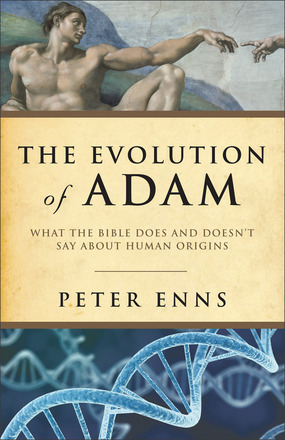
 Peter Enns, The Evolution of Adam: What the Bible Does and Doesn’t Say About Human Origins (Grand Rapids: Brazos Press, 2012), 170 pages, ISBN 9781587433153.
Peter Enns brings his considerable academic training and writing ability to bear on the thorny subject of Scripture and evolution. He believes that the evidence for evolution is so overwhelming that Christians hurt the cause of Christianity by continuing to hold on to a literal (i.e. historical) reading of creation account in Genesis. In this regard, he echoes Augustine’s concerns. But rather than proffering a grand harmonization between evolution’s and Genesis’ account of origins, Enns addresses a single component that impedes progress towards a resolution, namely the historicity of Adam.
Enns recognizes that the task before him is great. He contends that the belief in an historical Adam flows not from a direct or plain reading of the scripture but from a cultural and theological reading of scripture, called an “interpretive reading.” An interpretive reading is where the tradition around a text becomes the meaning of the text even if the text doesn’t clearly state that reading. For example, consider the story of Advent. We are taught, and may even believe, that Joseph put Mary on a donkey for the journey from Nazareth to Bethlehem even though the bible says nothing about a donkey.
To break the grip that our ‘interpreted reading’ of Adam has on us, Enns endeavors to create cognitive dissonance in readers by methodically questioning the foundation supporting the interpreted reading. He begins by stating (and with very little reference to specifics or scholarship) that archeology and science provide so much evidence against an historical reading of Genesis that to ignore it would violate our commitment to common sense and grammatico-historical exegesis. Genesis, therefore, is not about cosmic history but about how Israel came into being. In turn, Adam is not the first human, he is the first Israelite, or proto-Israelite.
Enns recognizes that many theologians contend that Paul’s use of Adam (Rom 5; 1 Cor 15) demonstrates that Adam was a historical person. Enns responds that Paul’s use of Adam does not necessarily support the notion of an historical Adam because 1. His arguments were conditioned by the style of argumentation present in his day, 2. Paul’s style of argument is complex and not always easily followed, 3. We only know half the story because Paul’s writings were letters, 4. Paul often didn’t read the Old Testament plainly but rather through the lens of his encounter with Jesus Christ, and 5. Just because we jettison the notion of Adam as the first historical being doesn’t mean that Paul’s theological arguments fall too.
As someone who believes that Adam was a historical being, Enns’ thesis is a profound challenge. I am not convinced of his argument not because I can’t be persuaded (though I admit it would be very hard), but because Enns didn’t provide sufficient details to support his sweeping claims. I hesitate to make this a significant criticism because I respect his attempt to present the big picture and let others fill in the details. Perhaps, he will do this in a later publication. But let me respond to at least one of his main arguments. I fully recognize that the Bible is God’s words in human language and culture, but I don’t think that recognizing the historical conditionedness of Scripture and the authors gives me permission to side step what the original human author, i.e. Paul, thought. Even if I accepted the notion that Genesis was written/compiled to answer questions of post-exilic Israelites, why does that mean Genesis 1-3 couldn’t be historical too? Can’t a verse perform two acts simultaneously? After all, every passage of the Bible was written by at least two people, the human and the Holy Spirit. In addition, just because the bible is not a scientific document, doesn’t mean it is inaccurate. Enns seems to think that because biblical authors saw the universe as a three-tiered cake, this view presents a scientific problem? I don’t know why because perspectivalism allows us to see the world the same way. Just because a story doesn’t tell us everything we would like to know doesn’t mean the story is wrong.
But I want to end this review on a positive note. I commend Enns for being transparent about the challenges any conversation between evolution and scripture entail and his position regarding our understanding of Adam. Enns argues his case but he is not so arrogant as to suggest he has proven it beyond reasonable doubt. His writing is lucid and enjoyable to read. Enns summarized his thoughts regularly to help readers refocus on the main points. He even ends the book with a nine point summary of his argument. Good writing helped this reader remain engaged. Finally, I think Enns’ comments relating Genesis with Proverbs was insightful and will help theologians connect the wisdom literature with the Pentateuch in their biblical theology.
In sum, Enns has presented a thought provoking book. But additional work needs to be done to show his position is viable.
Reviewed by Stephen M. Vantassel
Publisher’s page: http://bakerpublishinggroup.com/books/the-evolution-of-adam/336910
Preview The Evolution of Adam: http://books.google.com/books/about/The_Evolution_of_Adam.html?id=MeDIrsKgAfEC