
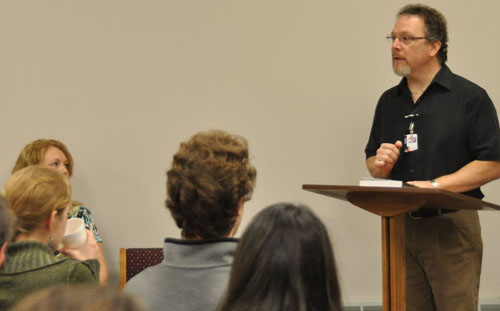
In Conversation with Andrew Schmutzer, Part 3

An interview with Andrew Schmutzer about The Long Journey Home: Understanding and Ministering to the Sexually Abused, and part 1 of the chapter, “A Charge for Church Leadership: Speaking Out Against Sexual Abuse and Ministering to Survivors” as appearing in Pneuma Review Winter 2014.
A Theology of Sexuality and its Abuse—Part 1 A Theology of Sexuality and its Abuse—Part 2
A Charge for Church Leadership—Part 1 A Charge for Church Leadership—Part 2
Note from the Editors: Beginning a conversation about sexual abuse is uncomfortable, but we feel strongly that this topic is something the church needs to address. We believe the testimonies of authentic recovery can help us embrace the pain of the hurting and make openings for God to bring healing.
Pneuma Review: Do you appreciate how Nason-Clark and McMullin invite church leaders to speak out against sexual abuse as an opportunity and not as an obligation?

Andrew Schmutzer: To their credit, I think they were trying to cast a positive vision for making change, rather than framing the needs negatively or sternly. When there’s so much education to do to train church leaders, adopt appropriate policies for survivors, and then actively address their needs in church services—I think they put these tasks in a more positive light.
The reality is that “opportunity” sounds socially welcoming to pastoral leaders and those interested in social justice, whereas “obligation” sounds impersonal today, adding to the “deadweight” of unachievable tasks. That said, the role church leaders have—as first-responders—is an ethical and ecclesiastical responsibility to speak for those who’ve been denied a voice. I see their message being an opportunity to have an impact of a dynamic relational and spiritual kind…obligations per se, belong on check lists. Opportunities exist for those willing to be relationally vulnerable.
PR: Please share with us a testimony of speaking out against sexual abuse.
Andrew Schmutzer: It’s understood when working with abuse survivors, your story is your story and their story is their own. So while I’m aware of many abuse stories, and have a growing army of friends learning to live on the other side of abuse, I’m not comfortable speaking of others’ personal stories.
What I can say is that I’ve conducted some very meaningful chapels at Moody, where I teach. Several weeks out, I have students submit their personal abuse stories to me by email. They know their story will be used anonymously. Having collected around 20 individual stories, I have two students volunteer to read portions of these stories, which the survivors knew would be done. With mics located in the back of the auditorium, the male student reads the other male stories submitted, and he alternates with a female reader reading portions of women’s stories. This testimony part is one of the most powerful parts of these chapels, as students hear some very painful stories from their own peers! Written prayers of lament, responsive readings, prayer circles, candles, oil, and other meaningful rituals can be woven into these student chapels. Would you believe, they can’t wait for the next one the following semester!
These are times of naming the abuse by speaking out. Here they acknowledge indescribable pain, confusion, anger at their abuser(s), anger at God, layers of mistrust at the church and leaders, and also themselves. Cutting, eating disorders, sexual promiscuity, sexual addictions, gender confusion, and self-loathing are common struggles of abuse survivors. But almost all of these students find such occasions to be a turning point in their life. It will get worse before it gets better, but they’ve started their journey of healing…even if someone named it for them. And here’s the thing, I know that churches could have similar healing services for the abused in their congregations…if only they would.
I should also mention that my own story was part of sermon series conducted at my church, Wheaton Bible Church, back in 2011. Here’s the link if anyone wants to see it.
http://www.wheatonbible.org/content.aspx?site_id=10713&content_id=322130
PR: Nason-Clark and McMullin offer some practical steps that every church leader can take to overcome silence regarding sexual abuse. How have you seen these steps work out in congregations?
Andrew Schmutzer: I’ve seen regular mention of sexual abuse (and other difficult experiences) made from the pulpit. In other words, I’ve seen the pastor normalize the problem and invite people to seek: prayer, professional counseling or join one of several support groups for abuse (and other problems). My wife and I started support groups for men and women called CHAI (Courageous Healing of Abuse and Isolation). To this day I still visit regularly with some of the first men who went through that support group. They say that the support group was more helpful than counseling, though both are meant to work together.
Silence is also overcome when churches invite speakers with known abuse stories of their own (e.g., Josh McDowell, Wess Stafford). As president of Compassion International, Wess just recently began talking about his childhood abuse—but why didn’t he do this 30 years ago? Part of the reason is that the church had zero stomach for the abuse discussion. In many churches (especially on the conservative end), one couldn’t even mention divorce 30 years ago. The church still doesn’t have much stomach for the abuse stories, because it’s a type of evil and violence that someone doesn’t choose, and there’s always a power shake up. But younger men and women are now used to their favorite sports and movie stars “outing” their stories of sexual abuse. So the younger generation of church goers is wondering why the church is so silent about its abused men and women, boys and girls—I couldn’t agree more!
Pastors have an abundance of biblical texts to draw from—stories of real people—that can “break the ice,” if leaders would just teach and preach from these! (incest = Lot’s daughters; sibling abuse/rape = Amnon and Tamar; power seduction = Potiphar’s wife with Joseph; power rape = David and Bathsheba, etc.). Pain doesn’t market well in churches, but if sexual abuse was framed as an extension of stories biblical characters have also experienced, that could be a huge step forward. Finally, a well-stocked library could contain quality books on sexual abuse and healing, like The Long Journey Home.
In fact, that group of male survivors I referenced earlier, we’re writing a book called Naming Our Abuse: Men Doing the Write Thing. Using small one-page entries, we each talk about the stages of our journey, using the metaphor of a car wreck: (1) the wreck, (2) the accident report, (3) rehabilitation, and (4) learning to drive again. Men work better “shoulder to shoulder” than “face to face,” and will huddle in the comfort of a “man-cave” and read the most horrific stories imaginable. This is one way to get men to talk about their painful stories. Many of these men have been facing their abuse for years now, but putting it into story-form has proven a dynamic way of telling our stories…and crying, I might add!
Do these suggestions work in both large churches and smaller congregations?
Andrew Schmutzer: Absolutely! It’s not the size of the church, but the attitude of the leadership that matters. Leaders can communicate an openness with pain by admitting some of their own struggles. This creates a culture of emotional honesty that is willing to cry with one survivor or 200! But leaders must also realize, they are reticent to enter the pain of others when they’ve not faced their own places of brokenness. Leaders set the tone for naming and healing, size makes little difference.
PR









EH, on the God’s Word to Women Facebook group, wrote about this interview with Andrew Schmutzer: “I just finished reading all three parts of this interview, I would say that what this man has to say is desperately needed in the body today in more ways than one!!”
I want to thank Pneuma Review for their vision to address sexual abuse. The leadership of PR are pace-setters, and I’m honored to share with them as God’s people name this most ancient of evil and plead for leaders to stand with the broken. Thanks PR for your grace and prophetic spirit to discuss what so few are willing to even name.
Blessings on you! Andrew
As an ordained minister, as well as a survivor of sexual abuse by a half-brother, I am grateful that Pneuma Review and Andrew Schmutzer have come together in promoting awareness of this damnable blackmark upon society that is known as sexual abuse. I am thankful to Pneuma Review in particular for being on the forefront of this movement. I sincerely believe that in this time of our story, with the enormity of evil in these matters in the church revealed just this past decade, that we need more open-minded and willing voices at the publishing level to not only acknowledge sexual abuse within the church, but to also dialogue with it, so that fellow survivors may be lead toward restoration.
Bradford, thanks for your on going voice for survivors of abuse. Male survivors in particular, need help finding help. Trying to plow through so many stereotypes (theirs and others) has been a huge barrier to speaking out…an average of 20 years after the abuse.
I have a very creative book I’ve edited about four male survivors (Naming Our Abuse: Men Doing the Write Thing), putting their stories out there to help other men tell their stories…but so far, no publisher is interested. Any ideas?