Spring 2010: Other Significant Articles
Reviewed by the editors.
 Sarah Pulliam Bailey, “‘A Voice for Sanity’: J. Lee Grady doesn’t want your gold. The journalist wants a ‘Holy Ghost housecleaning’ of the charismatic movement” Christianity Today (Nov 2009), pages 42-45.
ChristianityToday.com/ct/2009/November/33.42.html
See also the online-only article: Sarah Pulliam Bailey, “Modern-Day Mordecai: When he’s away from his day job, Charisma editor J. Lee Grady is probably working on a project to empower women and confront abuse” ChristianityToday.com/ct/2009/novemberweb-only/147-11.0.html
In February 2010, J. Lee Grady announced that he is stepping down as editor of Charisma to enter public ministry. charismamag.com/index.php/fire-in-my-bones/26289-the-lord-will-make-a-rehoboth-for-you
Also in the November 2009 issue of Christianity Today, a discussion about prosperity teaching. J. Kwabena Asamoah-Gyadu, “Did Jesus Wear Designer Robes?: The gospel preached in Africa’s New Pentecostal Churches ends up leaving the poor more impoverished than ever” with online responses from Pentecostal scholar Amos Yong and others. ChristianityToday.com/GlobalConversation/November2009
Calvin L. Smith, “Pentecostal presence, power and politics in Latin America” Journal of Beliefs and Values 30: 3 (December 2009), pages 219–229.
Although religion in general was once regarded as irrelevant by sociologists and political scientists, Latin American Pentecostalism is now often treated as monolithic and inherently conservative. Smith argues that Pentecostals in Latin America, in their many circumstances and expressions, are actually rather diverse in their cultural and political responses, defying easy stereotypes. “The explosive growth of Latin American Pentecostalism has strongly challenged Catholicism’s religious hold and as such has arguably ushered in a new Reformation in that continent during the latter part of the twentieth century which is no less profound than the Reformation in sixteenth century Europe” (p. 227).
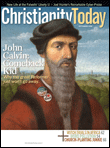
 Roger E. Olson, “Theologian of the Spirit: Calvin was no charismatic, but he was closer to it than some Reformed people readily admit” Christianity Today (Sept 2009), pages 33-34.
Christianity Today celebrated John Calvin’s 500th birthday by featuring several tributes, even from those that are decidedly not Calvinists. Roger Olson, a professor of theology who grew up in a Pentecostal heritage, comments on what Calvin got right. “Many Calvinists and charismatics will be surprised to read these passages [his doctrine of Word and Spirit in the Institutes], because in them Calvin rests all true knowledge of God on the inner testimony of the Holy Spirit. In my experience, too many Calvinists talk too little of the Holy Spirit, while too many Pentecostals and charismatics know little to nothing about Calvin’s emphasis on the third person of the Trinity.” ChristianityToday.com/ct/2009/september/19.33.html
Two controversial topics sure to animate any conversation: speaking in tongues and predestination. But what if John Calvin himself spoke in tongues? In the same issue, Ben Witherington said, “I remember reading in Gordon-Conwell’s newspaper a rather interesting historical curio from a letter of Calvin about how one morning he woke up and found himself speaking in lingua barbaria. The article went on to speculate that Calvin may have spoken in tongues!” in Ben Witherington, “Man of the Bible: When it comes to careful exegesis and consistent theological systems, Calvin set the bar high” Christianity Today (Sept 2009), pages 33-34. ChristianityToday.com/ct/2009/September/18.33.html
Someone has found and scanned the original newspaper article and discusses at: www.OldInTheNew.org/?p=411, including a comment by Jon Ruthven [available at time of printing]. The quote about Calvin’s alleged “ecstatic utterances” in Quent Warford, “Calvin Speaks Unknown Tongue” The Paper: Student Paper of Gordon-Conwell Theological Seminary 1.6 (March 24, 1975), page 6, may be even more interesting than what Dr. Witherington remembered:
On several occasions, Calvin, in his devotions, found himself uttering a lingua non nota et cognota mini. That is, the language was not known or understood by him.

Professor Henry I. Lederle, author of Treasures Old and New: Interpretations of Spirit-Baptism in the Charismatic Renewal Movement (Hendrickson, 1988), wrote to The Pneuma Review:
I am having my doubts about the Calvin reference. I have just read through [Theodore] Beza’s Life of Calvin and it is not there. I even got it in Latin from Calvin College—not there. …
What Charismatics may find equally interesting (that can be easily verified) is that Calvin in six places advocates the raising of the hands in prayer—three times in his chapter on Prayer which is the longest chapter in Institutes, and then again in his commentaries. The Institutes references are in Chapter XX sections 5,16,and 29—or if one is using the Battles translation, pages 854,873, and 892. …
The article you sent me references the work of Beza as De vitam Iohannes Cauvin—a minor inaccuracy that may or may not raise a red flag: ‘De’ does not govern the Accusative—so it should be De vita (not vitam).
Since the original reference is to “a letter of Calvin”—not a biography like that of Beza—I have not completely given up. Maybe it is out there in some of his correspondence!
Even if the newspaper article was nothing more than a student prank, the conversation stirred up by Witherington’s comment 35 years later certainly confirms the lightning-rod effect of mentioning Calvin and tongues together.
R. T. Kendall, “The Case for the Virgin Birth: Atheists scoff at the ideal. Liberal theologians deny it. But the miraculous birth of Jesus is one of the surest proofs of His divinity.” Charisma (December 2009), pages 24-27, 57-58.
charismamag.com/index.php/features/2009/december/23880-the-case-for-the-birth-virgin
As of Mar 10, 2014, this link now points to a revised article entitled, “The Stigma of Jesus’ Virgin Birth,” dated Dec 23, 2013, at charismamag.com/life/holidays/7280-the-stigma-of-jesus-s-virgin-birth
 Krish Kandiah, “The Missionary Who Wouldn’t Retire: Lesslie Newbigin launched a new career as age 66 by calling Western churches to act like they were in the mission field” Christianity Today (January 2010), pages 44-47.
ChristianityToday.com/ct/2010/january/1.44.html
John Paul Jackson, “Taking the Pathetic Out of the Prophetic: The misuse of prophecy has brought great embarrassment to the church. It’s time to clean up our act and apply biblical standards.” Charisma (July 2009), pages 46-48, 50.
John Paul Jackson addresses serious errors about prophetic ministry and calls for a full prophetic reformation. Read the full article here: http://www.charismamag.com/site-archives/610-spiritled-woman/spiritled-woman/8423-taking-the-pathetic-out-of-the-prophetic [available as of January 22, 2015].
Frank Viola, “Reframing Discipleship: How the organic church makes followers of Jesus” Ministry Today (Sept/Oct 2009), pages 42-44.
Frank Viola challenges the idea that discipleship is just a program at the local church. Rather it is “being part of the shared-life community” (p. 43), and he offers ideas about how an “organic church” could live this out. http://frankviola.org/ministrytoday.pdf [available as of January 22, 2015]