Gerald Hovenden: Speaking in Tongues

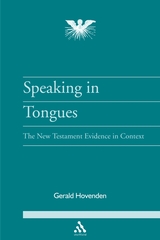
 Gerald Hovenden, Speaking in Tongues: The New Testament Evidence in Context (Sheffield, England: Sheffield Academic Press, 2002), 181 pages.
In this book Hovenden provides a well balanced and informed study into a phenomenon that is gaining increasing interest and acceptance within the Christian community. What started has a distinctive among Pentecostals in the early 20th century and later spilled over into the charismatic communities of Mainline and Evangelical churches is now the topic of much scholarly discussion. This is something that was rare in the past among biblical or systematic theologians.
Hovenden himself is a prime example of the expanding use of tongues in both the private and corporate spheres of spirituality. In his introduction Hovenden relates how this work grew “out of a long-standing interest” (1) in the phenomenon of tongues. He then goes on to tell of his early experiences as an Anglican discovering and then experiencing tongues. This window that Hovenden has opened on himself gives his study an added aspect of respectability. For Hovenden, tongues is not simply an academic study, although he does top notch academic work on the topic. It is, though, a dynamic and personal experience of the divine Spirit; one that he says is a “regular and … valuable part of my personal prayer life” (1). Academic study that flows out of such a profound experience is a breath of fresh air to an often stagnant discipline.
In this small work Hovenden bravely attempts to establish what Luke, Paul, and the earliest Christians actually believed tongues to be (3). In short he is trying to determine if tongues was viewed by the above mentioned groups as glossolalia, xenolalia, or something other than human language, i.e. angelic languages. He does this by examining the evidence of tongues in the ancient world, both historical and textual, to determine whether the early Christian communities understood tongues in light of what they knew of such occurrences in the Pagan and Jewish worlds. He admits that such a study will inevitably lead to comparisons of the Lukan and Pauline understandings of tongues, although this is of secondary importance with only a small section in chapter 4 devoted to such comparison.
The first section of his book is devoted to ‘tongues like’ activity in the pre- and para-Christian material. This is a survey of examples of ecstatic speech from both Pagan and Jewish literature. In dealing with Pagan examples Hovenden takes the reader through such ancient writers as Euripides and Plato, as well as fragments from the Delphic and other ancient oracles. He also deals with movements and groups that were more contemporaneous with first century Christianity such as the Mystery Religions and the writings of Livy (59 BCE – 17 CE). Hovenden shows that while there is ample evidence in the ancient Greco-Roman world for ecstatic speech there seems to be little hard evidence of such speech that was unintelligible. Instead they were almost certainly in Greek.
Next, Hovenden turns to inspired speech within the Old Testament, Inter-Testamental, and Early Christian eras. After examining both Old Testament and Inter-Testamental periods and concludes that there is no obvious evidence that tongues was a religious phenomenon in these periods. There is no doubt that the inspired speech of these eras was the result of divine revelation, but it was more often than not “delivered in a lucid and sober manner” (39). It is worthwhile to note that Hovenden does not hold to the position that the Spirit and prophetic activity ceased to be active in the ITP. In this he follows Max Turner and David Aune against notable Pentecostal scholars Robert Menzies and Roger Stronstad.
While the first section of his book has focused on what tongues was not (i.e. not equivalent with Pagan ecstatic or Jewish prophetic speech), he now turns his attention to an examination of the New Testament texts in order to ascertain a clearer picture of a first century Christian consideration of tongues.
He begins his discussion of the Lukan theology of tongues by dealing with historical issues. Is Luke’s account of the day of Pentecost historical? Is the phenomenon that Luke describes on that day glossolalia (unknown languages, perhaps gibberish), xenolalia (known languages), or akolalia (a miracle of hearing)? Do tongues, for Luke, serve a symbolic or practical purpose? These are some of the tough questions that Hovenden tackles in this section. The only one that he draws a clear conclusion on is that tongues, for Luke, is xenolalia.
In the next section on Luke Hovenden turns to theological questions surrounding Acts 2. He seeks to identify the theological framework of Acts 2 and whether or not this framework is programmatic for the rest of Acts. Hovenden then provides a summary of the various ways that scholars have viewed the Lukan theological framework. The different views summarized include Acts 2 as covenant renewal, reversal of the Tower of Babel, birthday of the church, and empowering of the church for mission. Hovenden is wise to point out that none of the positions fully capture the essence of what Luke records as happening on the day of Pentecost. Each theory is legitimate, but none hold a hermeneutical monopoly. He concludes that tongues are not likely a Lukan invention but historically linked to Pentecost. Luke interprets tongues as a manifestation of the Spirit of prophecy (94).
Hovenden then offer three suggestions as to the significance of tongues in Acts. The first is that incidences of tongues act as “landmarks” in the expansion of the earliest church. Basically this position argues that the occurrences of tongues mark the major stages of growth in the early church from the Jews to the Samaritans to the Gentiles to the disciples of John the Baptist (100). This would seem to fit with the expansion theology of Luke (Acts 1:8b; c.f. Luke 24:44-47).
Tongues, for Luke, are also an eschatological sign. They mark the beginning of the end and a foreshadowing of the future glory of the parousia. Hovenden does not concur with classical Pentecostalism that tongues is the initial physical evidence of the baptism in the Holy Spirit. He says only that tongues were a normal experience of the church of Acts and not normative.
In his section on tongues in the Pauline corpus Hovenden continues his quest to find out how tongues functioned in and were viewed by the early church. It affirms that it is a strong possibility that Paul believed that tongues was available to all Christians, although it was one gift among many. He shies away from claims by the likes of Menzies who say that “Paul affirms that every Christian may—and indeed should—be edified through the private manifestation of tongues”1 Hovenden points out that nowhere does Paul put moral pressure on the Corinthians specifically, or other believers generally, to speak in tongues (161). Paul does propose a framework guided by love (1 Cor 13) and order (1 Cor 12-14) for the common good (12:7).
Hovenden also takes the time to ask the question of whether there is a fundamental difference between the Lukan and Pauline understanding of tongues and prophecy. His suggestion is that the two are not as dissimilar as many think; they simply have different concerns. Luke is concerned with tongues/prophecy as an initial outburst of praise in response to the filling of the Holy Spirit. Paul on the other hand is concerned with how tongues affect the community of faith (160). Luke is dealing with the theological significance of the initial outburst of tongues in a missionary context, while Paul deals with the practical use of tongues/prophecy in the daily life of the church.
The author concludes with implications for Pentecostal/charismatic studies and ministry. Thankfully, Hovenden calls for a deeper appreciation and understanding of tongues as a gift within the church. Perhaps the best implication he draws for Pentecostal/charismatic communities is that they cultivate a sacramental appreciation of tongues. The fact that tongues were viewed by both Luke and Paul as a gift of God should cause Pentecostals to see the gift sacramentally, and subsequently impart that view to the broader church (167). He believes that tongues, for Pentecostal and non-Pentecostal alike, are an outward and visible sign of an inward grace.
While the book is an informative and interesting read it may not be practical those without formal theological training. The footnoting would be cumbersome and the Greek impossible for the average reader. There is no reason why, though, that pastors, seminarians, and Bible College students could not take Hovenden’s work and make it intelligible to Pentecostal/charismatic congregations, or for that matter mainline or evangelical congregations. It is precisely for the reason that Hovenden succeeds in his goal to establish what Luke, Paul, and the earliest Christians actually believed tongues to be (3), that his teaching on the gift of tongues should be made available to the Christian community as a whole. It will challenge classical Pentecostals, cessationists, and agnostics alike as to the importance of tongues in the life of the early church.
Reviewed by Robert Cooke
Notes
1 Robert P. Menzies. Empowered for Witness, 248.
Preview Speaking in Tongues: http://books.google.com/books/about/Speaking_in_Tongues.html?id=43mDfVbZvdQC